Showing posts with label Alfred Hitchcock. Show all posts

Saturday, October 25, 2025

Ten Days of Terror!: The Lodger: A Tale of the London Fog (1927)

Film: The Lodger: A Tale of the London Fog
Format: Streaming video from Amazon Prime on Fire!

Every great career starts somewhere. In the case of Alfred Hitchcock, his directorial career started with a couple of romances. He really came into his own with The Lodger: A Tale of the London Fog (hereafter referred to as simply The Lodger), the first of his movies to take a deep dive into suspense. The Lodger is a silent, but even here there are the clear beginnings in what would eventually be many of Hitchcock’s signature themes and ideas—mistaken identity, murder, and obsession with blondes, just for starters.

The Lodger is very clearly a riff on Jack the Ripper, as is evident from the opening scene when a young woman is murdered. As we will discover, the young woman is the seventh victim of a serial killer known as “The Avenger” based on a calling card the murderer leaves at the scene of the crime. The killer acts every Tuesday night, and only kills young, blonde women.

Tuesday, June 14, 2016

Know Your Spouse

Film: Suspicion
Format: Turner Classic Movies on rockin’ flatscreen.

When I did the 1001 Movies list, I watched a lot of Hitchcock, since he is by far the best-represented director on the big list. Not all of Hitch’s movies made the list, though, and the only one that contains an Oscar-winning performance was left off. That film is Suspicion, a film that is in many ways classic Hitchcock and in others seems tonally strange. It’s a hard film to figure. Part of the tonal strangeness comes from moments where the mood doesn’t merely shift but 180s on a dime. The other odd bit here is that we spend the entire movie knowing that Cary Grant is playing a rogue and a “bad boy” and convinced that he might well be a serial murderer.

Johnnie Aysgarth (Cary Grant) is a charming and dashing man, desired by all the ladies both despite and because of his bad boy nature. He’s an inveterate gambler, always broke, and always in debt. He meets Lina McLaidlaw (Joan Fontaine) on a train and manages to charm her despite her being something close to a spinster. When he suddenly arrives in her town, she is smitten in spite of herself and even though her father (Cedric Hardwicke) disapproves, she soon runs off with him and elopes.

Tuesday, August 4, 2015

Adrift

Film: Lifeboat
Format: DVD from personal collection on laptop.

With films like Rope and Rear Window, Alfred Hitchcock demonstrated his absolute mastery over creating massive amounts of tension in a very small space. While both of these are master classes in how to use a claustrophobic set as a benefit, both of them came after Lifeboat, Hitchcock’s first (at least to my knowledge) film that really reduced his characters’ ability to get away from each other. As the name implies, the film takes place in its entirety on a lifeboat with survivors from a recent torpedoing in the Atlantic. As the film plays out, tensions develop between the survivors for a variety of reasons until the film almost repeats the opening at the end to bring the action to a close.

Central to the lifeboat is Constance Porter (Tallulah Bankhead), a correspondent and author who has managed to bring most of her possessions from the ship onto the lifeboat. As the film begins, Connie is alone, but is soon joined by John Kovac (John Hodiak), a crewman. Kovac is followed by industrialist Charles “Ritt” Rittenhouse (Henry Hull), then injured crewman Gus Smith (William Bendix), nurse Alice MacKenzie (Mary Anderson), and radioman Stanley Garrett (Hume Cronyn). The next three to board are crewman Joe Spencer (Canada Lee) with Mrs. Higgins (Heather Angel) and her infant child, who has drowned. The last to arrive is Willy (Walter Slezak), who comes from the submarine that sank the ship, but was in turn sunk by return fire.

Monday, July 14, 2014

Hitchcock Goes to War

Film: Foreign Correspondent
Format: DVD from NetFlix on various players.

I didn’t realize before today that Foreign Correspondent was an Alfred Hitchcock film until the disc showed up. I’m certain that this is merely more evidence for the “You’re an idiot” crowd, but I’m okay with that. I’m not an encyclopedia. Anyway, Foreign Correspondent comes at an interesting point in Hitchcock’s career. In a lot of ways, it’s a throwback to films like Sabotage and The 39 Steps, yet has some similarities to a lot of his later films. This is something like a war film without really being one. When it was created, England and most of Europe were at war, but the U.S. (where Hitchcock had moved) was still neutral, a fact that will become part of a minor plot point at the end.

A newspaper editor (Harry Davenport) is unhappy with the quality of reporting he’s getting out of Europe as the continent slowly gears up for World War II. He decides that the best way to get the story is to stop relying on the “foreign correspondent” types and send over a solid writer more attuned to a crime beat. Enter Johnny Jones (Joel McCrea), who is sent off to Europe to find stories. He is also introduced to Stephen Fisher (Herbert Marshall), the leader of a collective seeking peace on the continent. Because the name “Johnny Jones” doesn’t strike the editor as exotic or impressive enough, he christens his reporter Huntley Haverstock, which sounds like a name that comes equipped with a trust fund and a monocle.

Wednesday, September 25, 2013

Abracadabra!

Film: The Lady Vanishes
Format: Streaming video from NetFlix on rockin’ flatscreen.

Everything about pursuing this list of films is conditional. I thought I had been done with silent films for some time, but the number of silent film reviews I’ve posted in the last couple of weeks belies that. Additionally, I had been done with the work of Alfred Hitchcock, and yet here we are again with another Hitchcock film. This time it’s The Lady Vanishes, a film from the late 1930s, and one that sees Hitch starting to include the sort of complexity that he eventually became known for. There’s a straight through-line in this film; there’s just a lot of stuff going on on the side and on the fringes of the plot this time.

An avalanche has closed of traffic in a small, fictional European country that is vaguely Switzerlandish, at least based on the languages spoken by the various people who crowd into a guesthouse. Included in this motley collection is Iris Henderson (Margaret Lockwood), a British girl looking to get back home in time for her impending marriage to a man she doesn’t really love or even care for very much. We meet a few more people here, too. The most important of these are Gilbert (Michael Redgrave), who is researching the folk songs and dances of the native population; and Miss Froy (Dame May Whitty), an ex-governess travelling back to England.

Monday, July 15, 2013

Finishing Hitchcock

Film: Frenzy; Rear Window
Format: DVD from Rockford Public Library (Frenzy) and from personal collection (Rear Window) on laptop.

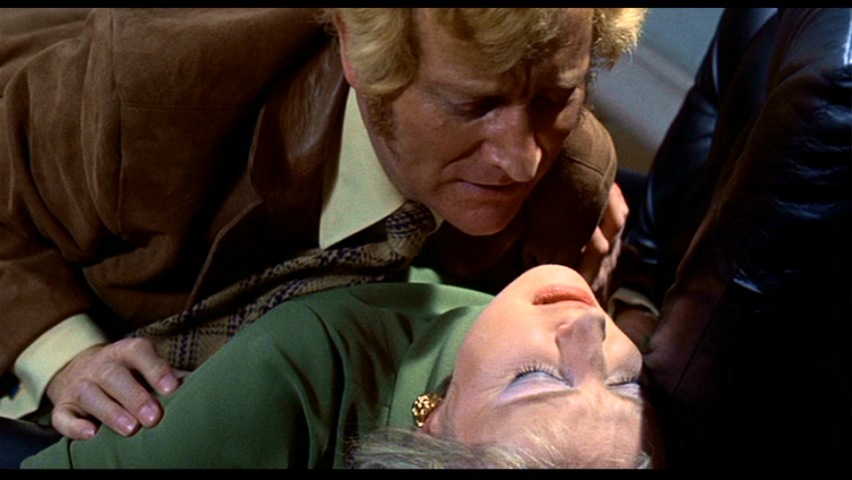
I made the executive decision to finish up the films of Alfred Hitchcock today, which meant that I’d be watching Frenzy. I’ve tried to watch Frenzy in the past and it just didn’t interest me at all. Nothing about this film made me want to continue. I got about 30 minutes in and just turned it off from lack of interest. Certainly it manages to trade on a lot of Hitchcock’s signature ideas, but the main character is singularly unappealing, and Hitchcock’s decision to play in the R-rated end of the swimming pool didn’t make his films better or more interesting; it just allowed him to roam his camera around a bit more. Knowing I had two Hitchcock’s left, I made the second executive decision to watch Frenzy first. Hitchcock deserves to leave The List on a high note.

Here’s what we get in Frenzy: London is being stalked by a man called the Necktie Murderer, who strangles women with a tie. We learn pretty early on that the identity of the killer is a man named Bob Rusk (Barry Foster). We also learn pretty quickly that Rusk is either incredibly lucky or that the police are amazingly incompetent, but that’s a rant for a little later (we’ll get there). In one way, Rusk is luckier than most criminals—he has a patsy who stumbles into the crosshairs for him. That patsy is Richard Blaney (Jon Finch), Rusk’s personal friend.

Wednesday, June 5, 2013

Knowledge is Power

Film: The Man Who Knew Too Much
Format: DVD from Rockford Public Library on laptop.

The more I watch Hitchcock, the more I like a lot of his work. At the same time, I also realize what a limited palette Hitchcock had. The Man Who Knew Too Much is a ridiculously entertaining film, but in many ways it’s no different from many other Hitchcock films. There are elements of The 39 Steps and North by Northwest and Rear Window packed into this film. What this one has that the others don’t is exotic locations. Hitchcock was all about ordinary people trapped in extraordinary circumstances, mistaken identities, and people in the wrong place at the wrong time.

Dr. Ben McKenna (James Stewart), his wife Josephine (Doris Day), and their son Hank (Christopher Olsen) are on an exciting trip. After a medical conference in Paris, they’ve seen Madrid, Lisbon, and Casablanca and are now heading to Marrakesh before they head back home to Indianapolis. On the bus the meet a man named Louis Bernard (Daniel Gelin), who is friendly but fairly mysterious. While Ben has no problem with him, Jo is suspicious of him. She’s more suspicious when Louis begs off of the dinner he promised them, then shows up at the same restaurant and ignores them completely.

Wednesday, January 9, 2013

Wrong Place, Wrong Time

Film: The Wrong Man
Format: Turner Classic Movies on rockin’ flatscreen.

I have to admit that I’m enjoying having both Turner Classic Movies and a DVR again. TCM seems to show a lot of great movies at odd hours, making them perfect for recording. I snapped up The Wrong Man the other day when I knew no one in the house would be awake to object, and since my NetFlix film showed up damaged, I figured I may as well get to this one. On a more personal note, I had been carefully doling out the Hitchcock films, not wanting to see all of them right away. As it turns out, I now have more John Huston on the remaining list, so perhaps I haven’t been as careful with the Hitch as I intended.

Anyway, unlike most Hitchcock films, this one is actually based on a true story, and while there’s a little bit of license here and there, it sticks mostly to the actual story that happened. Manny Balestrero (Henry Fonda) is a bass player at the Stork Club. He leads a pretty simply life without the glamour that many might think he lives with. He has a wife and two kids and pretty typical bills and problems. The current issue is his wife Rose’s teeth (Vera Miles), which need a $300 wisdom tooth removal.

Sunday, December 9, 2012

Psychobabble

Film: Marnie; Spellbound
Format: VHS from Northern Illinois University Founders Memorial Library on big ol’ television.

I’m going to spoil Marnie. I’m going to be upfront about this on the off chance that you, Dear Reader, haven’t yet seen it and don’t want it spoiled. If that is the case, jump down to the second picture in this review, because I won’t be spoiling the second film. In the case of Marnie, though, I figure I’m doing everybody a service. This is a film that deserves to be spoiled. That’s not something I expected to say about a Hitchcock film, but this one deserves it for being the Freudian mess that it is.

Marnie (Tippi Hedren) is one messed up little chickadee. She works a con in which she gets hired as a bookkeeper or accountant at a firm, works there for awhile until the circumstances are right, and then steals as much as she can from the company safe. Then she changes her identity by putting her hair back to its natural blonde color, and moving to another city after visiting her rather cold and distant mother in Baltimore. She also has a significant problem with thunderstorms and can’t abide the color red. In fact, red drives her berserk.

Thursday, November 8, 2012

Family Matters

Film: Shadow of a Doubt
Format: DVD from NetFlix on laptop.

Alfred Hitchcock got his reputation for a reason. If you asked me to point to one of his early films that really cemented that reputation, I wouldn’t go with Strangers on a Train or The 39 Steps or Rebecca, but with Shadow of a Doubt. While there’s no question that he was making thrillers before 1943, Shadow of a Doubt is one of his best early films, and the biggest reason for this is the acting skills of one Joseph Cotten.

With Shadow of a Doubt, Hitchcock delves into the world of small-town family life, making this film sort of a Blue Velvet for the black-and-white, World War II set. A fairly typical family receives word that the brother of the mom is coming in town for a visit. Seems harmless, right? But this is Hitchcock, so we’re going to go somewhere dark and dangerous very quickly.

Saturday, August 18, 2012

Her Name is Rio

Film: Notorious
Format: DVD from Northern Illinois University Founders Memorial Library on kick-ass portable DVD player.

A couple of weeks ago when I reviewed Rope, I was trolled because I said that Hitchcock was a one-trick pony. That certainly overstated my case, but there’s still some truth behind what I said. Hitchcock did like to reuse the same plot. A case in point is Notorious. In that strange way that happens, I find this film reminds me of one that came after simply because I saw the older film first. To put it in historical order, my favorite Hitchcock film, North by Northwest is Notorious with the added twist of mistaken identity.

Notorious, as befits the earlier stage of Hitchcock’s career, is simpler than his later (and greater) film. We begin at the end of one story, a trial in which a man is convicted of treason. We focus then on his daughter Alicia Huberman (Ingrid Bergman). She is naturally the target of the press and longs to escape. At a small party, she is introduced to a man who turns out to be a federal agent named Devlin (Cary Grant). Devlin, we get initials but never a first name, is interested in recruiting Alicia to help round up a gang of Nazi collaborators working in Brazil—a gang that her father was once a part of. She demurs, but eventually agrees.

Tuesday, July 31, 2012

Timing is Everything

Film: Rope
Format: VHS from Northern Illinois University Founders Memorial Library on big ol’ television.

I like Hitchcock in general, although there’s a lot of his filmography I haven’t seen yet. Still, in many ways he was a one-trick pony. He liked a particular type of story, and with a few exceptions, he made that same story over and over. Other directors of the era were far more versatile in what they produced, but Hitchcock produced Hitchcock films. I’m happy to call him a genius, but in general, you know what you’re going to get with Hitch.

Rope is a film created more or less to explore camera trickery. The film unfolds like a one-act play (and was in fact based on a stage play). The plot is pure Hitchcock. Here’s the elevator pitch—two men kill a former classmate for intellectual thrills, then hide the body in a trunk and serve dinner off it to the friends and family of the victim. There, in fewer than 30 words, is the essence of Hitchcock’s high concept film, a simple story simply told.

Thursday, March 15, 2012

Boom Goes the Dynamite

Film: Sabotage
Format: Streaming video from Hulu+ on rockin’ flatscreen.

It’s interesting to watch the early work of a great director. With some directors, you can see where they are headed long before they get there. With Hitchcock, for instance, a film like Sabotage (sometimes known as The Woman Alone) gives a clear indication of precisely where the man wanted to go with his films. While his films eventually became very dark at times, there was always an edge to them, and with this film, he goes very dark, indeed. While his themes would become more refined over time, Sabotage shows that he was steering in the direction he’d come to be known for even at this early stage.

The film is a modified retelling of Joseph Conrad’s The Secret Agent. A saboteur with a network of other agents in London essentially hides himself in plain sight by posing as a business man. It’s not clear where the man, Karl Verloc (Oskar Homolka) is from, but there’s a definite hint of Bela Lugosi in his voice. Anyhow, he and a few other men are planning a series of bombings in London. To avoid suspicion, they are posing as business men in a London district. Despite this, there is some suspicion, as Scotland Yard has posted an agent named Ted Spencer (John Loder) at a nearby grocery to keep tabs on the suspects.

Two people who don’t suspect him at all are his wife (Sylvia Sidney) and her kid brother, Stevie (Desmond Tester). After all, he’s been good to them. But, Verloc is most certainly guilty, and is responsible for a power outage throughout London at the start of the film. But a power outage really is little more than an inconvenience. He and his cronies plan a bombing on the Tube underneath Piccadilly for a larger impact on the greater London area. Even more nefarious, because of delays on his end, he puts the bomb in the hands of the easily distracted and rather slow-witted Stevie.

The last 20 minutes or so of the film are really the crux of the film, and rather than risk spoiling anything, I’m going to leave them alone. It’s the last half hour of the film that really makes the film what it is, though. While this is still rudimentary Hitchcock just getting his legs under himself in the directing business, there’s evidence of the man’s sense of creating tension and building suspense. We know (because he reminds us) that the bomb Stevie is carrying is going to go off at 1:45. And as Stevie unknowingly transports the bomb from one end of town to the other, we get constant reminders of exactly what time it is. Over and over, we see him pass by clocks, with time ticking down inevitably to the fateful moment when the bomb will detonate. It sounds pretty standard, really, but it’s quite gripping.

If the film fails anywhere, it’s in the person of many of the characters on screen. It’s the bad guys, particularly Verloc, who are the interesting characters here. Mrs. Verloc is timid and fairly tepid, not showing much in the way of emotion or personality until the film draws to its climax. Similarly, Stevie is a baby step or two above a complete halfwit. And the story has trouble hanging together as it should. There’s plenty going on here that doesn’t really fit too well, like Spencer’s conduct around the still-married Mrs. Verloc.

The good news is that Sabotage for all its pre-war message about vigilance against the red menace, is all about the visual style of the film. The reason is that even at this early point in his career, Hitchcok had a penchant for rough stories and brutal, unflinching looks at the stories he undertook.

Sabotage is not a film that anyone will consider adding into the pantheon of great films or even of top-level Hitchcock. However, as an artifact of something early in Hitchcock’s career, films like sabotage show the direction in which he was headed long, long before he ventured into the full thriller and intrigue set of films.

In other words, Sabotage does nothing to advance the portrayals of characters in the world of the cinema. It really is a great indication of the direction he was going in thanks to his dedication to the basic story of innocents hurt and killed for political reasons. I’m not ready to put this on a high pedestal; it deserves at least a little love.

Why to watch Sabotage: Is there a reason to avoid Hitchcock?
Why not to watch: His early work didn’t show the promise of his later career.

Sunday, November 20, 2011

Haunted

Films: Rebecca; Vertigo
Format: DVD from Rockford Public Library on kick-ass portable DVD player (Rebecca); DVD from personal collection on big ol’ television (Vertigo).

If you’ve watched the Hitchcock that everybody watches, it’s easy for him to fool you. The truth is that virtually all of Hitchcock’s movies have a similar thread running through them. He only had a couple of basic stories he liked to tell, and most of them involved murder in one respect or another. But Rebecca, the first film he made in the U.S., has the feel of a romance, at least at the start. There are certainly romantic elements that run through the entire film, but this is not a real romance.

A young woman who is never named for us (Joan Fontaine) is vacationing in Monte Carlo with the overly-wealthy Edythe van Hopper (Florence Bates). The younger woman is a paid companion, there to keep the older woman entertained. It is here that they counter George Fortescue Maximilian de Winter (Laurence Olivier), who goes by Maxim. He’s in Monte Carlo as a sort of recovery. See, a year earlier, his wife died in a mysterious boating accident. Mrs. Van Hopper tries to ingratiate herself with the rich, young man, but he’s having none of it. He does, however, appreciate the pretty young thing at her side. They have a whirlwind romance, and when it’s time for Mrs. van Hopper to go away, the young woman instead marries Maxim.

And then the fun starts. The two return to Manderley, the ancestral home of the de Winter family, and the new Mrs. de Winter is suddenly confronted with a few important facts. First, Rebecca, at least according to a lot of people, was pretty damn near perfect. Second, she (our main character) has no real idea of how to run a large manor house like Manderley. Third, and most importantly, Rebecca’s former servant and current housemistress Mrs. Danvers (Judith Anderson) worshipped Rebecca, and thus hates everything about the new Mrs. de Winter.

Like I said a the start, Hitchcock really only had a couple of stories he liked to tell. One of them was about mistaken identity, and he got a lot of mileage out of that basic idea. The second of his major themes was insanity, and that’s the role that Mrs. Danvers is going to play for us here.

Anyway, Mrs. de Winter tries her best to fit in, and seems to be thwarted at every turn by Mrs. Danvers, who hates her passionately. Regardless of how evident it is that this hatred exists, Mrs. de Winter attempts to trust her, going so far as to use Danvers’s suggestion for a costume party with disastrous results. And then, the unthinkable happens. The boat in which Rebecca foundered is discovered and it still has Rebecca’s body inside—a problem since Maxim identified a body as hers a year earlier. And, it seems that Maxim has a few skeletons of his own that need to be revealed before we get to the end.

It’s an interesting story all the way around. There is a sense of doomed romance about our main couple that would seem to be very much at home in the Victorian period. While the film is modern in the sense that it essentially takes place in the time it is filmed, it does have that sort of antique feel to it. The story feels older, like it should be playing out a century or so before it actually is, and it would play in that time as well.

It’s also too long. The run time is just over 130 minutes, and a good half hour or so could be easily trimmed from this film to speed up the process and tighten up the suspense a bit. It feels far too roomy for the story it wants to tell, almost as if Hitchcock wanted to explore something new and wasn’t quite yet sure of how to do it. While the story never really gets boring, there are too many scenes that don’t have much impact. For instance, in one scene, the new Mrs. de Winter breaks something. This comes up later when Danvers accuses another servant of stealing it and threatens to have him fired. It doesn’t establish much—perhaps that Maxim becomes aware of his wife’s discomfort with Danvers, but that can be easily established elsewhere and get rid of a good five minutes between the two scenes. There’s too much of one thing in a scene being set up and a lot more call for efficiency in the way the story is told.

That said, it’s a good film and one worth watching. It goes to some pretty lurid places for the time, and I imagine it may have had a difficult time skating past the Hays Code. It’s also quite interesting to me that when Hitchcock first decides to film in America, he films a story set in his own country.

Much the same ground is covered in Vertigo, a film that comes nearly two decades later in Hitchcock’s career. There are some real similarities in that the main character in this film is haunted by the spirit of a dead woman. This time, though, the plot is far more intricate and far closer to what most people think of when they think of Hitchcock. There are twists and plots within plots, precisely what we expect.

Policeman John “Scottie” Ferguson discovers that he has acrophobia when the chase of a criminal leaves him hanging off the edge of a building and leads to the falling death of an officer. Essentially unfit for duty now, Scottie retires from the force and looks for something else to do. That something else comes in the form of Gavin Elster (Tom Helmore), an old college acquaintance. Gavin tells Scottie an incredible story; he wants Scottie to tail his wife, Madeleine (Kim Novak), because he thinks she is slowly going crazy. More specifically, he believes that Madeleine is being possessed by the spirit of her grandmother, Carlotta Valdez.

It’s at this point that I heartily recommend that you go listen to the Harvey Danger song “Carlotta Valdez” while reading the rest of this review. Anyway…

Scottie decides to take the job to help out his old pal and because he gets a good look at Madeleine, who is quite the Hitchcockian cool blonde. He tails her for awhile, and it does seem that she is acting in very strange ways. But Scottie is entranced by the woman, and appears to develop feelings for her, so it comes as a terrible shock when she takes a swan dive off the top of a bell tower, killing herself on the rocks below. Because of this, it comes as an even greater shock to his system when he starts seeing a woman around town who looks exactly like Madeleine in every detail. It’s strange enough, in fact, that he starts to get suspicious and launches his own investigation.

This is where the film starts to get really strange. I won’t spoil it or even get too close, but essentially, Scottie is so taken with this new woman that he attempts to turn her into Madeleine, bleaching her hair to blonde, and forcing her to dress exactly like Madeleine did in an effort to recreate the relationship with the dead woman. He takes it to an obsessive, nearly psychotic extreme, attempting to convince her that she really is the dead woman. It’s a dark fantasy, one that borders on the taboo of necrophilia, and while it’s fascinating, it’s also pretty creepy.

I’d be remiss at this point if I failed to mention Scottie’s former fiancรฉe, Midge (Barbara Bel Geddes). She acts as a sort of conscience throughout the film, giving Scottie someone to talk to and bounce ideas with. Midgs is a really fun character, the kind of a girl who is the protagonist’s best friend despite their failed romance. I like Midge, and sort of wish there was more of an excuse for her to be on screen more.

It’s worth saying here that Hitchcock was a smart director in that he liked very much to keep his audience guessing. Sometimes he gave his audience the standard Hollywood happy ending with the bad guys dead or captured and the good guys triumphant. He also sometimes went the other direction and ended the films on a down note. Vertigo is extremely dark in its ending, about as dark as Hitchcock ever got, and it’s something that very much makes the film work the way it should. This one probably couldn’t end on an up note and be even remotely palatable. That, and like many a film in Hitch’s repertoire, the conclusion comes a few moments before the end of the film—there’s almost no denouement to give the audience a moment to recover from the final shock.

It will ruffle a few feathers when I suggest that of Hitchcock’s great films, Vertigo is probably the least. His five great films are Rear Window and then the incredible four consecutive Vertigo, North by Northwest, Psycho, and The Birds. All are great and worthwhile, but this one in many ways has aged the worst. The surreal elements, certainly some of the highlights of the film when it was made, come off a bit silly now despite the fact that they are still pretty stylish and have that unique Saul Bass-y feel to them. But Hitchcock’s desperate need to control every aspect of every shot led him to use a lot of in-studio shots with a lot of rear projection, and rear projection never looks as good as it should to a modern audience.

Why to watch Rebecca: Hitchcock branching out a bit.
Why not to watch: It’s too long for its story.

Why to watch Vertigo: It’s essential Hitchcock.
Why not to watch: It hasn’t held up as well as it could have.

Monday, August 22, 2011

Chance Encounter

Film: Strangers on a Train
Format: DVD from personal collection on kick-ass DVD player.

Alfred Hitchcock was best known, and rightfully so, for his tight direction and his interesting and intricate plots. What makes many of his best films so good is that the plots are deceptively simple, or at least come from an extremely simple premise. Strangers on a Train, for instance, starts with the idea of a chance meeting on (naturally) a train and a chance conversation between two men.

In this case, the two men are Guy Haines (Farley Granger), an amateur tennis player with his eye on a political career and Bruno Anthony (Robert Walker), a dilettante with too much money. Bruno recognizes Guy Haines from his picture in the newspapers. In addition to being a well-known tennis player, Guy has also appeared in society and gossip columns. It seems that despite being married, he’s been spending a lot of time with Anne Morton (Ruth Roman), the daughter of Senator Morton (Leo G. Carroll). Of course, no one blames Guy in this case because his wife Miriam (Laura Elliott) is known to go a-stepping with anyone wearing pants.

Bruno has an idea. He’d like to get rid of his father, and he’s pretty sure that Guy would like to be rid of his wife. His suggestion is to trade killings; he’ll kill Guy’s wife and Guy will kill his father. Since there’d be no motive for either man, there’d be no suspicion on either man. Guy, naturally, thinks this is nothing more than a flight of fancy until Miriam is killed and Bruno starts showing up in Guy’s life.

As I said, the plot is deceptively simple. What it needs is complications, and it gets them almost entirely through the actions of Bruno. Part of the interest here, though, comes from the fact that Hitchcock allowed this script to get pretty racy for 1951. We learn that Miriam Haines, for instance, is pregnant with another man’s child. Then, in the scenes leading up to her murder, we see her essentially dating two men at the same time. And she’s a vicious woman—now that Guy’s tennis career is really taking off, she refuses to divorce him and threatens to derail anything he attempts simply so she can get what she wants.

Bruno, it quickly becomes evident, is a sociopath. He can’t leave Guy alone, and as Guy continues to resist his half of the plot, Bruno gets more and more brazen. Guy holds off as long as he can, but finally has to admit to Anne what is going on. A big part of this is the fact that Bruno seems to get completely wiggy every time he sees Anne’s sister Barbara (Patricia Hitchcock), who looks quite a bit like the now-dead Miriam.

It’s a solid enough plot that it’s been remade a couple of times—both as comedies. Throw Mama from the Train and Horrible Bosses cover the same basic territory. What those films lack is some of the really artistic touches included here. The murder, for instance, is filmed by giving us a view of the scene as the reflection in Miriam’s glasses, which have fallen to the ground. It’s an incredible shot, one worth watching again and again, and quite possibly good enough to justify the entire film.

Where this one falls down is toward the end. While the wrap-up of this film is sufficiently Hitchcockian, it simply takes too long. Guy has a tennis match and knows that he can’t forfeit or throw it—he has to win quickly, but naturally his opponent fights back. Later, Guy and Bruno finally confront one another on a speeding carousel that has gone out of control. Both of these sequences go far too long—long enough that in both cases I was more than ready for them to end about halfway through. Any tension that has been created by the situation and the knowledge that Bruno is ready to force Guy’s hand is lost by these scenes that simply don’t end when they should.

It’s not my favorite Hitchcock, and not in my top five for Hitchcock. It’s not a bad film, and certainly not the worst of Hitch’s 18(!) films on The List. It’s just not that great, and I wish it lived up to its simple but compelling premise.

Why to watch Strangers on a Train: A plot truly worthy of Hitchcock.
Why not to watch: Some parts trade tension for simply being too long.

Sunday, January 2, 2011

Early Hitchcock

Film: Blackmail, The 39 Steps
Format: DVD from Rasmussen College Library on kick-ass portable DVD player.

All directors start somewhere. If we as the movie viewing public get lucky, the director matures and develops as his or her career progresses. Early works become more fully developed and realized as the director as the director gains maturity. Sometimes this doesn’t pan out while at other times, the director ends up living up to or exceeding such early promise.

Blackmail is Alfred Hitchcock’s first every talkie film, and in fact the first talkie produced in the U.K. It’s evident that this film started as a silent one, since the first 15 minutes or so take place exactly as a silent movie. In those minutes, Hitchcock establishes Detective Frank Webber (John Longden) as a no-nonsense member of Scotland Yard, and does this without using a single title card. Pretty impressive, really.

The story really doesn’t get cracking until we are introduced to Alice White (Anny Ondra), a young girl who lives with her parents and works at their shop. She goes on a date with our cop friend, Frank, but Alice is fickle. She’s got plans with another man at the same tea room where she is with Frank. She acts capriciously, and eventually Frank gets fed up, allowing her to wander off with the other man (Cyril Ritchard).

This other man is an artist, and in one of the oldest lines ever used, he takes her up to his studio to show her his etchings. Well, paintings, really. The pair flirt a bit, and she paints a quick little picture, which he finishes. She signs it, and then notices one of the outfits he has for his models to wear. On his insistence, she tries it on, and he tries to get too friendly. She decides to go, and while changing out of the costume, he takes her street clothes and plays keep away with them. One thing leads to another as he is overcome with lust, and to defend herself, she stabs him with a palette knife, killing him.

In her daze, she remembers to cross out her signature on the painting, but forgets her gloves. She wanders the streets of London until the morning, and goes home, constantly haunted by what has just happened. A neon sign depicting a cocktail shaker turns into a hand holding a knife, stabbing endlessly, for instance.

Frank is assigned the case, and he discovers one of Alice’s gloves at the scene, and realizes that the dead man is the one he saw Alice leave the tea room with. He acts to protect her, but just as he assures her that he will help, a man named Tracy enters Alice’s parents’ shop with the other glove. He knows at least part of the story, and he’s going to cash in. Alice and Frank will have to pay to keep him silent, and thus we have a film called Blackmail.

If you are used to the typical convoluted and complicated Hitchcock plot, you may well be disappointed with Blackmail because the story is incredibly simple and straightforward. There’s one major problem, one major foil, and everything gets resolved. Hitchcock was still learning at this point, and hadn’t really developed the skills that would lead him through his later, much greater films. In our current world of films that contain plots within plots within plots, Blackmail comes across as a sort of children’s book, albeit a children’s book with attempted rape, murder, and extortion.

What’s important here is that in his first movie with sound, Hitchcock is doing more than simply using sound for dialogue. At breakfast, the morning after the murder, poor Alice is distraught over the events of the evening, naturally. As she sits at breakfast, a customer talks to her parents about the murder, which is big news in the neighborhood. Subtly, the sound of the woman’s babbling starts to fade into an unintelligible murmur. Except for the word “knife,” which rings out clearly every time she says it. It’s a great trick, giving the audience a clear view into the inner workings of Alice’s mind at that moment.

Blackmail isn’t important because of the story. It’s important because it shows Hitchcock in his formative years, when he’s starting to figure out exactly what would turn him into the Alfred Hitchcock of legend. The fact that the story is simplistic isn’t important. The fact that it shows the beginnings of the straight line that would lead to Rear Window, Vertigo, and North by Northwest is.

Hitchcock showed signs of this maturity with The 39 Steps a few years later. Here, the plot is much more complex, although still simpler than many of his later plots. I’m a lot more attuned to this film than Blackmail because this is like the beginner version of North by Northwest, which happens to be my favorite movie, Hitchcock or otherwise.

The 39 Steps covers territory that Hitchcock came to love—the story of a man wrongly accused of a crime he didn’t commit. A Canadian citizen named Henney (Robert Donat, whose name is a mere vowel away from being Robert Donut) is in London on business. He goes to a Vaudeville-style show where he encounters Mr. Memory (Wylie Watson), a man who every day “learns 50 new facts, and remembers them.” Essentially, he takes questions from the audience and answers them, a fairly lame act on its face. Suddenly, a shot rings out, and the place erupts in pandemonium. A woman named Annabella Smith (Lucie Mannheim) latches onto Henney and asks him to take her to his room.

Once there, she claims that she caused the disturbance because there were men at the show trying to kill her. These men are agents of an enemy power planning on taking vital secrets of a new aircraft engine out of the country and giving them to this unnamed power—most likely Germany or the Soviet Union, given the time of the film. Henney scoffs, but he stops scoffing a few hours later when the woman wanders back into his room with a knife sticking out of her back and a map of Scotland with an important location circled clutched in her dead fist.

Now, with all of the evidence against him, Henney flees the scene and takes a train to Scotland in an effort to find out who is behind her murder and to clear his own name. Pursued on the train, he slips into a car and kisses the woman (Madeleine Carroll) there passionately, and she immediately turns him in. He makes a break for it, and leaves the train, traveling across the moor and eventually finding the man behind the plot (Godfrey Tearle).

More chases ensue, and in another case of mistaken identity, Henney is forced to give a rousing speech at a political gathering. He’s captured again after being identified by Pamela, the woman from the train. The two are led away—him for questioning and her for identification purposes, but when the car is stopped by a herd of sheep and the pair are cuffed together for safe keeping, Henney escapes, dragging the unwilling Pamela with him. Cuffed together, the two make the best of it until she discovers that the police who took them into custody really are enemy agents and that Henney has been telling the truth the whole time.

While much more involved than Blackmail, The 39 Steps is still very simple in terms of a Hitchcock film. Rather than constantly rising action, there is a main plot and a series of obstacles put in the way of the plot that are overcome each in turn. Rarely, if ever, are there three threads of the story at any time. In looking to clear his name, Henney simply overcomes the hurdles placed in his way. Still, the story is more involved here, and it’s a fun one. Henney is completely likeable as a character, and while the film is short, a sort of chemistry develops between him and Pamela.

The Hollywood ending would have the unlikely pair falling deeply in love by the end of the film. There’s no indication of that here, although the two are certainly fond of each other by the end, indicated by a shot of them grasping each other’s hands in the conclusion, but there’s no heated embrace or promise of marriage.

There’s also evidence of Hitchcock’s enormous wit in this film. Running from the police, Henney finds a place to hide in the house of a Scots farmer, who immediately believes that he is trying to make time with his wife. The wife (Peggy Ashcroft) helps him escape despite her suspicious and prying husband. There’s a real wistfulness evident when Henney kisses her in thanks. It’s a cute scene that turns into a poignant one at its conclusion.

From here, Hitchcock got better with this basic story, but he started strong.

Why to watch Blackmail: The early stages of Hitchcock before he became legend.
Why not to watch: A plot far more simple than you may be used to.

Why to watch The 39 Steps: A great early example of Hitchcock’s favorite plot.
Why not to watch: Hitchcock did it more involved and better later in his career.

Sunday, October 31, 2010

Happy Birthday to Me

Films: Raiders of the Lost Ark, Tampopo, North by Northwest
Format: DVDs from personal collection on laptop (Raiders, Tampopo), and on middlin'-sized living room television (Northwest).


It would be natural to assume that, what with today being Halloween, that I spent the day watching things like The Texas Chainsaw Massacre and (of course) Halloween. That would be a natural assumption, but an incorrect one. As it happens, today is my birthday. Instead of watching scary films, I watched my three favorite films on the list. These are Raiders of the Lost Ark, Tampopo, and North by Northwest, which is my favorite movie of all time.

I was 13 when I saw Raiders of the Lost Ark (I refuse to call it by its reissued name) in the theater. This is still one of the greatest theater experiences I have ever had, and likely ever will have. Sometimes, everything simply falls together precisely and an extended moment becomes an event remembered forever. That was Raiders for me on that first viewing.

Raiders was made at a time when Spielberg could do no wrong, and a big part of the reason was that he was making films for his inner child. This was modern pulp cinema, the sort of thing that was serialized weekly in the 1930s and ‘40s. It’s filled with evil, adventure, buried treasure, bad guys, and a two-fisted hero who steps a little over the line when the situation warrants. Dr. Henry “Indiana” Jones (Harrison Ford) is essentially Doc Savage with a fedora and a whip, and that’s what he’s supposed to be. That he’s also a respected professor of archaeology matters not at all (Doc Savage was a scholar, too). We true believers know that professor is just his day job. Dr. Jones is a professional adventurer, an “obtainer of rare antiquities.”

So there I was, 13 years old, popcorn and soda clutched in my teenaged fists. I’d heard a little about the film at this point, and I’m excited. After all, it’s not that many years since I had my geekdom defined and solidified by Star Wars. I knew enough about the tradition of pulps to expect some of what was coming—I’d read a lot of Edgar Rice Burroughs at this point, so I knew there’d be crazy action and battling against great evil.

And then the film, the glorious film. In the first 15 minutes, our hero whips the gun out of a guy’s hand, breaks through diabolical traps with his doomed companion Satipo (Alfred Molina), recovers an ancient artifact, survives a double-cross, narrowly escapes certain death, is chased by a huge round boulder, gets the artifact stolen by his French adversary Belloq (Paul Freeman), is chased through the South American jungle by a tribe of natives, and escapes. This is what a geek boner looks like.

And then, it gets better.

The film centers around the Ark of the Covenant, the box that Moses put the pieces of the Ten Commandments in after he came down from Mount Horeb. American authorities have gotten wind that Hitler has designs on the Ark, since an army that marches behind it is invincible. Indy is the guy to get it, though, because his old mentor is named specifically in the cable as having a piece necessary for the Ark’s recovery.

What follows is the chase. Indy locates where his mentor was last seen and discovers instead his mentor’s daughter Marion Ravenwood (Karen Allen). She’s also an old flame, and the source of the falling out between Indy and his mentor, and this complicates matters. After a run-in with the Nazis, led by creepy Nazi sadist Toht (Ronald Lacey), she accompanies Jones to Egypt and the site of the dig. Here they meet Sallah (John Rhys-Davies), Jones’s friend. They discover the true resting place of the Ark, have massive fights in the Cairo market, and generally tear the place up before they are captured again, put into terrible situations, and more. Jones and Marion are trapped in a pit with snakes, and then there’s a fist fight around a burning airplane.

Eventually, the Nazis drive off with the Ark, and Jones pursues, leading to one of the greatest chase sequences ever filmed. Jones battles a group of Nazis, gets thrown off the front of the truck, crawls underneath, and ultimately drives off with the Ark in his possession. He and Marion sail off on a pirate freighter hired by Sallah, the Ark safely in the hold.

At this point, my 13-year-old self literally stood up and prepared to leave. I was completely unprepared for there to be another 20 minutes of movie that was easily as awesome as the first hour and a half. The first 90 minutes are so good that I felt like I’d gotten my money’s worth.

That’s the magic of this film—all of the action here fits into a package just under two hours long. That epic chase scene that I would have guessed lasts about 15 minutes is actually about seven or eight. Every part of that sequence is so good and so memorable, that my mind naturally expands it out to the length it would be in another film.

This is why I love it. It’s a giant rollercoaster and the hills never get smaller. Raiders is indelibly a part of American mythology and world culture. The soundtrack, the iconic look, the giant rolling stone, the guy in the market with the huge sword, even the warehouse at the end are all a part of the collective world consciousness and forever will be. Raiders is what an action movie ought to be, and every time I see it, I’m a 13-year-old kid having the best time he ever did in a movie theater.


On the other end of the film landscape is Juzo Itami’s Tampopo. As American as Raiders is, Tampopo is entirely Japanese. No one from another culture could make Tampopo, nor could the film be accurately remade without it changing drastically. It is a perfect marriage of time and culture, a unique artifact that would be much less made a year or two earlier or later, or from another cultural standpoint.

All cultures, of course, have a relationship with food, and this relationship varies from place to place and people to people. This relationship is what the film explores, both in the main story and in the short vignettes that pop up throughout the running time. Food plays a role in every scene in the movie. In this film, food is life, love, family, death, friendship, sex, and desire. Food is celebration and work. It is all consuming and all consumed.

Perhaps to demonstrate how food affects all things, Itami creates a cinematic onion for us. We first hear from a gangster (Koji Yakusho) who acknowledges that he is watching a movie just as we are watching him in a movie. Our scene then shifts to two men eating noodles. The old teacher instructs the young pupil on the proper technique for eating and enjoying a bowl of ramen. Then we discover that this is actually a book being read by a pair of truck drivers. They are made hungry by the story, so the stop at a little restaurant for a bite. The driver, Goro (Tsutomu Yamazaki) and his assistant Gun (Ken Watanabe) just want a quiet bowl of noodles, but they get more than they bargain for. The owner of the place is Tampopo (Nobuko Miyamoto), who is being harassed by Pisken (Rikiya Yasuoka). Pisken eventually starts a fight with Goro, who sleeps off the aftermath in the restaurant.

The next morning over breakfast, Goro and Gun inform Tampopo that her noodles are bad. The genius here is that they speak of the noodles as if they are pieces of art—they have a basic integrity, but lack guts. Tampopo begs the pair to help her. All she wants is to be a great noodle cook. Goro finally agrees, and this is the main plot of the film.

As the film goes on, we add more characters to Tampopo’s quest. Goro enlists an old doctor (Yoshi Kato), now a derelict. He leads a troupe of gourmet hobos, and is himself an expert in all things in the kitchen. The rescue of an old wealthy man in a restaurant adds Shohei (Kinzoh Sakura), who is both chauffer and noodle professional. Pisken, who is a building contractor, jumps in as well, after another fight with Goro.

Each man add his own part to the whole. While Goro helps Tampopo build herself into a great chef, the old doctor works on the soup. Shohei helps her figure out the best recipe for her noodles. Pisken handles the redesign of the shop into something that fits her smaller frame. Gun takes on her physical transformation from mousy widow into true noodle chef.

Through all of this, scenes that relate to Japan’s unique food culture appear and play out like little comic intermissions. Our gangster friend figures frequently, but many have no particular connection to the main story, except that food is always a central theme. Witness the group of executives ordering from a fancy restaurant, only to be upstaged by the most junior member. Witness the spaghetti eating lesson in which Japanese girls learn how to properly eat Italian noodles. They are copied incorrectly by the American businessman, and then copy him incorrectly in turn. Witness the dying mother rising one last time to cook food for her children before expiring.

In addition to celebrating food in all of its endless varieties, Tampopo has great fun with other film styles as well, gently and lovingly spoofing them. Tampopo’s reverie is clipped from virtually every classic Western, for instance, complete with the little kid running in and telling the homesteaders (Tampopo and Goro in this case) that the bad guys have arrived. The vignette with the money swindle is straight out of film noir, with little pancakes taking the role of femme fatale. The rice omelet cooking scene is silent comedy, and could have been done by Chaplin. These are loving and sweet spoofs, though, done with a wink and paying homage as much as they tease.

Tampopo is a love letter to food, but it’s also much more. It is a uniquely Japanese expression of what food means to all of us, from the rich to the poor. People die for a dinner, risk their lives for a special treat. They make a fetish of the textures and smells of food, and use it for both gastronomic and sexual pleasure. They risk offending their superiors, job loss, international incident, and loss of freedom for just one bite of a delicacy. Food is our first thought once we are born and our last thought before we die. Food is life. It is love, survival, meaning, and society. It is through food that we interact with others and the world. Food is everything.

I have watched this film over and over, and it never becomes old. It also never fails to make me ravenously hungry, particularly the rice omelet and the little pancake scene.

It’s also worth noting that even if this weren’t a completely engaging and lovable film, it would still be worth watching. Visually, it’s one of the greatest films I’ve ever seen. The camera work is stunning throughout. Even with a static camera, Itami always gets the audience to look exactly where he wants through the blocking of the actors and color. Watch the scene in the train station, where your eye moves precisely where Itami tells it to go with Tampopo’s movement combined with the color of her dress and the banner. Note the scene at the start in Tampopo’s restaurant where Pisken and Goro are perfectly framed by Pisken’s thugs. These shots are things of beauty, just like the food.


For our third and final film in today’s triple feature, we get my favorite movie ever, Hitchcock’s North by Northwest. I dearly love this movie. It is, I think the perfect film. It contains virtually every element I want in a film, and all as good as I could want them.

Our main player is Roger Thornhill (Cary Grant), an advertising executive with a couple of failed marriages. He’s out for a drink with a few colleagues when he realizes he’s made a mistake. He’s got plans to meet his mother, but needs to contact her, so he pages a worker in the hotel bar to place his call. Unfortunately for him, that worker is looking for a man named Kaplan at the behest of a couple of shady characters. When Thornhill stands up, they assume he’s Kaplan, and they kidnap him.

They take him to the home of a man named Lester Townsend, who threatens Thornhill. Evidently, Townsend and his group of thugs believe that Thornhill is a spy sent to stop them in some nefarious dealings. Thornhill, of course, has no clue as to what is going on, and can’t help them. Townsend decides that since he won’t help, Thornhill needs to be disposed of, and he leaves the job to his associate, Leonard (Martin Landau). Leonard pumps our ad exec full of booze and sends him down the road to a fatal crash, but Thornhill takes the wheel instead and drives into a police car. A good amount of the humor in the film comes in this scene, where the blasted-out-of-his-mind Thornhill calls his mother and sings about being hammered on bourbon to the police.

Protesting his innocence, Thornhill discovers that things at the Townsend house are not what he thought. Everyone there seems to recognize him, and Lester Townsend is addressing the United Nations that morning. However, when Thornhill goes to find out what happened, he discovers a few important things. First, Lester Townsend at the UN is not the man he met the night before. Second, the real Lester Townsend is killed by a thrown knife, and now Thornhill is on the run, since it appears that he was the killer.

We also discover a few important clues that Thornhill doesn’t know. Kaplan isn’t real. He’s a fake secret agent following on the trail of a man named Phillip Vandamm (James Mason), who masqueraded as Townsend. Additionally, the government has an agent in place very near Vandamm, and nothing can be done for poor Mr. Thornhill.

What does happen, though, is that while escaping from New York on the train, Thornhill meets the lovely Eve Kendall (Eva Marie Saint). She’s traveling alone…or is she? She’s the agent placed near Vandamm, and while she knows Thornhill is innocent, she also can’t blow her own cover. There’s a connection between Eve and Roger, which gives us a romantic element to our mistaken identity thriller. There’s a chemistry between them, and a lot of good innuendo.

And on and on it goes. We learn that Vandamm is a smuggler, and what he’s smuggling is microfilm to enemy governments. All Thornhill wants is to survive, and to run away with Eve if he can, but Eve is in mortal danger.

North by Northwest is filled with wonderful set pieces and scenes that will be around as things to study for as long as films are being made. Hitchcock could pull off long scenes where nothing happens, but tension increases constantly. The bus sequence is absolutely this. Told he will meet Kaplan at a country bus stop, Thornhill waits. Cars drive past and don’t stop. People show up and ignore him. A car pulls up and a man gets out, but he’s not Kaplan, either. Eventually, the bus comes and Kaplan still doesn’t arrive. All of this takes a long time, and while nothing really happens, by the end of the scene, the tension is palpable. The payoff is an attack from men armed with a machine gun attacking from a crop duster.

There are scenes like this throughout the film, and each one is a set piece of how to make a movie. The conclusion, which takes place on the faces of Mount Rushmore, is one of the great final scenes in history.

In my mind, North by Northwest is the perfect film. It’s exciting, interesting, and a little bit sexy. It’s also got a great plot, and was directed by one of the greatest stylists ever to touch a movie camera. Hitchcock made a lot of great films, and while I know that Psycho, Rear Window, and Vertigo get a lot more praise, this one stands as the top of the heap in my world. It has all of the elements I want in a movie. Even the soundtrack is great.

I’m not doing it justice, but I’m also not really trying. This is not a film to have spoiled on an Internet blog. You should go rent this and watch it, and you should do this in the next few days. Put it on your NetFlix queue, and when it shows up, make some popcorn and enjoy it.

If you can’t watch a Hitchcock movie without looking for the director’s cameo, he’s the guy who misses getting on the bus right at the end of the opening credits.

Why to watch Raiders of the Lost Ark: It’s one of the most culturally important American films of the last 50 years, and it’s awesome.
Why not to watch: You no longer are in touch with your inner child.

Why to watch Tampopo: It’s made of perfection.
Why not to watch: If you’re hungry when it starts, you’ll end up ravenous.

Why to watch North by Northwest: Because it’s the greatest movie ever made.
Why not to watch: Because you want to spoil my birthday.

Wednesday, October 6, 2010

Winner, Winner, Chicken Dinner

Film: The Birds
Format: DVD from DeKalb Public Library on laptop.


Alfred Hitchcock really made only two films that can be classified as horror. Certainly he had scares a-plenty in a lot of his work, and almost everything he did had a touch of the morbid, but only twice did he really delve into horror. The first time was Psycho, which was part psychological horror film and part thriller. His next film was The Birds, which was straight out scare.

Horror movies tend to be either ridiculously complex or are able to be summed up in a sentence or two. The Birds is the second variety. Essentially, a number of flocks of birds attack a coastal town in California. There is no explanation for this. The birds attack; the birds fly away and come back to attack again.

Our main character here is Melanie Daniels (Tippi Hedren), who is sort of the low-end Paris Hilton of her day. She’s the daughter of a wealthy newspaper publisher in San Francisco, and she raises hell for fun, pulling practical jokes on people because she knows she can get away with it. Our introduction to her, though, is in a pet store that specializes in birds. She’s looking for a myna bird that she has ordered, and we learn that it will be a gift to her strait-laced aunt, after Melanie teaches it a couple of choice phrases, naturally.

While in the store, she is approached by Mitch Brenner (Rod Taylor, who is sort of Robin Williams-y). Looking to play a joke on him, she pretends to be an employee, but it’s quickly obvious that she knows nothing about birds. He calls her on it, and claims to know her, or at least be familiar with her various stunts. Sparks fly between the two. He claims to have wanted a pair of lovebirds, and after he leaves, Melanie orders a pair. She also tracks him down through her connections at her father’s newspaper.

As it turns out, Mitch Brenner spends his weekends in Bodega Bay with his mother (Jessica Tandy) and his much younger sister, Cathy (Veronica Cartwright). It’s his sister he wanted the lovebirds for, so Melanie follows him to the city and discovers where he lives. She also verifies the name of the sister with the town’s school teacher, Annie Hayworth (the wonderful and often underrated Suzanne Pleshette). Anne, it turns out, has a bit of thing for Mitch Brenner.

Melanie plays her joke on Mitch, but as she sails back across the bay, she is attacked by a seagull. And then things start to get interesting. She and Annie find a dead bird on Annie’s front porch, evidently crashing itself into the house, and at Mitch’s place, his mother Lydia complains that her chickens have stopped eating. Suddenly all of the birds in town are acting strangely. The next day, Lydia heads out to talk to a local farmer and finds a gruesome sight—the birds have attacked in the night, broken into his bedroom, and killed him, pecking out his eyes.

The birds next attack the school where Cathy is, then outside a diner where they cause a pretty cool explosion. And then, they attack the Brenner home, attempting to peck their way in against all of the defenses that Mitch has nailed up. Poor Anne gets brutally pecked to death at one point. And again, there is absolutely no explanation for any of this. The birds attack, fly away, and attack again, and no one knows or discovers why.

This lack of a reason, for some films, would be a detriment, but here it works. This is terror that happens just because it does. There aren’t years of abuse in the birds’ childhoods, none of them were neglected by mommy bird. They just start to attack, and because of sheer numbers and surprise, are incredibly effective at causing havoc in Bodega Bay, and as we hear on the radio at the end, in a few other places as well.

What I didn’t realize until this viewing of the film, though, is that The Birds is actually a zombie film. Sure, it came out half a dozen years or so before Romero’s film, but that doesn’t change the fact that these two films have a great deal in common, enough that I can virtually guarantee that Romero watched the last 20 minutes of this film over and over while writing his own. So this is another thing we can thank Hitchcock for—he rewrote the idea of the thriller through the bulk of his career, he helped invent the slasher film with Psycho, and he did the same thing with zombie films here.

Really, the boarding up of the house, the scene of the bird attack, with birds coming through the windows and Mitch fighting them back, then them attempting to come in from another part of the house is almost certainly what Romero studied for his film. He just lengthened the scene dramatically and changed the foes from birds to undead ghouls. This may be one of the reasons I like this film so much: its influence on the horror genre is palpable and obvious.

It’s true that many of the visual effects don’t work as well now as they did 40+ years ago. It’s not that difficult in most places to tell what’s a real bird and what’s not, but that doesn’t change the effectiveness of the scare. The rest is best covered in spoilers.

*** BIRD ATTACK! ***
This is a very dark and troubling film throughout, with no real hope of a positive resolution at the end. Instead, the film simply ends with our characters driving away. We get no sense that this is an isolated incident or that the Brenners and Melanie will get to San Francisco safely, only that they’ve managed to get away for now, and only because the birds let them. One of the better established facts here is that the car they are in is a ragtop convertible, which means if the birds do attempt to go for them, our heroes have little if any protection from beaks and claws.

However, before this scene is the one where Melanie is attacked in the upstairs room. She goes up and looks in to what is almost certainly Cathy’s room and sees that the birds have managed to tear open a part of the wall and ceiling, and have roosted inside. Melanie strangely but believably gets caught in the room with the birds and is attacked, pulled out at the end by Mitch. It’s at this moment that I really fell in love with the film. When Mitch tries to bandage her, Melanie panics and flails, and following this, for the next few minutes at least, her eyes are completely dead. It’s fantastic. She’s completely broken from the woman she was at the start of the film.

Additionally, there’s a nice counterpoint between her and Lydia. In the middle of the film after Lydia finds the farmer with his eyes pecked out, Melanie acts as nurse for her, and in fact goes to rescue Cathy while Lydia complains of not being strong enough to cope without others. At the end, Melanie is driven away from the house with her head on Lydia’s shoulder. Now Lydia is the strong one.
*** THE BIRDS FLY AWAY ***

I love this film. It’s obvious to me that the guys who did Mystery Science Theater 3000 loved this film, too, because they referenced it constantly. They especially liked the diner scene, and referenced the woman screaming at Melanie and the drunk Irish guy saying “It’s the end of the world” frequently. And really, who can blame them?

Why to watch The Birds: Because Hitchcock is freakin’ awesome.
Why not to watch: You’ll never look at a chicken dinner the same way again.

Wednesday, September 22, 2010

Oedipus Wrecks

Films: Psycho, Peeping Tom
Format: DVD from DeKalb Public Library on laptop (Psycho); DVD from personal collection on middlin’-sized living room television (Peeping Tom).


So now that I’ve reached 20% done on this cinematic expedition, it’s come time for me to finally watch something by the great master of suspense cinema, Alfred Hitchcock. I’m generally a fan of the maxim “Go big or go home,” so Psycho it is. There’s no question that Psycho is one of the great films in suspense/horror history. It’s been spoofed, made homage to, copied, and parodied, but it’s never been duplicated. It is certainly Hitchcock’s most famous film, although not anywhere near his best in my opinion. Regardless, it’s a landmark cinematic event, and a first viewing of this film is always something special. It’s also a film that really trades on its shock ending. Consider the rest of this entry under a spoiler warning—if you’ve never seen Psycho, you should stop reading now, because the shock ending is worth it.

Now that we’ve gotten rid of those who haven’t seen this movie, we can talk a bit more freely. If you think for a minute about what you can recall from Psycho, you’ll probably think of two to four scenes—the money scenes, as it were. These are the shower scene, the death of the detective on the stairs, the reveal at the end, and the final sequence in the asylum. Because of this, it’s easy to overlook just how damn good this film is everywhere else. There’s a lot to notice here, and a lot that’s worth considering even without those four critical sequences, and the fact that there is so much here worth seeing shows just how good a filmmaker Hitchcock really was.

The film starts like typical Hitchcock. A young woman named Marion (Janet Leigh) embezzles $40,000 from her employer. It may not sound like much, but this is 40 grand in 1960 dollars—roughly a quarter million in today’s money. She takes the money so that she can pay off the debts of her boyfriend Sam (John Gavin). She drives out of Phoenix on her way to California to share the new wealth and (she hopes) start a new life with him. Along the way, she trades in her car for a new vehicle, and eventually stops at the Bates Motel for the night.

Here she meets Norman Bates (Anthony Perkins), who is quiet, awkward, and under the thumb of his domineering, disturbed mother. Norman displays his collection of taxidermy birds to Marion, and he’s obviously taken with her. But then, while she is taking a shower, Marion is brutally slain by Mrs. Bates in one of the most famous sequences ever filmed. The rest of the film is the search for the missing Miss Crane, lead by her sister (Vera Miles), the boyfriend, and private investigator Milton Arbogast (Martin Balsam), who also meets the knife point of Mrs. Bates in another, not-quite-as-famous-but-just-as-great scene on the staircase.

Of course, the biggest moment in Psycho beyond the shower sequence is the reveal—Mrs. Bates is long dead, and is another of Norman’s taxidermy projects. Norman himself is the killer, dressed up as mother and wielding a massive kitchen knife. It’s a great shock moment, one that is memorable permanently after being seen only once, and it’s what really makes the film.

The genius of this film, though, is that throughout, up until the very end when we discover precisely why the film is called what it is, our sympathies rest almost entirely with Norman. When he ditches Marion’s body by sinking her car into a nearby mudhole, there’s a tense moment when it stops sinking. The first time I saw the film, I can remember wanting the car to sink to protect Norman; he seems like such a nice guy.

The ending, though, pulls the rug out from under us. Norman isn’t a nice guy—he’s massively disturbed and scary, and the trick that Hitchcock has managed is to get us to sympathize with a complete lunatic.

There are subtle things at work here. Marion, in the opening scene where she is getting dressed after a little afternoon horizontal boogie with her boyfriend, is wearing a white bra and carries a white purse. Later, after she has stolen the money (and is thus bad), her bra is black, as is her purse; her actions dictate the color of her wardrobe. The misdirection is also brilliant. Marion Crane is the focus of every scene up to that point in the film. The few times she isn’t on camera, we’re seeing things from her point of view (the first shots of the Bates house in the rain, for instance), or she is the focus of the scene (Norman spying on her through the hole in the wall). To have her ripped from the film less than halfway through is a risky move, but it’s also startling and brilliant.

I can’t imagine this film in color. The black and white is so good and so moody that it’s really the only way the film should be viewed. The music is also perfect for the film, consisting entire of stringed instruments throughout, especially in that critical shower scene.

That scene is worth an extra look, incidentally. It shows nothing and implies everything. There is no noticeable nudity, and we never seen the knife actually enter flesh. We see no wounds, and the only real blood is running down the drain or on Marion’s hands. And yet, it is so well done that we feel like we’ve seen everything. This scene is a dissertation on direction, style, and editing.


While Psycho is a great film, I’m a bigger fan of Michael Powell’s Peeping Tom. That seems strange to say, but it’s absolutely true. While Hitchcock makes his audience sympathize with a deranged, homicidal maniac, Powell takes it one step further. In Peeping Tom, we know in the first ten minutes that the character Mark (Karlheinz Bohm) is the killer. We watch through the lens of Mark’s camera as he kills a prostitute, films it, and then we watch with him as he looks at the tape.

We learn a little bit about him from here. He works as a focus puller for a film studio and does some cheesecake photography on the side. He also owns the building he lives in, and takes in boarders. Specifically, he rents to young Helen Stevens (Anna Massey) and her blind mother (Maxine Audley). Mark avoids them pretty assiduously until Helen’s birthday when she introduces herself to him.

Mark is immediately taken with her, and she with him, in no small part because he is so shy and awkward. Helen asks to see some of Mark's films as a birthday present, and he lets her in on one of his terrible secrets. His father, who left him the house he owns, was a psychologist whose main research was on the subject of fear. To investigate fear, he experimented on Mark, doing everything he could to terrify the boy and test his reactions. He shows her some of his home movies, including his mother’s funeral and the best gift his father ever gave him: his movie camera.

Helen, it turns out, has written a children’s book about a magical camera and wants Mark to take the photographs for her. He doesn’t want to, because everything he photographs he eventually kills, and he has started to care very much for her. In one very telling scene, he plans to go out with Helen, but first must deal with setting aside his camera, almost as if he is being unfaithful to his mechanical eye.

There are a couple more murders, including one of a young woman (Moira Shearer, from Powell/Pressburger classic The Red Shoes) who is acting on the movie Mark is working on. We learn a little more about Mark’s method of killing when he threatens Helen’s mother, and ultimately, we learn the entire truth at film’s end. The reality of his murder method is so fascinating and so bizarre, that I don’t even want to put it under a spoiler warning—it needs to be experienced.

The genius of this film is that, like Psycho from the same year, we are made to sympathize with a serial murderer. In Psycho, though, we are misled. Here, we know from the very beginning that Mark is the killer. However, Bohm plays Mark so sympathetically that the audience can’t help but feel something for him and, like Helen, want everything to come out well for him eventually.

Even more, all of the murders are filmed from Mark’s perspective. Essentially, the audience is made complicit in the killings, since we experience them voyeuristically through the eye of Mark’s camera. These murders are made to look like we have committed them as much as Mark has. While we may not approve, we are, in terms of the way the camera is used, just as guilty as he is.

It is this fact, the sympathetic killer who makes us a part of his killings, that caused the universally unfavorable reaction to the film upon its release. Actually, that’s understated. The outcry against Peeping Tom was so great that it destroyed Powell’s career and he eventually emigrated to Australia, giving up the film business almost entirely. It wasn’t until a good 20 years later when other filmmakers like Martin Scorsese cited the film as a major influence that it was given another chance.

As it turns out, Powell was simply ahead of his time by a dozen years or so. Had he produced the film in 1970, it would have been hailed as visionary, and by 1976, it would have been tame and almost trite.

It’s hardly a perfect film. It’s never explained, for instance, why Mark, who claims to have been born in the house he lives in, has a German accent. But this is a detail that can be overlooked. It’s a strong, powerful film that can still manage a shock, particularly at the ending. Bohm’s portrayal of Mark is tremendous, and Anna Massey is great. She’s oddly attractive—there’s nothing about her that screams beauty queen, but she’s perky and cute, and impossible not to like here.

Anyway, I like this film more than I like Psycho only because Powell went further than Hitchcock did. Both deal with mild-mannered killers with Oedipal issues (Norman with his mother, Mark with his father). Hitch went far afield and was applauded; Powell went further and it cost him everything. Damn shame. More people should know this movie.

Why to watch Psycho: Hitchcock’s first real foray into horror.
Why not to watch: Bad sequel, worse sequel, unmentionable prequel, stupid remake.

Why to watch Peeping Tom: You owe it to Michael Powell’s reputation.
Why not to watch: Mark’s unexplainable accent.