Showing posts with label David Fincher. Show all posts

Sunday, December 6, 2020

The Organ Grinder's Monkey

Film: Mank
Format: Streaming video from NetFlix on basement television.

Long-time readers of this blog (and let’s be honest—that’s most of you) will know that I’m usually behind the times. Oscar nominations come out in January and I’ve usually seen no more than two and I don’t get them all watched until late September, and sometimes not until the following January. The pandemic, for as terrible as it has been, has changed the way films are released. This gives me the opportunity to watch a few likely contenders early. One of those contenders is Mank, the story of Herman Mankiewicz (Gary Oldman), the man who wrote Citizen Kane for Orson Welles. More realistically, it’s the story of how that screenplay came to be. It’s a likely contender for Best Picture, Best Director, Best Actor for Gary Oldman, possibly Best Original Screenplay, and it might turn up a nomination for Amanda Seyfried for Best Supporting Actress, and a Best Supporting nod for Arliss Howard.

It will not come as a surprise, or should not at least, that Mank takes its cues from Citizen Kane itself. We’re going to get a series of vignettes that show us the history of the players as well as the story in the film’s present of Mankiewicz actually writing the script while convalescing from a serious car accident. We’re going to go back and forth in time, learning the backstory of the screenplay and then the actual creation.

Wednesday, January 24, 2018

Wednesday Horror: Zodiac

Film: Zodiac
Format: DVD from personal collection on laptop.

It seems strange when looking at a list of horror films to be watching a film that is essentially a straight crime drama. Zodiac is based on the actual case of the Zodiac killer in the late 1960s and early 1970s. I’ve said before in regard to the They Shoot Zombies list that when you get down toward the bottom of the list, you get three things—underknown horror movies, horror movies that aren’t really that good, and movies that aren’t really horror. That’s clearly the case with Zodiac. There are horror elements here, but this is a crime drama more than it is anything else.

Zodiac is also a film that makes a turn in terms of genre at some point, and I’m not exactly clear where that happens. The opening part of the film is very much a serial killer movie. In fact, the film opens with an attack on a couple (the guy survives), and another follows not too long behind. There’s a vague feeling of a film like The Silence of the Lambs in this part as we deal with the murders and slowly start to get a feel for both the police investigation and the pursuit of the story by the San Francisco Chronicle. As the film continues and the mocking letters from the killer to the press change and slow down, it becomes much more about the investigation.

Tuesday, October 31, 2017

Ten Days of Terror!: Alien3

Film: Alien3
Format: IFC on rockin’ flatscreen.

The common wisdom when it comes to trilogies is that the third movie in the trilogy shits the bed. That’s not always true, of course, but it’s certainly true often enough that we come to expect that a third movie in a given series is going to be a letdown. With the possible exception of The Godfather Trilogy, there may not be a bigger drop off in quality than Alien3. I’m sure there are a lot of other possibilities. You can fight it out in the comments below; that’s what a comments section is for, after all.

It’s actually not too surprising in this case, though. Alien is one of the best science fiction action movies of the last 40 years and Aliens is one of the best science fiction movies ever made. Alien3 would have to be nearly perfect to even play in the same ballpark. Sadly, it’s filled with a number of problems. Also, just to save myself the pain in the backside of having to type the superscript for this movie, I’m going to stop doing it until the end of this. Finally, you can assume that the rest of this review is going to be filled with spoilers. I’m not putting it under a spoiler tag because I don’t really care that much about spoiling this movie.

Wednesday, February 22, 2017

Wednesday Horror: The Game

Film: The Game
Format: DVD from personal collection on rockin’ flatscreen.

The Game isn’t really a horror film at all despite my placing this as a part of watching horror movies on Wednesday. I’m kind of forced to label it thus, though, because it does appear on one of my horror lists. In reality, this is almost a pure psychological thriller, and it’s a pretty good one. This is something that more or less wants to sit the audience down and screw the viewers’ heads until the final credits roll. That’s pretty much it.

In this case, our main character/victim is Nicholas Van Orton (Michael Douglas), a wealthy banker/investment manager type who has a very specific and regimented life. As the film starts, Nicholas is experiencing his 48th birthday. As it happens, he witnessed his father commit suicide on his 48th birthday, something that has haunted him since that day. His brother Conrad (Sean Penn) offers him a voucher for a game from a company called Consumer Recreation Services, telling him that the company changed his life completely.

Wednesday, April 8, 2015

The Fatale-est of Femmes

Film: Gone Girl
Format: DVD from NetFlix on rockin’ flatscreen.

I think the Academy hates Ben Affleck. I say this despite him having won two Oscars. Argo, which he produced, starred in, and directed, saw him unnominated as an actor or director. Things got worse with Gone Girl, a tense mystery thriller with a complex, intriguing plot. Despite a great screenplay, solid direction from David Fincher, and a solid performance from Affleck, it was nominated only for Best Actress. I can only think that Ben Affleck’s presence is to blame, because there are some nomination misses here.

That said, I’m not really sure how much I like Gone Girl. I remember people going crazy for it when it first came out, but since I rarely go to the theater, I didn’t rush off to see it. I even consider myself a fan of Fincher, so were I going to see one of the many films that were looking for nominations at the end of last year, this is one that would definitely be on my radar. This has a lot of the hallmarks of David Fincher—complex plot, tons of flashbacks, huge sections of the film designed specifically to mislead the audience…even a Trent Reznor/Atticus Ross soundtrack. But there’s something about this film that’s like chewing on tinfoil.

Sunday, October 7, 2012

Sweden vs. America

Film: The Girl with the Dragon Tattoo
Format: DVD from NetFlix on big ol’ television.

I’m a long-time fan of David Fincher. I decided that he was a director to start watching the minute I saw Se7en. For whatever reason, though, I didn’t really have any interest in The Girl with the Dragon Tattoo despite the amount of hype it received. If I had to think of a reason why, it’s because I’m always a little suspect of immediate American remakes of foreign films. I kind of object to them on general principles; it speaks to a dumbing-down of American culture. Somehow, a huge percentage of our population can’t appreciate something unless it shows up in English.

My other issue with the Fincher remake of The Girl with the Dragon Tattoo is that I’d been told by no small number of people that it’s very slow to start. This, by the way, is accurate. I wouldn’t call it a slow burn because once it gets going, there’s nothing slow about it. The film is more than 150 minutes long, and it starts out slowly and with a good amount of confusion. It picks up right about the time there are two hours left, becoming increasingly compelling as the stories unfold.

Tuesday, July 24, 2012

What's in the Box?

Film: Se7en
Format: DVD from personal collection on kick-ass portable DVD player.

Se7en might be the film that really turned me into a film fan. I remember seeing it for the first time absolutely perfectly. It was a film I wanted to see based on seeing the trailer, and I was lamenting the fact that Sue wouldn’t go with me because it’s not the sort of film she typically likes. I mentioned this to a guy I worked with, and he was in the same situation. As it turned out, Sue was gone one weekend, and his girlfriend was out of town at the same time, so we went.

I’d been to plenty of movies before this, of course. I’d seen movies in the theater and seen movies that I had truly enjoyed and that had moved me emotionally. Se7en, though, was the first time I noticed more than just the story and the characters. It was the first time I watched something and started to see the environment that the film operated in. I noticed the lighting, and what the lighting seemed to mean for particular scenes. It was, in a manner of speaking, the first time I really started to watch something as a critic.

Friday, November 4, 2011

Social Climbing

Film: The Social Network; A Place in the Sun
Format: DVD from Rockford Public Library on kick-ass portable DVD player.

Chances are good that if you’re reading this, you have a Facebook page. I have a Facebook page. So do my wife, my older daughter, and my mother. My younger daughter has a fan page on Facebook. If you’re active online, the chances are extremely high that part of your activity involves Facebook. The people who don’t have a Facebook page are those who’ve never bothered to sign up and those who have, for one reason or another, rebelled against it. Friendster and MySpace still exist, after all—and MySpace still has around 30 million users.

Anyway, The Social Network is the Facebook story, because when it comes to online social networking, it is the 800-lb. gorilla. MySpace may still have 30 million users, but Facebook has 800 million worldwide—so many that I’m surprised my version of Microsoft Word doesn’t recognize the name of the site automatically. The film takes place essentially as a flashback as two separate lawsuits have been brought against Facebook CEO Mark Zuckerberg (Jesse Eisenberg). As each new topic comes up, we get flashbacks to what actually happened.

I’m resisting recounting the plot, not for any spoiler reasons or because it’s not worth recounting, but because this movie is surprisingly dense. I mean this in a positive way; the first hour of the film feels very much like two hours simply because of everything that it includes. There’s a lot going on here, and the first hour of the film recounts the story of the website’s initial genesis, creation, and the start of its expansion. A lot of characters come and go, and there is a tremendous amount of story told here. In the hands of a less confident and competent director, this would be at least a three-hour film.

And yet, it never becomes bogged down or overwhelmed by its plot. Despite the vast number of characters here, the story is also very easy to follow. Essentially, Zuckerberg is a computer programming genius, but also (at least according to this film) has jealousy issues, a desperate need to be the center of attention, and the social equivalent of Tourette’s syndrome. The film opens with his break-up with his girlfriend, Erica Albright (Rooney Mara), who he destroys on his blog. Throughout the film, when he feels he’s being snubbed or not taken seriously, he utters incredibly offensive, rude, and otherwise abusive things to the source of his personal shame, particularly to his best friend and original business partner, Eduardo Saverin (Andrew Garfield).

And really, that’s sort of the path the entire movie takes. Zuckerberg can’t help but irritate, annoy, bother, or otherwise piss off everyone he knows in his quest to create Facebook, and thus invent himself in some way. Eduardo and Erica are only two of the casualties. He also draws a lot of attention from twin rowing Olympians Tyler and Cameron Winklevoss (Armie Hammer is credit with both roles, and Josh Pence is additionally credited with Tyler) and their associate Divya Narendra (Max Minghella). He also has a few choice encounters with Napster founder Sean Parker (Justin Timberlake).

This is one of those strange films in which almost everyone is, or at least acts, reprehensibly. While the Winklevoss twins and Narendra are certainly not blameless, in many ways Zuckerberg and Parker come off as the film’s biggest villains. Only Eduardo Saverin really ends up being shown in anything like a positive light. While his actions at one point jeopardized the entire venture, his actions are also completely understandable in light of everything that happens during the course of the film.

The Social Network got a lot of hype last year, and a great number of people were disappointed when the film didn’t win Best Picture at the Oscars. I can see that. I am perhaps showing my age when I say that I didn’t like this film more than I liked The King’s Speech, but I do understand why so many people enjoyed it. In many ways, Mark Zuckerberg is the most relevant famous person in a lot of lives. He is very much like the Bill Gates of the generation after mine, and thus the film about him is sure to resonate with many.

What’s interesting to me, though, is that it reinforces something I’ve long suspected is true. People who end up in positions like Mark Zuckerberg get there for a variety of reasons. One, plainly, is an obvious and specific genius. Facebook, at this point, exists in the way it does and with the popularity it does simply because it does. If you want a social presence online, it’s the only real option, especially after what looks like the spectacular failure of Google+. But a great deal of this film happens because Zuckerberg and Parker especially act in absolutely the most cutthroat manner possible. These are not nice men working for a better world, but men working for their own end, and to hell with everyone else, including friends. They sacrifice everything simply to be on top, and stop at nothing to proclaim their own victory immediately to those they have trampled to get there.

Is this accurate? I have no idea. It’s what’s here in the film, but I have no idea whether or not this film reflects the reality of what happened. However, there’s a lot of evidence to suggest that the Erica Albright character doesn’t exist in reality—Zuckerberg has had the same girlfriend since before Facebook was created. So…one wonders.

A Place in the Sun tells a more grisly, brutal version of the basic social climbing story. George Eastman (Montgomery Clift) is the nephew of a man named Charles Eastman (Herbert Heyes). The uncle hires the nephew to work in his factory out of some combination of familial respect and kindness. Since the uncle is extremely wealthy and the nephew is extremely poor, it’s kind of a charity case. But George proves himself pretty capable.

Sadly, George also proves himself unable to abide by the single important rule of the factory—don’t date any of the other workers. He begins seeing Alice Tripp (Shelley Winters) who works in the same part of the factory he does, almost out of convenience. Alice is naรฏve and a bit in awe of George’s last name, but ultimately begins to understand that he’s from the wrong side of the family and isn’t really starting at the bottom as she believes.

But, George does begin to rise in the company, and as he does, he attracts the attention of Angela Vickers (Elizabeth Taylor), a society girl with more time and money than anything else. The two quickly fall for each other, this time George being the one who is dazzled by the promise of money and romance. Sadly for him, Alice Tripp has some bad news; she’s pregnant and demands that he marry her, despite the fact that both of them will lose their jobs because of it.

And so George begins to think of what he can do. He has no way out. He wants nothing more than to be with Angela, but Alice has him trapped with her pregnancy, and she is insistent that he marry her no matter what. And so he starts to think of what to do, and he remembers that poor naรฏve Alice can’t swim and that the Eastmans have a house on a lake nearby, and all of his plans start to fall together, and those plans involve Alice only up to the point where he pushes her out of a boat and she drowns.

It’s an interesting film because it can easily be interpreted in a variety of ways. On the one hand, this is pure bourgeoisie propaganda—the people with money aren’t to blame in any of this. They try to bring the poor boy into the fold and what happens? His greed and lust become the seeds of his downfall. In truth, it is Angela who is the most sympathetic character here, and the one closest to being considered a true innocent. Alice is a nag and a scold and George is just plain vicious and scheming. But it’s innocent (and fabulously wealthy) Angela who ends up with the broken heart, thanks to the evil man from the lower social order.

On the other hand, the left-leaning among us can interpret it as a fable about the ills of wealth and power. George was happy where he was, and was plenty happy with Alice until Angela showed up and tempted him higher. George’s betrayal of Alice doesn’t come from inherent evil, but the evil he comes to in trying to adapt to the unfair advantages of those in significantly higher economic bracket. George loses his soul because losing one’s soul is the only way to truly reach that sort of elite economic position—and to get there, George must betray everything he has ever believed in.

Which interpretation is correct? I don’t know. It’s another film in which I dislike almost every character on the screen for the entire film. And yet, the story is quite compelling, well acted, and gutsy for the time. After all, Alice is pregnant out of wedlock, it’s 1951, and the Hays Code is very much still in effect. For the time, this film walks a razor’s edge of what it can even talk about openly—Alice’s confession of pregnancy had to raise more than a couple of eyebrows.

Still, this is not an easy film to recommend. It’s a good story and a good film, but it’s also rather unpleasant, and leaves a bit of an oily feeling after watching.

Why to watch The Social Network: It’s a story that defines an entire generation.
Why not to watch: Almost everyone in this film is a walking sphincter.

Why to watch A Place in the Sun: A story that feels both Hollywood and based in gritty reality.
Why not to watch: No one to really root for.

Sunday, November 21, 2010

I Was so Much Older Then, I'm Younger Than That Now

Film: The Curious Case of Benjamin Button
Format: Streaming video from NetFlix on laptop.

Much of life is a confluence of events. Things happen, and these things cause other things to happen. Ripples in a pond, if you will, flowing ever outward, bumping into each other, and changing the pattern. This, more than anything, is the central theme of The Curious Case of Benjamin Button. There’s more to it, of course, and the film goes on at length about this idea, and about fate, and love, and kismet. Hell, the thing is close to three hours long—it had better be about more than just one thing for that length.

The tale is one of magical realism, set in the current world, but filled with the sort of wonder that only the movies or a particular type of book can provide. The film starts with the story of a blind clockmaker whose son is killed in World War I. As a testament to his son, he creates a clock that runs backwards, hoping to turn back time, hoping that this would bring his son back. At the same time, Benjamin Button (played by a variety of actors, most notably Brad Pitt), is born. He is born an ancient, wizened thing—cataracts, no hearing, ossified joints and arthritis. As the film continues, it becomes evident that he is growing younger while everyone around him grows older.

We follow Benjamin through his life, starting at a retirement home in New Orleans where his father (Jason Felmyng) abandoned him, terrified of the ancient baby his wife died giving birth to. Here he is raised by Queenie (Taraji P. Henson) and her paramour Tizzy (Mahershalalhashbaz Ali, whose first name would be a hell of a Scrabble word).

When Benjamin is about seven and looks about 80, he encounters the main love of his life for the first time in the person of Daisy (also played by several actors, primarily Cate Blanchett). Daisy will enter and leave his life over and over throughout the course of the movie. It is the fate of these two and their relationship with which the film is primarily focused, after all. However, because she is aging like the rest of the world and he is aging in reverse, their relationship has a doomed quality to it, truly blooming only when the two of them are similar in age.

Benjamin leads an interesting life, traveling the world as a crewman on a tugboat, seeing a little action during World War II when his ship is shot out from under him by a German U-boat. He continues to show back up in New Orleans, reconnecting with his adopted mother, and eventually with his actual father. Throughout this, Daisy continues to come back into his life for short stretches that end when one of them leaves the other for one circumstance or another.

All of this is told in flashback as Daisy lays dying in a hospital bed in New Orleans, just on the brink of Hurricane Katrina. Benjamin’s story is being read from his journal by Daisy’s daughter Caroline (Julia Ormond), with frequent interruptions and remembrances from Daisy. We learn well into the film that Caroline is the daughter of Benjamin, and not the man she believed to be her father.

The culmination of the film is essentially what you would probably expect. Benjamin is growing younger physically and older mentally, eventually ending up with Alzheimer’s in the body of a toddler. Daisy is growing older normally, trying to care for an irascible infant who continues to regress physically at the end of his life. While the ending may be uplifting, it certainly isn’t anything I’d call happy.

The most obvious parallel film is Forrest Gump, but I like this movie a hell of a lot better. The connection here is that both films tell the story of an ordinary man leading an extraordinary life. But there are other obvious connections as well, not the least of which is that both films came from the pen of the same screenwriter. The women in both films fly in and out of the main character’s life, settling down with him when it suits her and regardless of what he might think, desire, or feel. Both take place primarily in the South, feature a lot of action on a small boat, and have the title character inherit a great deal of money in one form or another.

And yet, I really hate Forrest Gump, and I liked this movie fairly well. I like the characters more here for one thing, and that helps a great deal. I like the story more here as well—Benjamin is a fascinating character who is worth watching and worth becoming involved with as a member of the audience.

The performances here are excellent, with the breakout belonging to Taraji P. Henson, who is magnificent. Fincher is an excellent director as well—one of my current favorites—and he does a lot with his cast and with the story. It would be easy to turn this movie into a full-blown fantasy of magical thinking, something like a dramatic Field of Dreams about romantic love instead of baseball and daddy issues, but Fincher plays it pretty straight. For the most part, the only truly outrรฉ part of the film is Benjamin’s issues with aging.

This is not a happy film by any stretch of the imagination, though. The ending is perhaps a foregone conclusion, based on how it begins, with Daisy gasping her last in a hospital bed while the most destructive hurricane in decades begins to pound the New Orleans shoreline. Despite this, there is a particular beauty to it and to the way the story unfolds. \

If I have a complaint here, it’s similar to one of my complaints I have with Forrest Gump. In Gump, Jenny comes across as a selfish, awful person even if we are supposed to think otherwise. Similarly, Daisy is terribly selfish—much of what is revealed here, including her ballet career, is unknown by her daughter until she reads of it in Benjamin’s diary. I find it difficult to find such characters sympathetic. Queenie at one point says, “I never took you to be the selfish type” to Daisy. How wrong she was for thinking that, and how right she was for saying it.

Why to watch The Curious Case of Benjamin Button: Because sometimes the best way to find value and affirmation in the real world is to see it in a magical one.
Why not to watch: Why does Hollywood forever give us terrible selfish characters who end up getting what they want?

Wednesday, January 6, 2010

Tyler Durden says, "Watch These Twice!"

Films: The Sixth Sense, Fight Club
Format: DVD from DeKalb Public Library on laptop (The Sixth Sense), DVD from personal collection on laptop (Fight Club).


I am always suspicious of people whose names appear to be too perfect. M. Night Shyamalan, for instance, writes and directs movies about disturbing, dark things, and his middle name is “Night.” It’s a little too perfect. I prefer to imagine that his real middle name is something like Gary and that he changed it for effect. Maybe I’m wrong and that’s his real name. If so, I apologize to Mr. Shyamalan, but if I’m right…

Regardless, Shyamalan tends to create movies that use a shock ending or a huge twist as their stock in trade. It’s what initially made him famous with the release of The Sixth Sense, and what viewers of his movies always look for with every new one. David Fincher’s films don’t necessarily have that problem, but he doesn’t always shy away from them either, and never more effectively than in Fight Club. These two films depend in some way on the big reveal, or the big surprise to get to the end. Because of that, they’re nearly impossible to discuss without giving up that big reveal.

***HERE THERE BE SPOILERS***

The magical moment of The Sixth Sense is not when young Cole (Haley Joel Osment) says the now-famous “I see dead people” line. Instead, it’s the big reveal when we discover that Dr. Crowe (Bruce Willis) didn’t survive the attack by his former patient at the start of the movie. It’s a moment that works and works brilliantly. Some people like to claim that they saw the end coming, that they knew all along, and I don’t believe them. It’s brilliantly handled throughout the film.

Dr. Crowe appears to interact with people around him, and at times, those people appear to interact with him as well, but this is something we do ourselves in the watching of the movie. It’s on the second viewing that it becomes evident that his wife really doesn’t see him, that he never really speaks with Cole’s mother (Toni Collette), and that he really doesn’t ever interact with anyone but Cole himself.

Because of this, watching The Sixth Sense a second time is an entirely different experience than watching it the first time. Once you’re aware of what the great secret behind story is, you can see all of the foreshadowing that Shyamalan put there, which allows the film to work at a second level. It still functions as a thriller, but the scary moments are far less so once you also know what it is the spirits Cole sees are after.

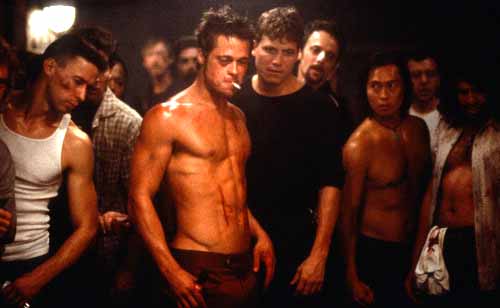
The same is true of Fight Club. Here, of course, the big reveal moment is when it becomes evident that the narrator (Edward Norton) and Tyler Durden (Brad Pitt) are actually the same person. Interestingly, though, this doesn’t so much change the view of the entire movie as it does the single character of Marla Singer (Helena Bonham Carter). On a first viewing, Marla is, bluntly, a crazy bitch who acts not only as Tyler’s special friend in the bedroom but also as a constant thorn in the side of the narrator. On a second viewing, knowing that the two men are sharing the same body, Marla becomes the most sympathetic character in the film. Instead of her driving the narrator insane, the narrator himself is treating her like garbage.

And here is where the two movies diverge for me completely. The Sixth Sense is brilliant in its own way, mostly because of the expert handling of that shock reveal. There are legitimately enough clues in the film to see that Dr. Crowe is one of the spirits haunting Cole, but this is handled deftly enough that it isn’t obvious until a second viewing. This is not as true in Fight Club, where the clues are much less obvious.

***THUS ENDETH THE SPOILERS***

In addition to the secret surprise ending, The Sixth Sense trades on a few tremendous scares and a couple of iconic moments. The most famous line from the film, arguably one of the greatest of the last 20 years or so, is the young boy lying in a hospital bed, saying, “I see dead people” to his psychologist. Other scenes rank highly, though. Cole sitting in his tent, seeing his breath in the air made freezing by the presence of a ghost, the clothespins holding the blankets together snapping off one by one, for instance, is still effective. Once we as the audience realize that Cole’s seeing of dead people is reality and not insanity, we begin to accept their presence regardless of how terrifying that presence might be.

But the very major twist at the end of the film that makes The Sixth Sense so iconic as a movie, and what made it work so well, is also the very thing that makes further rewatching of the movie less interesting. The first time gives us the surprise, the second gives us the chance to pick up on all of the dropped hints…and after that, there are no surprises left.

It reminds me of the Shirley Jackson story “The Lottery.” I can remember being assigned that for the first time in school and being surprised at the way the story ended. Then I was assigned the story a second time by a different teacher the next year in school. And like The Sixth Sense, it was a completely different story the second time around. And then I was assigned it again. And again. And again. Finally, the last time I was assigned that story in a class, I came back the next day and commented to the class at large that I found the story funny. The rest of the class didn’t see it, but I had read that story so many times, over and over, that it had lost its ability to surprise me or frighten me. The Sixth Sense is like that. After a couple of viewings, there is nothing more for it to give.

Often, two different movie companies in Hollywood will release very similar films at almost the exact same time. Armageddon and Deep Impact, for instance, or Volcano and Dante’s Peak. Roughly a month after The Sixth Sense came out, another film with similar themes was released. Stir of Echoes is also about a young boy who sees dead people and is compelled to help them. Sadly, Stir of Echoes was lost in the furor around The Sixth Sense despite the fact that it is in many ways a much better movie. The young boy is far more tragic, there is no reveal that prevents multiple rewatchings, and the ending is so existentially terrifying that, at least for me, it is also significantly more affecting.

Fight Club doesn’t have this problem. While the movie is different a second time, it also continues to reveal little subtleties every time it is watched. Fight Club works not because of a particular piece of cinematic sleight of hand, but because it is about far more than just the secret it carries. Fight Club is all about the irony, not the shock.

What makes Fight Club tick is the disparity between Tyler Durden’s spoken philosophy and the reality of what that philosophy becomes in practice. At one point, in an impassioned speech, Tyler says to the audience, “You're not your job. You're not how much money you have in the bank. You're not the car you drive. You're not the contents of your wallet.” It’s a good, solid philosophy, one that I find fairly life affirming. I am more than my job and my car. But over the course of the movie, when Tyler’s and the narrator’s personal path of self destruction gets truly underway and they begin Project Mayhem, the men who have decided to be more than the contents of their wallet become something far less. While they may be more than the contents of their wallets and more than their cars, at the center of Project Mayhem, they all dress the same way, all look the same, and have even surrendered their names. In trying to be something other than what society wants, they instead become less than they were, a nearly perfect irony. It’s an irony foreshadowed by the narrator’s taking a different fake name at every support group he goes to.

Beyond this, Fight Club features a narrator capable of the most staggering observations, most of which are tossed off as blithe asides, simply thrown away and yet worth remembering. It’s a movie worthy of studying simply because the observations are fascinating and the way in which they are revealed is so forthright and upfront that there is nothing else like it. How can you ignore lines like, “If I did have a tumor, I’d name it Marla. Marla. The little scratch on the roof of your mouth that would heal if only you could stop tonguing it, but you can’t.”

So ultimately, Fight Club works better because it’s a movie that can be watched over and over, while The Sixth Sense really doesn’t function well after the second viewing. It’s worth noting that after directing Fight Club, director David Fincher went on to direct Panic Room, Zodiac, and The Curious Case of Benjamin Button. M. Night Shyamalan hasn’t done anything but, in general, disappoint his audience since the release of The Sixth Sense.

Why to watch The Sixth Sense: A few iconic moments and the line “I see dead people.”
Why not to watch: You’ve already seen it twice or you’ve seen the superior Stir of Echoes.

Why to watch Fight Club: It’s made of equal parts awesome and rock and roll.
Why not to watch: Because you’re a lily-livered Nancy boy.