Showing posts with label Paul Leni. Show all posts

Saturday, October 25, 2025

Ten Days of Terror!: Waxworks (Das Wachsfigurenkabinett)

Film: Waxworks (Das Wachsfigurenkabinett)
Format: Streaming video from Hoopla on various players.

I seem unable to get away from horror anthologies. Waxworks, or Das Wachsfigurenkabinett if you like the German, is potentially the first horror film anthology in existence, but I’m not as versed on silent film history as I should be to be able to make that as a definitive claim. In truth, since this isn’t really that scary and only one of the three stories is overtly horror, it’s possible that someone might claim a later film as having that title. Regardless, there are certainly some clear sense that this has at least horror intentions. It might be better thought of as a prototype rather than the real thing.

The framing story is, unsurprisingly, going to take place in a wax museum. The proprietor of a wax museum (John Gottowt) and his daughter Eva (Olga Belajeff) put out an ad for a writer. It’s answered by a man called only “The Poet” (William Dieterle), who is engaged to write backstories for three of the museums exhibits: Harun Al-Rashid, Ivan the Terrible, and Spring-Heeled Jack, the silent version of Jack The Ripper, renamed to avoid problems with the censors. The Poet notices that the figure of Harun Al-Rashid is missing an arm, and this is the entry point for the first tale.

Thursday, October 3, 2024

Want to Know How I Got These Scars?

Film: The Man Who Laughs
Format: Streaming video from Tubi TV on Fire!

There are a few truly iconic comic book characters. One of those is Bat-Man. Of the Caped Crusader’s vast and colorful rogue’s gallery, his most infamous and deadly opponent is the Joker. Anyone with even a little knowledge of comic book history can tell you that the Joker was based, at least visually, on Gwynplaine, the hero of The Man Who Laughs, a novel by Victor Hugo and one of the most influential silent films ever made.

In the late 18th century, near the end of the reign of King James II (Sam DeGrasse), the king is informed by his evil jester Barkliphedro (Brandon Hurst) about the capture of Lord Clancharlie (Conrad Veidt), who refused to kiss his ring. Clancharlie has returned for his son, and is informed that his son has been given to Hardquanonne (George Siegmann), who has carved a permanent smile on the boy’s face. Clancharlie is executed, and to get rid of the boy, the king orders all of the “Comprachios,” people of folklore who cripple children as a way to create circus performers, ordered out of England. They leave, but the boy, Gwynplaine (Julius Molnar as a child, then Conrad Veidt as an adult), is left behind.

Monday, January 24, 2022

I Taut I Taw a Puddy Tat

Films: The Cat and the Canary (1927)
Format: Internet video on Fire!

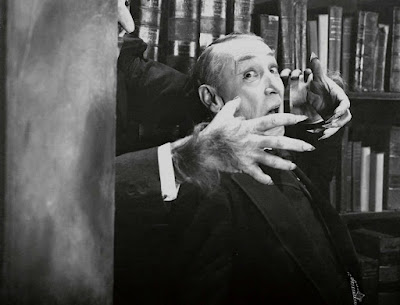
For as much as I purport myself to be a cinematic snob, I can really struggle with silent movies. While silent comedies are often still funny (a guy falling on his ass is a guy falling on his ass, after all), dramas are a lot less accessible. Horror movies tend to fall somewhere between. There’s a lot of possibility for some interesting visuals at the very least. Horror movies are where a lot of the early cinematic language was created. Superimposing one piece of film over another, camera tricks, odd angles, and more came in part from horror movies because there was a need to keep the audience in suspense and fright. That makes a film like 1927’s The Cat and the Canary an interesting one.

This is a haunted house story and a murder mystery as well as a mildly comic film, although not all of the humor really translates to a modern audience. The plot is one that isn’t going to be that shocking. Variations of this have existed for as long as there have been contested wills and continue today in movies like Knives Out. This should give you a solid idea of the direction we’re going and at least the general tenor of the story.