Showing posts with label epic. Show all posts

Thursday, November 13, 2014

Fine China

Film: The Good Earth
Format: DVD from Rockford Public Library on laptop.

I’ve spoken of the acting prowess of the great Paul Muni before. He’s a forgotten actor these days, and it’s a damn shame. The man was, in addition to being a commensurate actor, a chameleon. This quality worked against him during his career because he was difficult to market. It works against him now, because he is frequently unrecognizable. In 1937, Muni had three movies released. One, The Life of Emile Zola, won Best Picture. Another, The Good Earth (the subject of this review), was nominated. It was a good year for Muni.

The Good Earth is an oddball of a film for 1937. It’s an epic, but it takes place in China, a world that would be completely alien to the majority of Americans. Once Muni was tagged to play Wang, the lead character of the film, the Hays Code required that any actress playing opposite him in the role of O-Lan, his wife, would need to be white as well. The role was filled by Luise Rainer, who became the first person to win back-to-back acting Oscars thanks to this role. It does feel like an odd film, though, especially these days with white actors in, for lack of a better word, yellowface. Some Chinese actors were used in other roles, but having white actors play foreign roles was hardly unusual for the time.

Monday, November 10, 2014

Better than the Shroud of Turin

Film: The Robe
Format: Streaming video from NetFlix on rockin’ flatscreen.

I suppose I shouldn’t be surprised at the number of Biblical epics that appear on the Oscars lists. There was a time when anything set in that era could almost guarantee a nomination or two, it seems. In that respect, The Robe’s presence shouldn’t be too shocking. There are even a few Biblical epics I like unabashedly. I enjoy Ben-Hur, for instance, and The Ten Commandments is surprisingly entertaining, even for a heathen like me. It seems like there’s one every other year in the 1950s.

The Robe, though, is completely overwrought as a film. I put it on a par with a film like Quo Vadis, a few good performances, but a very odd depiction of Christianity. A film like The Robe seems to have been made in no small part as a way to play in to the idea of Christian persecution. While plenty of Christians don’t live a life of paranoia, there is a set of them who like to think of themselves as under the threat of constant oppression.

Saturday, January 11, 2014

How the West Was Won

Film: How the West Was Won
Format: DVD from Rockford Public Library on laptop.

This is not going to be easy. How the West Was Won is a film that not only spans a massive amount of time, a good 40-50 years, and has one of those casts that starts on a Tuesday and ends on Friday. Lots of folks are given top billing for a few minutes work here but nonetheless, there are so many stars and future stars involved in the cast of this that it would take a full paragraph or two to name them all. Just as interestingly, many of them are not immediately recognizable, but can be identified by their voices. Henry Fonda in particular doesn’t look anything like himself, but there’s no mistaking that voice. Ditto for John Wayne, who makes a several minute appearance as William Tecumseh Sherman. Spencer Tracy narrates the film, and his voice is just as immediately recognizable.

We begin with the Westward quest of the Prescott family, heading to the wild country of Ohio. Led by patriarch Zebulon (Karl Malden) have little but their own gumption for the trip, and they encounter a series of problems. One of those problems turns out instead to be a friend named Linus Rawlings (James Stewart). There is a mutual attraction between Linus and Eve Prescott (Carroll Baker), but Linus is a mountain man. When he saves the family from being bushwhacked, that attraction grows. It’s not until a serious accident kills off Zeb and his wife that Eve makes a choice to stay on that spot, and Linus agrees to stay with her.

Monday, March 18, 2013

Watching Oscar: The Greatest Show on Earth

Film: The Greatest Show on Earth
Format: DVD from Rockford Public Library on various players.

It would be completely dishonest of me to not mention at the start of this that I really don’t like circuses. I mean that I really don’t like them. That being the case, The Greatest Show on Earth has a strike against it before I’ve cracked open the DVD case. Strike two is that this film is often mentioned as a film that should never have won Best Picture. There’s almost always some anger around what wins in any given year, and most of that is reserved for recent memory. Most people couldn’t peg this as something that won that particular award. Unlike classic winners like Casablanca and Gone with the Wind, The Greatest Show on Earth has sort of faded into a sort of well-deserved obscurity.

Super-heroishly named Brad Braden (Charlton Heston) runs the Ringling Brothers and Barnum & Bailey Circus as it travels around the country. But the circus is going through some rough times in the post-war depression years and the bigwigs of the big top want to run a short season—10 weeks playing only the major cities. Brad convinces them to allow him to continue on the road as long as the show remains in the black. He does this by telling them he’s acquired the services of The Great Sebastian (Cornell Wild), the world’s greatest trapeze artist, and that Sebastian only agreed to work for the circus on the promise of a full season.

Friday, March 15, 2013

Watching Oscar: Quo Vadis

Film: Quo Vadis
Format: Turner Classic Movies on rockin’ flatscreen.

There are times when I don’t look forward to a particular film specifically because of the subject matter. That’s pretty normal, I think. I pretty much don’t watch torture porn because I don’t want to watch torture porn. I have no real interest in subjecting myself to that, and so the rare film that crops up that touches on that subject is one that I dread. It’s why I put off films like Audition, Funny Games and Henry: Portrait of a Serial Killer for as long as I did. At other times, I feel like it makes sense to knock these films out as soon as I can so that they aren’t hanging over my head. Thus it is I spent nearly three hours watching Quo Vadis, a biblical epic that seems tailor-made to tell the faithful how special they are.

I’ll try not to get too anti-religion on you with this one, but that’s not easy for someone with my religious outlook when it comes to a film like Quo Vadis. This is a film tailor-made for the sort of Christian believer who wants to claim persecution for his or her faith, since this film is entirely about the persecution of Christianity by the Roman Empire under the reign of Nero. Never once are we led to doubt anything but the literal truth of the biblical account, and right there and in a large way the film loses me.

Saturday, October 27, 2012

Old Souls

Film: Cloud Atlas
Format: Kerasotes 16 theater.

Sometimes I love what I do.

I don’t go to the movies very often. It’s not the expense (I watched today’s film for a paltry $5.00), but the time. I tend to watch films piecemeal because I have to. Twenty minutes here, half an hour there. There are times when it takes me a full day to get through a 90-minute film. When I do have a chunk of time to watch something, it’s usually because I’m doing something else. I’ve paired a lot of socks and done a lot of ironing while watching a movie. Since theaters don’t allow me to come and go as I please or pause when I ask them to, and since they won’t allow me to bring in my ironing board, I find myself without the necessary chunk of consecutive hours most days. But I do make exceptions, and Cloud Atlas is just such an exception.

Before I get too much into the heart of this, let me say this now and like this: I officially forgive the Wachowskis for Matrix: Revolutions.

Saturday, August 11, 2012

Wuxia

Film: Xia Nu (A Touch of Zen); Wo Hu Cang Long (Crouching Tiger Hidden Dragon)
Format: DVD from NetFlix on kick-ass portable DVD player (Xia Nu); DVD from personal collection on big ol’ television (Wo Hu Cang Long).

A few months ago, I started compiling reviews for the Large Association of Movie Blogs, also known as the LAMB. Every month, I put up a compiled list of film reviews from fellow members on a specific national cinema, genre, or style. This is called “Foreign Chops.” The first edition of this was on wuxia films, a Chinese genre of film that follows the exploits of martial heroes. While this may include martial arts films, often the hero is armed with a specific weapon. Typical xia (warrior) heroes are not in service to a lord or master, and use their abilities to help the oppressed or to redress wrongs done to others.

When I compiled that first list of films, Xia Nu (A Touch of Zen) appeared from several people. I knew it was on my list, but I didn’t really know anything about it. I’ve seen a couple of more modern wuxia films, but remained interested in this one, put off only by its three-plus hour length. Well, after a crazy week, I finally had time to watch it. Since watching, I’ve done a little research on it and have discovered that this film is formative for the genre, and now that I’ve seen it, I can also see this influence—a power it continues to have in Chinese films to this day.

Thursday, July 19, 2012

Watching Oscar: Around the World in 80 Days

Film: Around the World in 80 Days
Format: DVD from Northern Illinois University Founders Memorial Library on kick-ass portable DVD player.

When a film wins an Oscar for anything, some people are going to be upset. In retrospect, though, few choices for Best Picture have been as rethought and questioned as the 1956 winner, Around the World in 80 Days. It is very much a film in that classic Hollywood vein slightly after the true golden era of film, and that’s likely one of the reasons it captured the top spot. It was also ably assisted by a very weak field.

The film is a screen adaptation of the book of the same name by Jules Verne, and it’s no different than the title suggests. For a film that runs around three hours long, it’s remarkably easy to sum up. A British gentleman named Phileas Fogg (David Niven) undertakes a bet with several other gentlemen of his club. The bet is that, in the time of the film (the mid-1870s) it would be possible to circumnavigate the globe in precisely 80 days. The men accept the bet and Fogg heads off taking with him a suitcase full of cash and his new manservant, Passepartout (Cantinflas). Coincidentally at the same time, a daring robbery of the Bank of England has taken place, and Fogg’s behavior seems suspicious. So, Mr. Fix (Robert Newton) pursues Fogg around the globe in the hopes of bringing him to justice for a crime that Fogg (of course) didn’t commit.

Sunday, June 10, 2012

Harlequin Romance

Film: Out of Africa
Format: DVD from Rockford Public Library on big ol’ television.

I spent more than two and a half hours watching Out of Africa today. This is one of the great films of the mid-1980s according to the hype and the Oscar nominations and wins. It’s a romance on the grand scale, the sort of romance that doesn’t really get made any more. The film is epic in scale as well as length, filled with gigantic vistas of open land, sweeping events, love, and tragedy. And for the life of me, I’m having trouble thinking of anything to say about it.

Karen (Meryl Streep), who later in life became an author working under the pen name Isak Dinesen, is a wealthy, unmarried woman in Denmark. Because she is unmarried, she asks a man named Bror Blixen (Klaus Maria Brandauer) to marry her out of convenience. Bror has a title but no money, so the marriage would be mutually beneficial—he gets money he needs and she gets a title she wants. The plan is for the two of them to start a dairy farm in East Africa.

Tuesday, March 20, 2012

Braveheart II: This Time, He's Roman

Film: Gladiator
Format: DVD from Rockford Public Library on rockin’ flatscreen.

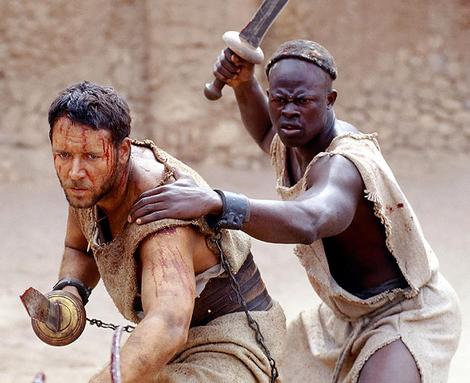
When the Academy Awards for 2000 rolled around, I don’t remember there being a lot of doubt that the ultimate winner for Best Picture would be anything but Gladiator. There may have been a little buzz around the other films, but Gladiator was the one on everyone’s lips. I drank the Kool-Aid as much as anyone. I remember watching it with my wife and being surprised at just how much she got into it as well.

Like many a historical epic, Gladiator takes some license with the source material. A great deal in this case is made from whole cloth in that most of the characters (including the bulk of the major cast) are simply representative of the time and history. While I cannot be sure, only Commodus (Joaquin Phoenix) existed in the real world. License was taken with him, but less than you might expect. His reign was short and plagued by political intrigue, and some historians have determined his reign as the beginning of the fall of the Roman Empire.

Regardless of this, the film is one that doesn’t specifically require historical accuracy to be entertaining. The film follows the life of Maximus Decimus Meridius (Russell Crowe), a general in the Roman Army, serving under Emperor Marcus Aurelius (Richard Harris). After a victory in Germania, the dying Marcus visits his general. Here he tells him that the fate of Rome lays in his hands—he intends to make Maximus the protector of Rome until the Senate and the people of Rome are ready to rule. This does not sit well with Marcus’s son, the aforementioned Commodus, who kills Marcus Aurelius, and then sentences Maximus to death for not swearing allegiance. He also has Maximus’s wife and son slain.

But of course Maximus escapes his execution and returns home to see his family murdered. Wounded, tired, hungry, and sick, Maximus collapses and is picked up by a slave trader and sold to Proximo (Oliver Reed), who owns a stock of gladiators. And so now the great warrior Maximus has been reduced to the lowest state of a warrior. As a gladiator, he meets two men—Juba (Djimon Hounsou) and Hagen (Ralf Moeller)—who will become his friends.

In the rest of the world, Commodus becomes emperor, his treachery suspected but unproven. Intrigue abounds, in part because Commodus displays himself as inept as a ruler. Part of this (at least for the audience) is the fact that he has obvious designs on Lucilla (Connie Nielsen), his sister, and makes no mistake of the fact that he would like her to rule beside him in every incestuous sense of the word. Lucilla, of course, is a former lover of Maximus, and there's still some evident feeling between them. There’s also quite a bit of infighting between Commodus and parts of the Senate, particularly Senator Gracchus (Derek Jacobi). As the film continues, these two spar with increasingly high stakes until Commodus is left with no alternative but to move against Gracchus. Frequently, Lucilla is used as a pawn in this, as is her son Lucius (Spencer Treat Clark).

Of course, the greatest pawn in all of this is Maximus himself, who hides his identity for the bulk of the film, and is known among the gladiators and to Proximo as the Spaniard. His own progression is shown mainly through his progression of gladiatorial battles, each one becoming more and more vicious, more and more extravagant, and up to a point, bloodier and bloodier. This, even more than the story, was the original selling point of this film to the masses. In some ways at least, we in the audience were much the same as those Roman citizens who sat in the Coliseum and watched avidly for the bloody spectacle of death.

I’m not trying to sell this short; the arena combats are fantastic, and are a selling point of the film for a better reason than the fact that they are battles. They are hyper-kinetic contests of speed and brutality, and exciting in a way that only movie battles can be exciting. Today, 12 years after the film was released, they are still one of the major selling points of the film and for the exact same reason. Put plainly, the battles kick ass.

So if the battles are the reason to watch the film, what about everything else? Tonight was the first time in probably a decade I put Gladiator in the spinner, and while I certainly remembered the film, there was quite a bit that I had forgotten. For instance, I had forgotten how much I enjoyed the brief appearance of Richard Harris in this film; he brings an air of wisdom and of serenity to this film much as he did in the first few Harry Potter films. I also had forgotten much of the character of Proximo. I remember now that he was one of my favorite parts of the film when I first saw it, and he was one of my favorite characters this time as well.

The film is a showcase for Russell Crowe, of course, and one that more than any previous turned him into the major star he is today. Certainly he had roles in films like L.A. Confidential before this one, but this was the film that turned him into a household name, and with reason. It’s a star turn like few others.

Ultimately, Gladiator is a film that plays out a great deal like Braveheart of a few years before. It’s evident early on how the film will play out and once Commodus is impressed enough to meet the “Spaniard” after a gladiatorial combat, there’s really only one way the film can end. There’s a great deal of melodrama here, a bit more difficult to recognize because of the intensity of the bloodshed, but melodrama it is.

You know what? Who cares. It’s bread and circuses, but they’re damn fine circuses.

Why to watch Gladiator: Ridley Scott, Joaquin Phoenix, and Russell Crowe at their best.
Why not to watch: The path of this story is pretty evident after 20 minutes.

Monday, March 12, 2012

History vs. Narrative

Film: Braveheart
Format: VHS from personal collection on big ol’ television.

In this world, post Mel Gibson’s anti-Semitic, drunken tirade, it’s difficult to remember that Gibson was once an extremely talented actor and filmmaker. There was a time when people would go to see something specifically because he was in it, and more often than not, they’d be happy with the results. Gibson made a transition from good looking action guy to more thoughtful fare slowly. Even his more cerebral, meaningful stuff, like Braveheart, comes with a load of action and violence. Gibson’s name was crap for some time, a reality that he’s still sort of fighting against (last year’s The Beaver grossed less than $1 million). It’s instructive at times to remember why this guy was so damn popular and seemed to be made of Teflon for years. Even his shitty movies didn’t seem to affect his popularity, drawing power, or appeal.

No film cemented his reputation as a serious actor and filmmaker more than Braveheart. This was Gibson at the height of his acting chops and at the moment he became not a guy making movies but a true filmmaker. In many ways, Braveheart is sort of a tipping point for Gibson’s career. Up to this point, with a few forays into other genres, most of Gibson’s output was action or the occasional action-fueled comedy. After, Gibson seemed set on essentially remaking Braveheart in other, more American, patriotic forms or going the full-on religious route, with Apocalypto being a noteworthy exception.

This makes Braveheart important in Gibson’s career, but it’s an important film for other reasons as well. It is in many ways a return to or at least a continuation of the concept of epic filmmaking that had returned to vogue in the ‘90s. Braveheart clocks in at close to three full hours, and along the way, it goes through some very specific segments of film style. There’s no doubt from the opening scenes and narration that we’ll be going to war eventually, but that’s not where we spend much of the first hour.

We start with the young William Wallace (played as a youth by James Robinson). His father (Sean Lawlor) and brother (Sandy Nelson) head off to battle and come back dead, leaving William in the care of his uncle, Argyle (Brian Cox). Argyle takes William on pilgrimage to Rome and through France, and William returns later in life, ready to settle down and raise (as he says) crops and a family. And now he’s Mel Gibson. He encounters a few old friends, particularly Hamish (Brendan Gleeson), Hamish’s father (James Cosmo), and Murran (Catherine McCormack), who he has rather carried a torch for in his long absence. There is a brief, whirlwind romance between the two, and they marry in secret to avoid the problem of primae noctis, allowing the feudal lord bed rights for any woman on the night of her wedding.

Of course, it all goes to pot when Murran is accosted by a few English soldiers and fights off a rape. Wallace comes to her aid and tries to lead the soldiers away, but Murran is captured, accused of inciting rioting against the king, and has her throat cut. And this action, which happens relatively early in the film, fuels Wallace’s rage for the next several hours.

Of course, it all comes down to unbridled rage at the English king of the time, Edward I, called Longshanks (and played by the strikingly awesome Patrick McGoohan). Longshanks is depicted in the film as a brutal tyrant, capable of any atrocity to expand his own territories. His son, who would eventually become Edward II (Peter Hanly) is effeminate and depicted as gay and weak, which is one of the few aspects of this film that is at least marginally correct; Edward II is historically thought of as bisexual. Regardless, Edward’s queen, Isabella of France (Sophie Marceau) is often sent into diplomatic missions with the idea that she might succeed, but if she were to be killed, she’d be no real loss.

And there’s lots of fighting. Wallace fights the British, the British lay traps for Wallace, and he kills pretty much anything that stands in his way or appears to stop him from killing more English people. It’s all about the death and destruction here, and Braveheart really pulls not a single punch. The war scenes are filled not with gratuitous violence, but realistic violence. We see limbs and heads removed, skulls crushed, and blood aplenty. No one dies with a sword through the ribs and a spot of blood. Instead, we get military picks driven through helmets and into the brains beneath. Battles end with everyone covered in gore.

There are a few other things worth mentioning here as well. I’d be remiss if I didn’t discuss the role of Robert the Bruce (Angus McFadyen). Of all the characters in the film, he is one of my favorites because of the way in which he is depicted. This is a man who would eventually become the king of Scotland, but in this film is merely learning what it means to be a ruler of men. He gets advice from his father (Ian Bannen), who remains hidden due to leprosy. His advice seems to come directly out of Machiavelli’s The Prince, and Robert finds himself perpetually battling between doing what his father wishes and doing instead what he feels is right. Of all the characters in the film, it is Robert the Bruce who undergoes significant changes, makes mistakes, pays a price for them, and learns from his errors.

I also need to discuss Stephen (David O’Hara), the insane Irishman who shows up around the middle of the film. Stephen is borderline insane, but also cunning and a hell of a warrior. He injects a necessary bit of insanity, levity, and comedy into the final mix. While certainly there are those who might not be his fans in the world, I don’t know any of them. I think the guy is great, and he easily makes the film for me, if only because he’s not so completely serious all the time once the killing starts.

It is the end of the film that most people remember, of course, because it is the end of the film that is the most powerful. Wallace, finally captured and to be put to death faces his stoutest test, and, of course, finds a way to inspire the masses when he meets it. If you’ve seen this, you know what I’m talking about. If you haven’t, well, you should watch it.

The biggest issue with Braveheart as a film is that it is completely inaccurate in almost every aspect. Yes, there was a guy named William Wallace, and he did fight against the English. He was eventually captured and executed. And just about nothing else is true to the narrative. Even the essential plot element of primae noctis is a fabrication—the rule certainly existed, but there’s no evidence that Longshanks ever used it. Couple this with the fact that Edward II married Isabella after Wallace’s death, and you’ve got a film in which virtually all pieces of accuracy were sacrificed on the altar of narrative. I’m not saying this is a bad thing, but it’s a true thing. It also makes me wonder if the real story isn’t compelling enough, why film it?

If I want to go disturbing on this, there’s some evidence that this film was instrumental in a rise of Scots nationalism and anti-British sentiment. Couple this with some of Gibson’s later behavior, and one has to wonder if perhaps this film wasn’t the beginning of Mel Gibson going controversial and dividing as well as entirely historically inaccurate. Food for thought, no?

Why to watch Braveheart: Mel Gibson at his best and before the crazy set in.
Why not to watch: To paraphrase John O’Farrell, it couldn’t be more historically inaccurate if it included a clay dog and were named William Wallace and Gromit.

Monday, January 9, 2012

The Orestean Trilogy?

Film: O Thiassos (Travelling Players)
Format: Internet video on laptop.

I’ve never really objected to long films. Some of my favorite film experiences from the past couple of years have been films of extreme length--The Lord of the Rings Trilogy, The Decalogue to name just a couple. What I don’t understand, though, is the evident idea that a film is somehow given more power and more weight and more importance simply because of its length. That is certainly the case with Theo Angelopoulos’s O Thiassos (Travelling Players).

There are three stories at work here, which may account for a little of the length. On the surface, we have the tale of a group of (as the English title suggests) travelling players, a theater troupe wandering around Greece attempting to perform an erotic drama about a woman named Golfo. Frequently, we see the opening scene of the play only to have it interrupted by some event.

Second, O Thiassos is a sort of history of Greece from before World War II, through the war, and into the post-war period of civil strife with the communists, and into the years of Anglo-American intervention. The film does not tell this history in a straight narrative. In fact, it frequently jumps back and forth and sometimes happily mashes two time periods together in the same shot. For instance, we may see German troops standing guard at an installation while a truck drives by, telling people to vote for the man who put down the communist rebels in the late 1940s.

Third, and perhaps most significantly in terms of film narrative and art, O Thiassos serves as a modern retelling of the Orestean cycle of classic Greek plays. Our major characters bear the same names as their classic counterparts, and in good retelling fashion appear to be completely unaware that they are the namesakes of a series of tragedies.

It would seem like that should be more than enough to fill a film of nearly four hours in length. In reality, though, it’s not nearly enough. This film is packed with long takes, frequently with the aftermath of what has just happened appearing on screen for half a minute before moving on. Allegedly, the entire film is made with a mere 80 shots, and based on the length of some scenes involving a static camera, I wouldn’t doubt the veracity of that claim. All of this serves to further slow down a film that is by all accounts dreadfully slow in pace. What this means is that, for instance, when the inevitable rape/interrogation scene happens (because you just knew there was going to be one), we see it at length.

Additionally, the film is very confusing. Part of this may well be the language barrier and the fact that while watching, I am forced to spend at least a part of the time reading the bottom of the screen. However, there are long sequences without speech of any kind, so there’s evidently some natural confusion in the narrative itself. I point to the blending of time periods as being the biggest culprit in this. In fact, I was confused for the first half hour or so of the film, thinking I had perhaps misread something. We see World War II-era German soldiers and hear about the Communist Party in 1949. It wasn’t until this happened a second time that I started to realize what was going on. In a way, it seems sort of unfair to create a film of this length and at this pace that requires a second viewing to truly understand. There are a couple of moments of fourth wall breaking during which a character will approach the camera and speak at length about their past and what has happened. These soliloquies do help, but they don’t quite go far enough.

And really, I don’t think I’ll give it a second viewing. O Thiassos is not a bad film by any stretch, but it is a film that requires a significant commitment to watch. As it is, I have watched it over the course of about a week, half an hour here, a little bit there, until a final marathon at the end to finish it up. That I call how I finished the film a marathon is not merely a pun on the film taking place in Greece. My final push was perhaps two-and-a-half hours give or take. It’s a length of time that wouldn’t phase me for most films, and I’ve watched much longer without a break and without complaint. But it felt like a marathon here, because the film simply never wanted to end.

I’m not sure where cuts should or could be made. It’s sort of in general overweight and bloated. Ultimately, I think I might rather read the Orestean plays again rather than sit through an overlong modernization a second time.

Why to watch O Thiassos: It gives a reason for the benefits of a classical education.
Why not to watch: It’s the length of two movies with the content of one.

Monday, December 26, 2011

The Seven Pillars of Wisdom

Film: Lawrence of Arabia
Format: DVD from personal collection on big ol’ television.

Epic films seem to come and go in waves. Every now and then, someone makes a great long film, and suddenly that’s what everyone wants to make. For a few years, all of the great films are three hours long or more, and a lot of the shitty ones are that long, too. At least until someone makes a tightly paced and controlled film of 90 minutes to show that it can still be done. Nobody did epic like David Lean did, though. While not all of his films are eternal in length, most of his great ones are. None is so great or so long as Lawrence of Arabia.

We start at the end of T.E. Lawrence’s life in a motorcycle accident. At his funeral, it appears that opinion on the man is rather mixed. Many consider him a great man and a hero while others are of the opinion that he was little more than a self-aggrandizing show off. The bulk of the film is the most important sequence of Lawrence’s life, which goes to essentially prove both that Lawrence was a great man and a supreme egotist.

Lawrence (Peter O’Toole) is a member of the British military during World War I, stationed in Cairo. Rather than fighting against the Germans, he is stuck essentially nursemaiding some British allies. He is transferred to Arabia to better understand the Arabian problem from the British perspective. The Arabian tribes are battling the Turks, and have only mobility on their side. The Turks have efficient and modern weapons including artillery and aircraft, which makes the life of the Turks difficult.

Lawrence learns of the harshness of the environment, both physical and political, first hand when his initial guide is killed by Sherif Ali (Omar Sharif) for drinking from a well that wasn’t his. The Arabs are at this point in history a splintered people, a collection of tribes who have at best uneasy alliances with each other, and at worst practice open war. Tribesman kills tribesman for water rights, leaving the entire population essentially at the mercy of the Turks.

Lawrence sees this as the biggest problem that the Arabs face. He sets about uniting them as best he can, winning over Prince Feisal (Alec Guinness) and using this influence to unite Sherif Ali with Auda Abu Tayi (Anthony Quinn). Lawrence leads men across the most severe and terrible desert so that his men can take the fortress town of Akaba from the land, claiming the guns there as well as the port.

And this, essentially, is the bulk of the film. Lawrence attempts to lead the Arabic people to unity and freedom, simultaneously battling the British interests in the region. His preference is for a free Arabia, a new power in the Middle East acting as a true nation of united people instead of a collection of warring tribes. In many cases, he feels he must bring this about against the will of everyone, including many of the Arab tribes.

There are a number of noteworthy things in this film. On the positive side is the incredible cinematography. This is a film that needs to be watched on a large screen, the larger the better. Much of what Lean wants to accomplish with this film is to show the severity of the landscape, so this is quite a bit of what we see. There are incredible long shots of the desert, often with a single distant rider slowly approaching. It would be easy for these shots to be boring, but they are not. Instead, they are starkly beautiful, even thrilling at times. Lean contrasts these long shots with intense close-ups of his principle actors. There’s a great juxtaposition of images here. The intensity of the interpersonal conflicts matches the intensity of the world in which these characters live.

Where I take issue with the film is in the casting. It’s nearly impossible to get too terribly upset about the actors in this film because they are all excellent, but it seems that the racism of the period has managed to filter into this film as well. Omar Sharif at least is of Arabic descent, but none of the other major Arab characters are. Guinness is pure British and Anthony Quinn is Irish-Mexican. And yet here they are playing Arab tribesmen. I find that difficult to stomach on some level.

While all of the major performances are great, it is O’Toole who makes the film, though. He plays Lawrence with true conviction. He is entirely believable as Lawrence because he believes himself to be Lawrence, and so we believe it, too.

Lawrence of Arabia is not a film to watch lightly. With the fill musical sections included, the film runs close to four hours long, making it a significant undertaking. This is not to discourage anyone from sitting down and taking this film in. It is a brilliant film from start to finish and entirely engaging. If nothing else, it is a brilliant example of a story in which the hero gets everything he desires and nothing at all at the same time. Lawrence is ultimately a tragic figure, but tragic through the faults of others and not his own.

Just make a lot of popcorn for this one, and plan your bathroom breaks carefully. You’ll need them.

Why to watch Lawrence of Arabia: Epic filmmaking at its greatest and most epic.
Why not to watch: I still don’t understand the casting.

Monday, May 16, 2011

Kurosawa...in Color!

Film: Ran
Format: DVD from NetFlix on big ol’ television.

Akira Kurosawa is one of those directors who has enough great films in his repertoire that it’s not difficult to find a great one to watch. I haven’t seen his entire catalog by any stretch of the imagination, so it’s easy to assume that he has some lesser films and possibly a few stinkers in there. Hey, Hitchcock and Kubrick didn’t bat 1.000, either, and not every Bergman film is worth careful contemplation.

Ran is Kurosawa’s last great samurai epic, and “great” is the operative word in that sentence. It’s commonly thought of as Kurosawa’s take on Shakespeare’s “King Lear,” and the two stories do have more than a little in common. There are some significant differences, of course—hordes of samurai for one—but the stories have enough in common that it feels like a natural thought to call one the Japanese version of the other. However, a great deal of Ran feels like it comes from Kurosawa’s life instead. The production of this film saw the great director aged, alone, unable to secure backing, with the opinion of many being that the world of film had passed him by. This film showed that it hadn’t.

Ran centers on the Ichimonji clan, specifically on Lord Hidetora Ichimonji (Tatsuya Nakadai), a ruling warlord. Through his life, he has risen to the exalted rank of Warlord through feats of arms, brutality, and treachery. Now, nearing the end of his life, he wishes to retire and allow his sons to rule. So he decrees that he will retain his title, but will pass the rule over the Ichimonji clan to his eldest son, Taro (Akira Terao). Taro will rule at the first castle. Second son Jiro (Jinpachi Nezu) will hold the second castle. Third son Saburo (Daisuke Ryu) will hold the third. Jiro and Saburo are entrusted with these castles with the idea that should Taro need them, they will follow his lead.

While it seems like a nice plan at first, it immediately goes to smash. Both Taro and Jiro are ambitious and would like to rule entirely. Saburo still has respect for his aged father, and warns him that his plan seems like a very bad one. Since Lord Hidetora gained his position through ulterior means, expecting his sons to act together seems like insanity. Hidetora immediately banishes his son from his lands, and follows that banishment up with another. Also forced to leave is Tango (Masayuki Yui), his servant, because he dares to tell the Lord that Saburo is right.

Things go well for Saburo, though, since he is adopted into the house of Fujimaki. Things don’t go so well for Hidetora. Immediately, the scheming begins. Taro’s wife Kaede (Mieko Harada) tells Taro that he should be the Great Lord, and Taro forces his father to sign a compact giving up all his power. Hidetora signs, but then leaves immediately to go to the second castle and Jiro. Here he finds that Jiro wishes to use him as a pawn against Taro. Hidetora has no option but to head to the third castle, which proves to be a trap. His men and concubines are killed or kill themselves, but Hidetora cannot commit seppuku because his sword is broken. Instead, he loses his mind completely, and his rescued from wandering the wilderness by Tango and Kyoami (Pita), his fool and comic relief. All of this is the first half of Hidetora’s downward spiral from the great heights of warlord-dom to almost total dissolution.

The story is a great one. We have the great man who is torn apart not only by the life he led, but also by the decisions he has made and continues to make while his children essentially fight for the right to pick his bones clean. The same thing happens now often enough when a powerful and wealthy patriarch dies and his children fight over what he leaves behind. For taking place in the warlord era of Japan, this is a very modern story.

It’s also blood-soaked, as any film involving hordes of samurai should be. The aftermaths of battle are terrible and gruesome. In typical Kurosawa style, the battles are set pieces of direction and camera work. The initial major battle at the third castle, for instance, takes place in almost a dreamlike state, with music instead of battle sounds, until the reality of the situation he is in crashes around Hidetora, and the sounds of battle erupt.

Ran also has the benefit of being in color. I like a good black-and-white film, but the color here brings something to the table that Kurosawa’s previous samurai epics did not have: the pageantry and spectacle of the samurai armies arrayed on the battlefield. While the warfare is terrible and costly, the scenes of men arrayed in armor with huge pennants swaying over them are stirring to say the least. It makes a small part of me want to see films like Shichinin no Samurai in color just for the incredible spectacle.

One thing Kurosawa does that Shakespeare didn’t is he gives his old warlord a backstory. Hidetora Ichimonji was not noted for his benevolence. In fact, throughout the film we are reminded of exactly how brutal his push to power was. He murdered and slaughtered his way up the ladder, forcing the children of those he killed into marriages with his own clan to further strengthen his position, and otherwise destroying those who he could not marry into his family. His reputation for brutality, bloodshed, and treachery comes back on him through the course of the film, serving as a lesson in bloody, terrible karma.

Ran is not a happy film by any stretch. Nothing good happens to anyone in this film, but it probably shouldn’t. I don’t know if it’s my favorite Kurosawa film--Rashomon seems to be still battling Kumonosu Jo for that title—but Ran is Kurosawa showing that he still had the ability to stir emotions and excite the senses when most of his contemporaries and those following him believed that the world of cinema had passed him by. This film is magnificent and I do not in any way question its location here.

Why to watch Ran: Kurosawa’s final samurai epic, and it’s blood-soaked enough for two films.
Why not to watch: It’s also a constant reminder of one’s own mortality.

Friday, April 22, 2011

Fiddle-Dee-Dee

Film: Gone with the Wind
Format: Streaming video from NetFlix on middlin’-sized living room television.

Let’s talk movie event, shall we? While there were certainly great movies before Gone with the Wind was released in 1939, there had never really been a film that anyone could call “must see” other than people like me who follow lists made by other people. Other films had spectacle, great casts, epic length, sweeping stories, but until Gone with the Wind, no one put them all in one big shiny package. This film has it all plus a bag of chips, the chips being the fact that it’s in color.

Based on Margaret Mitchell’s book of the same name, the story covers the years immediately prior to the American Civil War, the years during, and the dark years that follow. We concern ourselves mostly with Katie Scarlett O’Hara (Vivian Leigh), a headstrong woman who has never been denied a thing she wanted in her entire life, with one exception. Scarlett wants anything that is possessed by someone else. She wants all of the attention, all of the men, and everything else as well. But what she really wants is Ashley Wilkes (Leslie Howard). Sadly for her, Ashley is engaged to her cousin, Melanie Hamilton (Olivia de Havilland).

What follows, then is one of the great unrequited love stories ever put to film. Scarlett does everything but hump Ashley’s leg every time she sees him, and while Melanie appears to notice this, she doesn’t do anything to discourage it. Melanie, it turns out, is one of those genuinely nice and decent people who look for the best in everybody.

Scarlett marries and is immediately widowed by the war, leaving her free to continue pursuing Ashley. At the same time, she is pursued by Rhett Butler (Clark Gable), a wealthy ne’er-do-well, smuggler, and otherwise shady individual. Scarlett first dislikes and then comes to appreciate the attention of Mr. Butler, mostly because of the “wealthy” part. War eventually comes to the South, Sherman marches to the sea, and Atlanta is burned in Technicolor. And during all of this, Scarlett’s home plantation, Tara, is virtually destroyed, her mother (Barbara O’Neill) dies, and her father (the always great Thomas Mitchell) loses his mind. These are the tough years, during which Scarlett must learn to work the farm herself and not depend on her servants. And just before the intermission, she famously declares that she’ll never go hungry again.

Things are looking up financially in the second half of the film. Scarlett marries again, this time stealing the fiancée of her own sister to get the money to pay the new taxes on Tara. She continues to expand her husband’s new business, operating a sawmill with her beloved Ashley, until her husband is killed while enacting some Klan-style retribution. Widowed again, she is successfully wooed (again, mostly thanks to the money) by Rhett Butler, setting of the stormiest relationship to that point in film history. This involves the birth of a child, the death of the child in a horse riding accident (just like Barry Lyndon. Authors note: keep young children away from horses), a miscarriage, fights, reconciliation, public embarrassment, attempted reconciliation, and, eventually, Clark Gable saying, “Frankly, my dear, I don’t give a damn!”

Wow!

So let’s talk about a few of the specifics here. I would be remiss if I didn’t talk at least a little about Hattie McDaniel, who plays the house slave/servant Mammy. McDaniel is both the first African-American nominated for an Oscar and the first to win one, which is quite an achievement. She also earned it. Mammy is one of the more memorable characters from this film. She’s simultaneously protective of the women in her house as concerns outsiders and a harridan around those people for whom she believes a little moral ass-whipping is needed—Scarlett more often than not. While the role itself didn’t do much to advance minority rights or better minority roles in Hollywood, McDaniel made the role hers and sold it so completely that the character has become as legendary as Scarlett and Rhett.

As for the other main players, I may differ from the opinions of a number of people. I don’t really like Scarlett that much. I don’t see her as a figure of feminism or a powerful woman. Instead, she is patently manipulative, scheming, and except when times are very bad, spoiled rotten. Sure, there is evident strength in her when it needs to be there, but when her world is fine financially, she turns into the moral equivalent of a Jell-o mold. She is the stereotype of the fainting Southern belle, always looking for assistance to do any minor task and repaying any and every kindness shown to her by a man with fawning flattery. And except for those poor saps under her spell, it’s immediately obvious what she’s doing and why she’s doing it. She’s an attention whore.

Melanie is a far more interesting character because, while she is physically frail through most of the film, she is morally strong and exhibits a sort of true kindness that someone like Scarlett can see and benefit from, but can emulate only in its most pathetic and saddest form. Melanie is almost purely good, which is of course why Ashley loves her.

And Ashley…Jeez, what a mush. Seriously, he’s perhaps the most unappealing romantic male character ever conceived. The man exhibits one strong opinion in the film at one time, and does so after a decade of stringing Scarlett along by the nose. He’s so concerned with being a nice guy to everyone that he ends up being sort of an asshole.

Finally, we come to Rhett Butler. He’s impossible not to like. He’s morally corrupt, says and does what he pleases, and cares little about the opinions of others, but he looks good doing it. Butler has style. He has panache. He’s the reason women love bad boys.

All told, this is a film you have to watch. It’s not my particular cup of tea, honestly, but it is great and grand in a way that few films are. No other film screams “old Hollywood” the way this one does, and there are perhaps half a dozen scenes in this film that rank among the greatest ever filmed—I can think of three or four right now without even trying. There’s a reason the phrase “must see” exists, and Gone with the Wind was tailor-made for that phrase.

Why to watch Gone with the Wind: The first, best, and greatest definition of Hollywood blockbuster.
Why not to watch: Some of the remarks are cringe-worthy with modern sensibilities.

Monday, April 11, 2011

My Return to Kubrick

Film: Barry Lyndon
Format: DVD from Rockford Public Library on big ol’ television.

When I started this a little more than a year ago, I watched several Kubrick films right away. I realized soon enough that if I kept it up, I’d be through all of the Kubrick-y goodness in a few months and have no Kubrick to look forward to over the long months and years to come. So I stopped watching them, despite the fact that I had ample opportunity to watch more of them. I figured if I was doing the same thing with Hitchcock, I could do the same with Kubrick.

Well, it’s been more than a year since I screened a Kubrick film, so I figured I’d waited long enough. I’m not entirely certain why I selected Barry Lyndon save for the fact that it was immediately available to me, and I’ve made it a goal to continue watching a few long films every month so that I’m not buried by them at the end.

Barry Lyndon is the tale of a man born Redmond Barry (Ryan O’Neal) as he stalks through the various courts of Europe in the mid- to late-18th century. His goal is to live the life of a gentleman, something taken from him at a very early age when his father is slain in a duel over some horses. Barry is raised in the home of his relatives, where he falls in love with Nora (Gay Hamilton), his cousin. This is made complicated by the fact that the family is in dire straits for money, and thus wants to marry Nora off to a wealthy British officer named John Quinn (Leonard Rossiter). Barry engages to fight a duel with the man and slays him (he thinks), and is thus forced to go on the lam to avoid imprisonment. He’s immediately robbed, and forced into the British Army as a way to survive.

As it turns out, the duel was a sham, and Nora did marry Quinn after all. Now in the service, Barry gets his first taste of battle and decides he’s had enough. At the first opportunity, he steals the uniform of a courier and deserts only to be eventually pressed into service by the Prussian Army. It is here that his life changes again; Barry is assigned the task of playing servant to the Chevalier de Balibari (Patrick Magee). The Prussians believe the man to be a spy, but he’s really just a card cheat. Barry throws in with him immediately, and the two work out a scheme to keep them in money. Barry helps the Chevalier cheat at cards, and does the dirty work of dueling those who refuse to pay.

Barry’s life changes again when he meets the lovely Lady Honoria Lyndon (Marisa Berenson). Her husband, the sick Lord Lyndon (Frank Middlemass) confronts Barry, and then is so enraged by the young man that he immediately has a heart attack and dies. Barry marries the widow and officially tacks her family name onto his own, becoming Barry Lyndon.

So now we’ve seen the rise; it’s time for the fall, because no good epic story about a complete bastard can ever be without a fall of at least the same length as the rise. The newly named Barry Lyndon begins indulging himself at every possible opportunity. The two have a son named Bryan, but the heir to the estate and the Lyndon name is young Lord Bullingdon (played as a child by Dominic Savage, and as a young adult by Leon Vitali), Lady Lyndon’s son from her previous marriage. Lord Bullingdon and Lyndon take an immediate dislike to each other, one that continues to grow through the years.

A large part of this enmity is that Bullingdon holds the title, and should anything happen to Lady Lyndon, Barry, his mother, and his son will all be turned out without a penny between them. Lyndon, realizing this, spends a great deal of the Lyndon fortune in an effort to get himself a title. It all goes for naught when Bullingdon insults him publically and Lyndon beats his stepson severely. While this manages to get rid of the stepson, it also gives Lyndon a reputation for merciless cruelty, and he is abandoned by his society peers.

To pile tragedy on top of problems, Lyndon’s young son is killed in an accident, sending Lyndon into a spiraling depression of grief and alcohol. It all comes to a head when Bullingdon returns and challenges his stepfather to a duel. The results of said duel are better kept as a spoiler.

*** HAPPINESS IS A WARM GUN ***

Bullingdon gets to shoot first, but his nerves cause the gun to go off prematurely. With his shot, Lyndon fires into the ground instead of at his stepson, essentially granting the boy his life. Whether this is from pity, or because he realizes that killing the lad will make him all the more hated isn’t clear. What is clear is that given a clear chance, he refuses to kill Bullingdon.

For this mercy, Bullingdon’s response is especially cold. Declaring that he has not yet had satisfaction, he takes another pistol and fires, wounding Lyndon in the leg. As a result, Lyndon has his left leg amputated below the knee. To finish him off, Bullingdon grants him an annual income of 500 guineas if he leaves England and never returns. Given that his only other option is jail, Lyndon takes it and returns to Ireland with his mother. He returns to his gambling ways, but never with any success.

*** BANG BANG, SHOOT SHOOT ***

The question here is one of crime and punishment as well as redemption. Is Lyndon redeemed by his actions at the end? I don’t know. I think it more likely that his redemption comes instead from the punishment he receives. But again, I don’t really know.

I also don’t know if I like it. Evidently, a great many people feel that this is one of Kubrick’s best films, and while it’s certainly pretty, I found very little here that got me excited. One man’s social climb and fall isn’t a story that excites me too much, and while everything here is beautifully filmed and appears to be exquisitely authentic, I sometimes found my mind wandering.

Where the film excels is the overall look. Kubrick is often at his most interesting when it comes to the visual style and appeal of his films, and Barry Lyndon does not disappoint. Many of the scenes are lit by candlelight, not just in appearance on screen, but in actuality; Kubrick used electric lighting only when absolutely necessary. This gives the look of the film another level of authenticity the really does play. It looks like 18th century paintings, which is almost certainly what Kubrick was after.

But this authentic look comes in the service of a very slow-moving plot in which the few points of actual action are the punctuation in some long sentences in which not much happens. As always, I’m impressed by Kubrick’s visual artistry. I just wish that for this film I were more impressed with the actual story taking place.

Why to watch Barry Lyndon: A great period piece with Kubrick at the helm.
Why not to watch: No one to root for.

Wednesday, February 16, 2011

Tarr...kovsky?

Film: Satantango (Satan’s Tango)
Format: DVDs from NetFlix on various players.

There are plenty of films in this world that make the average movie viewer distrust the serious film critic. Much of the catalog of Fellini, for instance, falls into this broad category. Films with really long takes, not much happening, huge pauses, shots of empty places, dry dialogue scenes, incomprehensible plots, and other staples of art films seem to thrill critics and both bore and frustrate someone who simply watches films for entertainment.


And thus we come to Bela Tarr’s Satantango (Satan’s Tango), a film that is the epitome of heralded art film that those not serious about movies will encounter initially with curiosity, then boredom, then frustration, and then outright anger. I admit, even though I consider myself more serious than most about studying film, this one was a trial. I’ve been watching it in bits and pieces for a couple of weeks—a necessity when the discs come one at a time from NetFlix and the film spans a full three DVDs.

Tarr’s style has been compared with that of Tarkovsky, and with good reason. This film takes the idea of a long take to ridonkulous levels, with some shots going on for ten minutes or more. In the full seven-plus hours of the movie, Tarr claims that there are only 150 different shots, and having seen the film, I don’t doubt that this is true. This is broken up at times with slow pans or tracking shots, but even these are a relative rarity for some long sequences.

The story concerns a failed collective farm in Hungary. The people are broke and broken, and spend their nights drinking, dancing, and stumbling around in a local bar. A conman they thought long dead returns and sells them on a dream of a new collective, a model farm, that will require their investment if they are to make it work. A bunch of them leave for the new place. And really, that’s the bulk of the film. Most of the time, people sit around drinking and waiting for something to happen, and it’s about as exciting to watch as it sounds like it would be.

But this film isn’t about excitement, and not all films should be. This is a meditation, perhaps on the failed Hungarian system or on the process of life itself. Certainly it’s bleak enough both in terms of how it is filmed and the story that transpires that it wouldn’t be difficult to assign this meaning to the film.

More than any other film, I’m reminded in parts of Chantal Ackerman’s Jeanne Dielmann, which couldn’t have been more of a trial for me had it been injected directly into my cerebral cortex. Tarr’s film has more happening, though, and is also in many ways an easier watch despite being twice the length. Many of the shots, while they seem eternal, are strikingly beautiful. While the film concerns itself in many ways with the banality of the existence of its characters, the ugliness of their environment, the terrible rainy weather, and human misery, there are a number of extended shots that are truly gorgeous.

Where Tarr loses the average viewer, and in many places lost me, is just how long he holds his camera in the same place without anything happening. We get close-ups of people that last for thirty seconds or a minute with no dialogue. Nothing happens. At times, I had to check to make sure the DVD hadn’t frozen, because nothing on the screen moved for half a minute, and just when I was getting ready to check, someone spoke or the camera twitched. Shots like this require intense patience both on the part of Tarr and on the part of the viewer, and this patience can be rewarded. These shots, for their lack of any action, are revealing in giving us genuine looks at the characters.

And yet, it could also easily be argued that there are far too many of these shots. Someone leaves a room, and the camera sits on the open door for upwards of a minute, an unchanging tableaux, until we are given a new shot. We watch people walk, camera in the face, with a background of unbroken gray clouds. At one point, a girl named Estike runs through the woods for what seems like a couple of miles, the camera tracking in front of her. In another scene, people sit around the bar while a man talks endlessly, repeating the same five or six lines over and over. Later, we watch people dance and act drunkenly for ten minutes or more while an accordionist plays the same few notes over and over. Tarr pulls no punches with shots like this—he opens the film with seven or eight minutes of cows walking in a paddock and a very slow tracking shot.

Perhaps the most difficult part of the film to watch comes in the middle, when Estike brutally tortures a cat. This may not sound like much, but this is painful to watch, and like every scene in this film, it continues far longer than it feels like it should to get the point across. Later, the girl spikes a bowl of milk with rat poison and forces the cat to drink it, saying over and over that she can do whatever she wants to the cat because she is stronger than the cat. Following this, the girl watches the drunken elders dance, then swallows the rat poison herself. It’s this sequence that caused the film to be at least temporarily banned in the U.K. despite Tarr’s assurance that there was a vet on hand the whole time, and his statement that the cat in question ended up as his personal pet.

Within the context of the film, we cover the same ground repeatedly. We see action from one perspective, then see the same action from another perspective later. The girl watches the dancers, for instance, and later, we watch the same scene from inside, catching glimpses of the girl standing in the rain.

Satantango was filmed to mimic the dance: six steps forward and six steps back. It’s a subtlety that is easily lost without being made aware of the fact, a statement true of many things in this film.

Is it good? Unquestionably, this is art film at one of its highest points. Tarr’s work is carefully crafted, smart, and unflinching. It’s also difficult to like. In other words, I’m impressed with the effort, the message, and the artistry here, but like many great works of art, it’s not something I want to spend a lot of time seeing. I went 43-plus years without sitting through this epic; I’ll happily go another 43-plus without doing it again.

Why to watch Satantango: This is art for art’s sake.
Why not to watch: A new definition of “long take.”

Saturday, February 12, 2011

Super Silent Saturday

Films: Intolerance, The Thief of Bagdad
Format: Streaming video from NetFlix on laptop.

When D.W. Griffith filmed The Birth of a Nation, he simultaneously invented modern film and created a storm of controversy. In an effort to soften that criticism, he produced Intolerance, the biggest, longest, and most expensive film ever created, at least for its time. Intolerance weaves four stories of intolerant behavior—three from history and one from Griffith’s present day—to show the terrible damage cause by judging others harshly and, well, being intolerant. Should you sit down with this one, be prepared to be hammered with the world “intolerance” virtually every time the story switches from one era to the next.

What Griffith does, rather than run each story through from start to finish, is skip back and forth between the four, spending the most time in the present day and in the oldest story, which takes place in ancient Babylon. It’s likely that the first story had the most interest for people of the time and it’s absolutely true that the Babylonian story, with its massive sets, huge crop of extras, and live freakin’ elephants was the most expensive, and he wanted the most bang for his buck there. What this means is that each story essentially builds to a climax at the same time and resolves at the same time.

The four stories are:
Babylon, the siege of the city by Cyrus, aided and abetted by the disgruntled priest of Bel-Marduk, upset that worship has turned to Ishtar instead of his god.
Judea, Christ against the Pharisees and Christ’s eventual crucifixion.
France, and the persecution and destruction of the Huguenots under Catherine de Medici and Charles IX.
And Modern, unrest, strikes, and temperance, leading to moral outrage from moneyed individuals who hold themselves superior to the working class.

The three historical stories all show the terrible consequences of what can happen because of intolerant behavior, and links between the stories come in the form of Lillian Gish acting as a sort of universal mother rocking a cradle, undoubtedly the easiest payday she ever scored.

While this does contain four distinct stories, only two have any real meat on them. The Christ story is almost non-existent to the point where it becomes difficult to recall anything from it. The Pharisees hold themselves above the common masses of the people, Christ here is depicted as the sort of ultimately tolerant individual he was, and he is crucified for defying the wisdom and influence of his elders. Perhaps it’s safe to say that Griffith gave the story so little traction here because it was (and is) such a familiar story to his viewers. Similarly, the French story holds little more than Catholics getting pissed off and killing scads of Huguenots, and disrupting a wedding.

The modern story concerns the destruction caused by the alleged good intentions of reformers, who actually do more to destroy people, tear apart families, and create crime than perform any positive service. This is shown by giving us the story of people who, through circumstances, are treated as emblematic of the problem in the eyes of the reformers, but who are essentially innocent of the crimes of which they are convicted. The intolerance of the reformers blinds them to anything but the necessity of getting their reforms across, whatever the cost, and no matter who is ground down in the wheels of their justice.

The big story, with the cast of thousands and the massive sets, is the Babylonian story, which probably could have (and perhaps should have) been the entire film. Here, religious intolerance leads to the complete destruction of Babylon, and lives are ground down under the wheels of an onrushing army, all because a priest was dissatisfied with the fact that his ruler and the people had turned away from his god.

In this story we get some of the most magnificent battle sequences ever filmed. The sets here are tremendous, and the cast is massive. Thousands of people throw rocks, get hit by arrows, and move massive siege towers into place against huge walls created for the film. There are some really fine bits here, with towers being knocked over and a couple of decapitations that certainly would have shocked people 100 years ago (although through modern eyes, the trick is an obvious one).

What’s really noteworthy here is that again, Griffith did things that no one had done before. We have huge crane shots over Babylon, crane shots with moving cameras that really look like modern camera work. And, even today, 95 years later, the sets are still staggering. It’s the spectacle that makes this worth watching.

What’s difficult for the modern viewer is the typical overacting and overreaction of silent film actors. The Mountain Girl, for instance, takes part in the battles in an effort to help protect her beloved Belshazzar. She launches an arrow, then points to it, and jumps up and down. Yes, you launched an arrow. Good for you. In the middle of battle at one point, she spots Belshazzar and moons over him while around her, people are dying. It’s the sort of thing that to a modern audience makes silent film difficult to take seriously. Her realization of the treachery of the Priest of Bel comes with so much eye-bulging and double taking that it becomes comic.

Doubtless Griffith wanted these characters to be iconic, which is why most of them don’t have names. The accused in the modern story is known only as “The Boy” and his wife is “The Dear One,” while the girl in the French story is called “Brown Eyes.” In general, the bad guys have names—they are specific, but our heroes are known only by what type they are.

Intolerance, for all its epic sweep and profound greatness, is a film without a time. When it was made, audiences reacted by staying away in droves, bankrupting Griffith’s production company. Today, the acting is too extreme, and everything too melodramatic to have any traction with a modern audience. This is a rough ride—watch only for study, and for the giant battle sequences. Otherwise, it’s a few hours of preaching, bad behavior, and overacting.

If you think that the actors in Intolerance overdo it, it’s only because you’ve never seen Douglas Fairbanks in The Thief of Bagdad. There isn’t a gesture here that can’t be made grander, or with a larger sweep of the arm. Seeing a dish of food he’d like, he smacks his lips and rubs his hand over his stomach from groin to chin.

Fairbanks, as might be determined from the previous paragraph, is the eponymous thief. The opening sequence shows him doing what he does. He filches purses by feigning sleep near a drinking spot, climbs walls and takes food, and steals a magic rope when its owner bows in prayer after being called by the muezzin. He also offers a speech to the clerics of Allah, saying that he looks for no reward in the next life. Instead, he takes what he wishes; this is a speech repeated a few minutes later by a Mongol prince, who has set his sights on Bagdad for his own.

To get it, he’ll try to win the hand of the Princess of Bagdad. To do so, the suitor must return with the rarest of treasures. The thief originally breaks into the palace of the Caliph of Bagdad to steal goods, but becomes so enamored of the princess that he decides that she is the true treasure. He first feigns being a prince himself, but is found out and flogged for his trouble. However, once he discovers what must be done to win the princess, he sets out on his own journey, fraught with peril, terrible monsters, and the treachery of his opponents for the princess’s hand.

At a touch longer than two-and-a-half hours, it would be nice to think that there’s more to the plot than this, but more really isn’t needed. Like the Babylonian scenes in Intolerance, the sell here is the spectacle on the screen. While the sets are huge and grand and a number of scenes have a large crop of extras, that’s not the focus. The focus is on the effects and on the talents and charm of Douglas Fairbanks.

Fairbanks is really something special. He was famous and a star back in the 1920s for the exact same reason that Jackie Chan is famous today—he looked like he could do anything, and made it look easy. In fact, while Chan often takes both a real and an apparent beating in his movies, Fairbanks does his stunts with a smile on his face. He is a tremendous acrobat, making everything he does look as simple as walking down a staircase. Naturally there were some tricks here—in one scene hidden trampolines aid his jumps, for instance. But many of these stunts were him and him alone. He moves with the natural grace of a dancer and the skill of a trained athlete. Few actors in history have had this natural gift, and fewer still used them so well and to such good effect.

As far as the special effects, it can be difficult to judge in this modern world of jaded viewers and films like Avatar and Inception. Still, for their time, they are ahead of the game, and while there’s no shock of how these effects were pulled off, several of them still look great and still work. What are the effects? Well, there’s a giant lizard monster, a bat creature, an undersea expedition complete with giant deep sea spider, and a winged horse that really looks great. The magic carpet is a nice effect, too. They all pale to the soldiers who appear from clouds of smoke, though. All in all, it’s impressive enough that it must have been cause for great discussion 85 years ago, and today is still good enough to be worth noting.

Sure, this film is overacted and melodramatic. And? It’s also a great deal of fun, filled with adventure and entertainment. If Douglas Fairbanks makes too much show of everything he does, who really cares? This is really the first non-comedy silent film I can say I have truly been entertained by, and that’s worth the price of admission.

Why to watch Intolerance: It’s grand in a way few films have ever been.
Why not to watch: Being hit over the head with message/message/message is never pleasant.

Why to watch The Thief of Bagdad: Stunts you won’t believe aren’t trick photography, and some of the greatest early effects ever made.
Why not to watch: Crazy, crazy melodrama.

Sunday, January 23, 2011

Shining, Glistening Eyes

Film: Doctor Zhivago
Format: DVD from Northern Illinois University Library on big ol’ television.


The epic romance is a style from a bygone age. Dr. Zhivago, based on the novel of the same name by Boris Pasternak, is one of the last epic romances on the grand old scale. A true epic takes place on a grand scale against a massive backdrop, usually of war and usually with huge, sweeping expanses of land. Since this story takes place across the years of World War I and the Bolshevik Revolution, the scale doesn’t get much grander.

As tends to be the case with huge Russian epics, we have a lot of characters to keep straight here, but there are only a few that are really important. Also as is the case with Russian epics everybody has three names, and you can expect them to be used at any time, which can make some conversations difficult to keep straight.

We start, as many films of this sort do, at the end of things, with a Bolshevik general named Yevgraf (Alec Guinness) looking for his niece. The girl, who might be the right one, is brought to him, and he begins to tell her the tale of his half-brother, Yuri Zhivago (Omar Sharif). Yuri’s mother died when he was very young, and he was taken to Moscow by an adoptive family that includes Tonya (Geraldine Chaplin).

Yuri grows up to be a competent doctor as well as an acclaimed poet. He becomes engaged to Tonya around the time of World War I. Simultaneously, we are introduced to Lara (Julie Christie), a young woman who is enamored of a Bolshevik named Pasha (Tom Courtenay), in part because of his great passion.

The two meet for the first time when Lara’s mother attempts suicide and Yuri is one of the two who attends her. He is immediately smitten with the girl, but also discovers another rival in the form of Komarovsky (Rod Steiger), who acts as a sort of protector for Lara and her mother. He refuses to give his blessing to a marriage between Lara and Pasha, and takes it upon himself to essentially rape the girl as a way of exerting her dominance. She shoots Komarovsky during a Christmas party, and Zhivago watches her led out of the hall by Pasha and out of his life.

The war begins, and Yuri is posted to the Ukraine where he encounters Lara once again. She acts as his nurse while he tends to the troops, and they become quite close, but not in the Biblical sense. Back in Moscow, the situation has changed with the capture of the tsar and the Bolshevik Revolution. Yuri meets with Yevgraf, who manages to smuggle the family out of Moscow and out to a family estate in Varykino.

Here, naturally, Zhivago meets Lara again after first encountering Sasha, who now goes by the name of Strelnikov, and is quite the player in the Red (Bolshevik) Army. For the first time, their obvious love kindles into something much more despite the fact that Tonya is pregnant. No longer able to live with the affair, he breaks things off with Lara, but is captured by partisans and is forced to serve with them for nearly two years. He deserts and makes his way back to Varykino only to discover that his family is gone. However, Lara is still there, and she rescues him. They encounter Komarovsky again, who offers to take them to Vladivostok on the Pacific coast, but they refuse.

Of course, like the players in any great romance, both Lara and Yuri are doomed, in part because of the events that surround them and in part because of their great love for each other, forbidden by their marriages to other people. And yet, in the vast sweep of the conflict where people are lost and unaccounted for, they live a life together filled with the sort of romance that people generally only dream of, burning terribly for each other constantly. Of course they are forced to separate eventually, and of course, their passion is what continues to drive them and eventually proves to be the thing that destroys them, only in the most impossibly romantic way.

The cinematography is, of course, as lovely and grand as you might expect from someone with David Lean’s reputation and track record. The film is truly grand, and it’s grand in no small part because of the huge expanses of Russian countryside filled with trees, empty spaces, and acres upon acres of white, glistening snow.

Despite this, it’s not the vast expanses of Russian steppes that I remember, but the close ups, particularly of Omar Sharif, with his eyes glistening with tears, shining in whatever ambient light happens to be available. Seriously, the man is read to cry so often that he’s almost a leaking faucet. Everything he does reminds him of this great love of his life or the injustices he sees under the Bolshevik system, and these things cause tears to well up in his eyes constantly.

Doctor Zhivago is the story of this great love. It’s also really freakin’ long for the story it tells. I had trouble more than once keeping my eyes open through some of the passages. It’s not that the story isn’t gripping in its own way, but the epic sweep, while impressive, doesn’t strike me as being entirely necessary for a boy-loves-girl, loses-finds-loses girl story.

Ultimately, I can’t get past those glistening eyes. Zhivago’s passion more often than not comes off as a weepy bitch. Great and grand, but not in the way I was hoping. And prepare to hear that damned balalaika version of "Lara's Theme" in your head for the rest of your life.

Why to watch Dr. Zhivago : Epic sweep and romance on a grand scale.
Why not to watch: Three-plus hours of shining-eyed close up.

Saturday, October 9, 2010

How Much is One Man Worth?

Film: Saving Private Ryan
Format: DVD from personal collection on laptop.


There was a time in cinematic history when war movies followed a particular formula. The bad guys were very, very bad and the good guys were very, very good. In fact, in American war movies of the ‘40s and ‘50s, the Americans were generally heroic, never faltering in their unwavering ability to fulfill their duty against overwhelming and terrible odds. The good guys came out on top, and when they died, they died like men, fulfilling an objective, saving their fellow troops, or perhaps even turning the tide in a battle. In movies about World War II, there’d always be a guy from Brooklyn who wondered how the Dodgers were doing, and the minute a guy showed someone a picture of his girlfriend back home, he’d be killed.

Modern war movies have become far more realistic in that sense. In modern war films, people often die without it advancing the plot in a particular way. People die because they’re in a war, and that’s what happens in a war. People break down, cry, fall apart, and want their mothers. It may not be the sort of Boy’s Own adventure that war had always been depicted as, but it certainly seems much more believable.

This shift started in the late 1970s and early 1980s, I think, when films started to be made about the Vietnam War. Films like The Deerhunter, Full Metal Jacket, and Platoon took the romance out of war films and made them into something terrible to behold. While these films started he trend, perhaps no film displays it more effectively than Saving Private Ryan, a film that in many ways remade the war film.

What people who have seen this film remember most about it is the long, terrible scene of the D-Day invasion. It is a scene impossible to describe in any detail save that it is all horrific. Men dying, limbs blown off, intestines on the ground next to them, carnage, blood. The most striking image is probably the man, his arm blown off at the elbow, picking up his missing hand and walking away with it, but the one that stays with me is of Capt. John Miller (Tom Hanks) picking up his helmet off the beach and pouring blood out of it before putting it back on. A number of combat veterans had flashbacks caused by this opening scene according to reports, and I believe it. It’s that intense and terrible. I’ve seen this film before, and it was this part that I was dreading.

From here we learn that in the D-Day invasion and previously, three young men named Ryan were killed. All three are brothers, and the fourth, Private James F. Ryan (Matt Damon) is at least potentially alive somewhere in France. It is imperative in the minds of the men running the American side of the war that Private Ryan be returned home, his family already having given so much to the cause.

To do this, Capt. Miller is rounded up and sent in search of Private Ryan, who dropped with the 101st Airborne, who were scattered over hill and yon in the French countryside. Going with Miller are his sergeant, Horvath (Tom Sizemore), Medic Irwin Wade (Giovanni Ribisi), and privates Mellish (Adam Goldberg), Jackson (Barry Pepper), Reiben (Edward Burns), and Caparzo (Vin Diesel). Additionally, since both of the translators in his squad were KIA in the invasion, accompanying the group is Cpl. Upham (Jeremy Davies), who has never been in combat, but speaks both French and German.

And this is your movie. After the short introduction of an old gentleman at the Arlington National Cemetery, we flashback to D-Day, and then it’s a manhunt in the French countryside. Of course, since much of this countryside is controlled by the Germans at this point, this is not a happy romp in the park. We learn a bit about the men as they search, and they encounter several pockets of German resistance along the way. At one point, Caparzo is killed attempting to rescue a child, and Wade is killed when the group attacks an enemy machine gun nest.

This is one of the key scenes. Reiben attempts to turn around and leave, since it wasn’t necessary for the squad to take out the machine gun nest, and it cost them their medic. Up to this point, one of the continuing threads is that no one knows much about Capt. Miller. To defuse the situation, he tells everyone where he’s from and what he did in civilian life. It’s also a key scene because it involves the capture of a German combatant, who pleads for his life. The entire squad wants to kill him because of the loss of Wade, adding to the tension in the scene.

Eventually (with a good hour left in the film, actually), the squad finds Ryan as part of a small group of under-manned and under-equipped soldiers holding one of two critical bridges. The Germans are mounting a counteroffensive to take the bridge and halt the Allied advance. Knowing this, Ryan refuses to leave, preferring instead to stay with his comrades who have fought alongside him up to this point. This sets up the counterpoint to the D-Day invasion, as the Germans roll in with several dozen infantry and a set of tanks.

It’s interesting to me to see the number of well-known actors who show up here for just a couple of minutes of screen time. For instance, Dennis Farina is in the film for a couple of minutes as the Lieutenant Colonel who gives Miller his mission. Paul Giamatti is in a couple of scenes as a sergeant in an advanced position (right around where Caparzo gets picked off). The Captain leading that group, Captain Hamill, is played by Ted Danson. Finally, and most amusing to me, is that when the squad finds the wrong Private Ryan (James Frederick Ryan from Minnesota instead of James Francis Ryan from Iowa), it’s Nathan Fillion from Firefly. Additionally, a glider pilot encountered by the squad is played by Leland Orser, who’s a “that guy” from a lot of films (most memorable to me as the guy wrapped in a blanket from the lust murder in Se7en). I like Leland Orser, and I’m a little smug that I can identify him.

Ultimately, the brutality of war is truly depicted here. There are plenty of senseless deaths, and every life is constantly on the line. We see men in combat as they truly are, and while there are heroics here, most of what we see in the combat sequences is men simply trying to stay alive by killing the other guys first. Upham, it turns out, acts like many of us probably would in combat and like none of us would want to—he breaks down completely—something we wouldn’t have seen in a film like this from three or four decades previous. Some of the deaths we witness close-up. Wade’s death is particularly terrible. He realizes where he’s been shot, asks for more morphine, and then asks for his mother before expiring. It’s wrenching, as are a few of the other deaths that happen on screen. These are probably best handled as spoilers.

***SAVING YOUR MOVIE EXPERIENCE***

We do see some deaths up close and personal, like Wade’s, and near the end, like Capt. Miller’s. He actually gets a death scene, grabbing Ryan and telling him to earn what has been done for him with the rest of his life. Other deaths are only implied. Jackson, in a bell tower acting as a sniper, is blown up by one of the German tanks. We see only the explosion, not him dying.

Of all of the deaths, the most terrible is Mellish’s. Fighting hand to hand with a German soldier, the German slowly inches a knife into Mellish’s chest.

The film ends with the return to Arlington, and we probably don’t really need to morph from Matt Damon’s face into the older version of Ryan at the end. We know at this point it’s Ryan. The only other survivors from the squad are the cowardly Upham and Reiben, who tried to leave earlier.

***RETURN TO COMBAT***

Despite the carnage and brutality here, there is certainly a nod to those earlier, propaganda-filled war pictures of yesteryear. When Ryan determines that he will not return until the bridge is reinforced, it’s Sgt. Horvath who essentially sums up the film, saying, “Someday we might look back on this and decide that saving Private Ryan was the one decent thing we were able to pull out of this whole godawful, shitty mess.” Even in this terrible place, there’s still a sense of honor and nobility. And that’s something special.

Why to watch Saving Private Ryan: The most influential war movie of the last 20 years.
Why not to watch: Carnage, pure and simple. It’s not for the faint-hearted.