Showing posts with label film noir. Show all posts

Monday, October 29, 2018

Ten Days of Terror!: Hush...Hush, Sweet Charlotte

Film: Hush…Hush, Sweet Charlotte
Format: DVD from Rockford Public Library on rockin’ flatscreen.
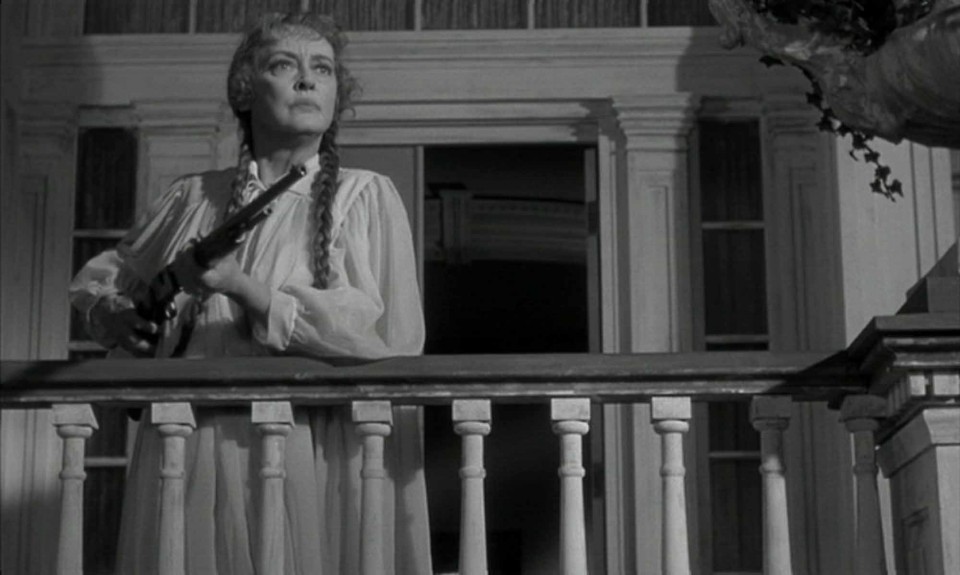
When I started this blog, I didn’t really consider myself a fan of Bette Davis, mainly because I didn’t know a great deal of her work. Now, having seen a ton of her films, I fully understand why she had the reputation she did. Davis was capable of playing just about anything, but she was at her best and her most Bette Davis-y when she had a good, bitchy role to sink her teeth into. Hush…Hush, Sweet Charlotte gives her the chance to bitch things up and also deal with some potential insanity. It’s a great combination for her.

We start in 1927, when young Charlotte Hollis (Bette Davis) is being romanced by a married man named John Mayhew (Bruce Dern). Charlotte’s father Sam (Victor Buono) understands precisely what this sort of scandal could mean to his societal standing in 1920s Louisiana, and demands that John call off his plans to run away with Charlotte. John agrees, and at a party at the Hollis house, he does so. Shortly thereafter, John is attacked by an unseen assailant, who chops off his hand and head with a meat cleaver.

Thursday, May 3, 2018

Where There's a Will, I Want to Be in it

Films: Sudden Fear
Format: Internet video on the new internet machine.

NetFlix is a lot like an umpire or autocorrect. When it does its job well, you don’t notice it. It’s only when it screws up that we really pay attention to it. Umpires, autocorrect and NetFlix all take more crap than they should because of that. What this means is that yes, I have a complaint about NetFlix. Sudden Fear has disappeared from its available discs. What this means is that I looked for it online and found it at DailyMotion. I appreciate it being there; I didn’t appreciate the ads every five minutes for much of the running time.

Sudden Fear feels like a movie I should have seen years ago. It’s a film noir, and I love film noir. It’s also a damn good film noir. It’s stylish and slick, and while there are certainly elements like a good femme fatale, this is very much a “woman in danger” film. In fact, since our main character is being threatened with death over the contents of her will, it’s entirely about her being in danger and finding a way to survive it.

Thursday, July 27, 2017

Prosecution on Defense

Film: Boomerang!
Format: Internet video on laptop.

Every now and then, you get a movie that you almost can’t explain. We tend to expect certain things from movies and from certain genres, but there are a few out there that are just out there in terms of genre expectations. Boomerang! is that sort of a movie. This is clearly film noir at least in tone, but it’s so strange and so off from the typical. It feels like a documentary in parts, especially with the voiceover, and while it is noir-ish, it ends with a long courtroom scene that is just a revealing of evidence.

We start with a murder, which is really how a good film noir ought to start. In this case, the victim is Father Lambert, a kind, mild-mannered man of the cloth in Bridgeport, CT. The killing happens at night, but on an occupied street directly under a streetlight. Despite this, the witnesses see only a man in a dark coat and a light-colored fedora fleeing the scene. Father Lambert is dead on the scene with a bullet in his head. We get a little bit of flashback, showing us the kind of man that Father Lambert was. This includes a confrontation with a local man (Philip Coolidge) who he thinks should have himself committed for some reason. Yes, this is going to be relevant, because we as the audience are going to be led to believe that this man is the killer.

Thursday, April 13, 2017

Public Enemy Number One

Film: Dillinger
Format: DVD from NetFlix on laptop.

There’s something fascinating to me about early crime films. In truth, 1945’s Dillinger doesn’t really qualify as being that early, since it’s right in the heart of the noir era. It’s an interesting Oscar nomination, since it was produced by Monogram, considered one of the better poverty row movie studios, which is sort of like the best looking person at a school for the blind. Like many movies of the era, it’s almost ridiculously short, clocking in at a spare 70 minutes. To its great benefit, though, it packs those 70 minutes with as much as it can, which very much includes a lot that doesn’t really seem to have much to do with the real John Dillinger.

In that respect, Dillinger is more of a spiritual biography of John Dillinger than one based in fact. It would seem that only his name is accurate in terms of the people in his life. Some of the broad sweeps—early imprisonment and learning the craft of crime from other criminals while in prison—seem to be accurate as well, but it would seem that none of the details are the real thing.

Tuesday, November 22, 2016

Ding Dong Bell

Film: The Well
Format: Internet video on laptop.

In 1949, a little girl named Kathy Fiscus fell down the narrow shaft of an abandoned well. The story became a national sensation and a national tragedy when she was pulled up dead from the shaft. Woody Allen made reference to this in the end of Radio Days and there’s a pretty solid connection with Ace in the Hole as well. But the clearest connection to the story is 1951’s The Well. The benefit for the viewers is that The Well only focuses a part of its time on the little girl who is trapped. The rest of the time is spent dealing with spiraling racial tensions in the town where the event occurs.

It’s also worth noting that The Well has the most misleading art I’ve ever seen for a movie. Take a moment and check out the IMDB page for this film. You’ll see a shirtless man clutching a woman who looks terrified. These events aren’t a part of this film, not even a little. You would expect, seeing that, a film about a dangerous femme fatale and a heist of gold bullion, not a film where a little girl falls into a well and a town explodes into racial violence.

Wednesday, August 31, 2016

Crazy Joan Crawford

Films: Possessed
Format: DVD from NetFlix on rockin’ flatscreen.

Say what you want about Joan Crawford and the reliability of the “Mommie Dearest” memoir, the lady could act. There’s lots of good Joan Crawford out there, but for me, the best Joan Crawford is crazy Joan Crawford. And so it was that I was really excited about the possibilities contained within Possessed where she plays a woman suffering from schizophrenia. It was either going to be an entertaining but complete train wreck or it was going to be sublime. The truth, as with most things, falls between those two possibilities, of course, but Possessed is more success in some ways than failure.

The film starts with a woman named Louise Howell (Crawford) wandering the streets of Los Angeles looking for a man named David. She’s eventually rounded up and sent to a hospital where it is determined that she’s got some significant mental issues going on. A little medication later and Louise is ready to recount her life story, which means that the rest of the film is going to be in flashback to get us to Louise showing up in the hospital.

Saturday, July 23, 2016

Everyone Gets Hit

Films: Champion
Format: Movies! Channel on rockin’ flatscreen.

Baseball might be America’s national pastime and football may well be our sport of choice, but when it comes to the Oscars, it’s all about boxing. There’s something about boxing that wakes Oscar up. In a world where the premier sports documentary (Hoop Dreams) can’t wrangle a nomination, it seems like every other film about boxing shows up on one or more of my lists. Champion from 1949 is yet another film about the fight game, putting Kirk Douglas in the ring and giving him plenty of battles outside of it as well.

Part of the lure of boxing is probably that there’s no need to manufacture drama. Oh, sure, we can add a bit here and there and plenty of filmmakers do, but once the two fighters step into the ring, the drama unfolds naturally. It’s about as pure a dramatic moment as can be imagined: two men step in to do battle until one of them falls or time is called. We don’t need anything more than that. It’s inherently dramatic, and so it’s a natural place to put a story.

Monday, December 14, 2015

Picks from Chip: Brick

Film: Brick
Format: DVD from personal collection on rockin’ flatscreen.

This is the twelfth in a series of twelve movies selected by Chip Lary at Tips from Chip.

A few years ago when I had a podcast with Nick Jobe at YourFace, we ran the show in a series of seasons. The idea was that our guest would pick a genre of film, Nick would pick a film in the genre he knew that I hadn’t seen, and I would pick a film in the genre he hadn’t seen. At least that was how it worked in theory. We did film noir every season, and every time we did, Nick toyed with the idea of having me watch Brick. When a Half Price Books had a massive movie sale last year (I got more than 50 movies for $30), I bought Brick figuring that I’d get to it eventually.

That eventually turned out to be sometime this year, since Chip put it on my list of 12 movies. Since I owned it, Brick was my insurance—if there was a planned film I couldn’t get, I could always fall back on watching this. Fortunately, that was never necessary, so Brick turns out to be movie #12. It’s a movie I’ve heard about from a lot of people, which means that, essentially sight unseen, I’m going into this with some expectations.

Monday, November 23, 2015

Off Script: Angel Heart

Film: Angel Heart
Format: Streaming video from NetFlix on various players.

By the time it wraps up, Angel Heart has gone through almost a half dozen gruesome and grisly murders and has moved from New York to New Orleans. But the film could have essentially been a short feature. We as the audience jump through a lot of hoops and have to keep a lot of plates spinning to get to the final sequence that finally reveals what many of us will deduce from previous scenes. Ultimately, we realize that a great deal of the film could have been handled by extending an early scene instead. Because of this, Angel Heart is about the journey rather than the destination.

Downtrodden private investigator Harold Angel (Mickey Rourke, back when he still had his own face) is contacted by a lawyer named Winesap (Dann Florek) to meet with a client. This client, Louis Cyphre (Robert De Niro) is an imposing gentleman with a full beard, immaculate black suit, and long, pointed fingernails that intentionally look like claws. Cyphre tells Harry Angel that a singer who was starting to make a name for himself a dozen years previous during World War II has backed out on his contract. He wants Angel to track the man down.

Wednesday, May 13, 2015

White Riot

Film: No Way Out
Format: DVD from NetFlix on rockin’ flatscreen.

I like film noir. I like it a lot, so I tend to spend a lot of time watching black-and-white films from the 1940s and 1950s. Of course I watch everything, but I’m always happy when a noir shows up in the mailbox. I wasn’t aware No Way Out was, in fact, a film noir until I popped it in and watched the first couple of minutes. This is not a traditional film noir in any sense, but it certainly fits into a place in the genre.

The reason No Way Out is more or less a stealth noir is that the surface story is entirely about race and racism. We’re presented with newly minted Dr. Luther Brooks (Sidney Poitier in his big screen debut, at least in a credited role). Luther has been working in a county hospital, and plans to hang around to get a little more experience. Actually, he’s hanging around because being a black doctor in the 1950s was not the sort of thing that many people were prepared to deal with.

Saturday, May 9, 2015

Disconnected

Film: Sorry, Wrong Number
Format: Movies! on rockin’ flatscreen.

I’ve never been shy about my deep and abiding love for the great Barbara Stanwyck, so when Sorry, Wrong Number appeared on Movies! I figured it was a good opportunity to get a little time with the delightful Babs. It also happened to be the only one of her four nominated performances that I hadn’t seen. This is a film long considered a classic and with pretty good reason. Best of all, it’s Stanwyck who carries about 80% of the film.

Leona Stevenson (Stanwyck) is a bed-ridden invalid with a heart condition. She’s also extremely wealthy thanks to her father (Ed Begley). On the night in question, she is distraught about her husband Henry (Burt Lancaster) being very late coming home from work. It happens to be the servants’ night off, which means that Leona is home alone. Trying to reach her husband on the phone, she is connected instead to a call where two men are talking, two men who can’t hear her. It soon becomes evident that the two men are discussing a murder that they are to commit that night at 11:15.

Saturday, April 18, 2015

Palooka

Film: Body and Soul
Format: DVD from NetFlix on laptop.

The movies have always had a love affair with sports because sports are guaranteed drama. Stick a group of people against another group of people vying for the same thing and the script writes itself. It’s the same reason that the movies are obsessed with romance and war. There’s no single sport that better exemplifies this than boxing, which is why Oscar loves boxing movies. Rocky, Raging Bull, Million Dollar Baby…the list goes on. That obsession seems to have started with Body and Soul from 1947. In addition to being a good old sports drama, this is a film that dips into film noir and one that is crawling with metaphor like any good sports drama should.

Before we get started, let’s get this off the top: Body and Soul is going to go exactly where you think it’s going to go. Plenty of movies have followed the path outlined by Body and Soul, and not a small number of those involve a palooka who wants to be the champ. You know there will come a point where he probably is the champ. You know there will come a time when he realizes that his friends are just there for his money, a realization that will probably come after a raucous party. You know he’s going to be asked to throw a fight at some point, and the third act will undoubtedly come down to whether or not he decides to throw it and give up his soul or reclaim his soul in the end. This is exactly where we’re going here, but Body and Soul went there first in a lot of ways. It’s important to remember that.

Wednesday, March 18, 2015

Sidewalks of New York

Film: Dead End
Format: Turner Classic Movies on rockin’ flatscreen.

I’ve discovered that when I have a list of films I’m pursuing, there are a few that become ones that I wonder if I’ll ever locate. There are a number of films that I haven’t been able to locate yet, but there are always one or two that stick in my mind Dead End was one of those films for me. So when it finally appeared on Turner Classic Movies, I was excited to see it.

Dead End isn’t exactly a plotless film, but it’s pretty plot-light. There are three intertwined stories going on, each of one which feels like less than a third of the movie. The action takes place in a changing New York neighborhood. While much of the area is covered in slums, the wealthy have built luxury apartments for the views of the East River. Naturally, such a situation creates a great deal of conflict.

Wednesday, February 11, 2015

Foregone Conclusion

Film: Crossfire
Format: Streaming video from TCM Watch on laptop.

This might not be entirely accurate, but in a lot of ways, I think Crossfire is the oddest film I’ve seen in a long time. This is a film that is very much a film noir at its heart, but it ends on something like an up note. We know mid-way through the film exactly who the real bad guy is, and it’s the person we suspect in the first fifteen minutes. Once we know that, the second half of the film is more or less us watching the characters come to the conclusion we’ve reached, and the last 20 minutes or so are just seeing a set trap come together. And yet, for all of these oddities and (at least in my opinion) flaws in the script, Crossfire actually works pretty well.

It’s also, oddly enough, the second of the four Best Picture nominees from 1947 I’ve seen so far that deals overtly with anti-Semitism. Gentleman’s Agreement is all about anti-Semitism as well, although it’s of a much more genteel, “not in our club, dear” variety. Crossfire, as befits a film noir, is about murder and hatred. Curious that most of our characters are in the military, and one of them turns out to be the killer.

Sunday, November 9, 2014

Yellow Journalism

Film: Five Star Final
Format: Turner Classic Movies on rockin’ flatscreen.

Sometimes I think it’s a shame that Edward G. Robinson made the movie Little Caesar. No matter how often I see him in something, my first thought when I know he’s going to be in something is of that character. It’s not fair to Robinson, who was a hell of a good actor and better than most of us remember. So, when a film like Five Star Final shows up, it’s unfair for me to think he’s going to be a gangster.

Then again, in Five Star Final, he plays something akin to a gangster. He plays Randall, the managing editor of a trashy New York City newspaper. Circulation is falling for the paper (slightly), and the owner Hinchecliffe (Oscar Apfel) is concerned. His decision is to make the paper a paragon of moral virtue by essentially doing prurient stories about the terrible crimes and placing the angle on the moral failings of the people involved. To get things going, he decides to reopen a murder case from 20 years earlier. A stenographer named Nancy Voorhees (Frances Starr) killed her boss, who had gotten her pregnant and then refused to marry her.

Monday, September 1, 2014

Famous Flower, Different Color

Film: The Blue Dahlia
Format: Turner Classic Movies on rockin’ flatscreen.

Like most people who appreciate films from the 1940s and 1950s, I’m a fan of the film noir style. The Blue Dahlia has the pedigree as the only original screenplay written by the great Raymond Chandler. What makes it interesting, at least from my perspective, is that it’s missing several of the elements of the classic noir, particularly in the femme fatale department. The real femme fatale here dies in the first reel, which makes what follows pretty unusual.

Johnny Morrison (Alan Ladd) is a Navy pilot put on leave along with two of his friends, George Copeland (Hugh Beaumont) and Buzz Wanchek (William Bendix). Buzz suffered a serious injury in the line of duty and has a metal plate in his head. Because of this, he gets frequent headaches, particularly from jazz music, and loses his temper quickly. Johnny goes home to his wife Helen (Doris Dowling) only to discover some ugly truths. Helen hasn’t been pining away waiting for Johnny’s return. Instead, she’s been living it up in a hotel with a group of rowdy friends and her new man, Eddie Harwood (Howard Da Silva).

Tuesday, August 19, 2014

Return to Sender

Film: The Letter (1940)
Format: TCM Watch on laptop.

It’s interesting to consider the 1940 version of The Letter a film noir even though it is a solid early example of the style. The reason it feels weird is that this is a remake of a film first made in 1929. I haven’t seen that version yet, so I don’t know how much it conforms. My guess is that it probably doesn’t much. This version, though, is very solidly a noir, having all of the main elements that the noir aficionado looks for. What makes it unusual is that in this case, the femme fatale isn’t the pursuit of the main character, but the main character herself.

The Letter has one of the better openings of a film I’ve seen in at least a year. We open on a quiet Malay night. The moon is high. Rubber drips from a tree into a waiting bucket. The plantation workers are preparing themselves for bed. A shot rings out. A man staggers out of a building onto a porch and stumbles. Leslie Crosbie (Bette Davis) follows him out, watches him fall, and empties the gun into the body on the ground. I couldn’t help but think I was in for a treat after the first minute or two.

Thursday, April 10, 2014

Caged

Format: DVD from Mokena Community Public Library through interlibrary loan on laptop.

Ah, the women’s prison movie. Typically, these films are on the bottom end of the class spectrum and feature gratuitous nudity and violence—watch Machete Maidens Unleashed! for a nice round up of at least part of the genre. In the case of Caged, though, what we have is something more along the lines of an exposรฉ about women’s prisons. In that sense, it’s like The Snake Pit or I am a Fugitive from a Chain Gang. There’s no gratuitous sexiness here, no lingering shower scenes or forced lesbian romps with the prison guards. No, Caged is meant to be sobering.

Marie Allen (Eleanor Parker) is 19, pregnant, a widow, and headed to prison as an accessory in the botched robbery that killed her husband. Poor Marie is painfully naรฏve and as innocent as a newborn lamb. She’s completely unprepared for the reality of prison, and in fact is unprepared for her own pregnancy. A kindly superintendent named Ruth Benton (Agnes Moorehead) is sympathetic to Marie’s plight and promises her a job working in the prison laundry, since that will be physically easier. Sadly for her, Marie is placed in the ward belonging to prison matron Evelyn Harper (Hope Emerson), who is both on the take from the wealthier prisoners and a sadist.

Monday, April 7, 2014

A Cat in Paris (Une Vie de Chat)

Format: Streaming video from NetFlix on laptop.

There are times when I wonder what the hell the Academy is thinking. Why nominate a film like A Cat in Paris for Best Animated Feature? Don’t get me wrong—this isn’t at all a case of a film not being good, but of a film that genuinely had about as much of a chance of winning that award as I did. What small readership I enjoy is pretty film-literate. My guess is that most haven’t seen this film and that a large portion haven’t heard of it. Was the nomination there to give a little publicity to a film that otherwise wouldn’t get it? I guess I can get behind that.

The most noteworthy aspect of the film is the art style. This seems to be a theme with me and animated films of late. The art is unlike anything I’ve seen in a film recently, although it bears some surface resemblance to The Secret of Kells. That surface resemblance is little more than it’s being 2D and hand drawn, though. In effect, this is impressionism seen through the lens of Keith Haring with the Squigglevision of Dr. Katz thrown in for good measure. It’s a bit disconcerting at first, but ultimately rather attractive.

Wednesday, November 6, 2013

No Femme More Fatale

Film: The Last Seduction
Format: DVD from personal collection on laptop.

Linda Fiorentino needs to work more. I say this because her IMDB profile lists only two films after 2000 for her. I have a tendency to like Linda Fiorentino in films, and I also have a tendency to like film noir. I like noir because it’s a great style and always deals with the seamier side of life. I like Linda Fiorentino because she has a great, smoky voice. It’s what makes her such a damn good femme fatale in a film like The Last Seduction.

This is a straight-up noir, too. I suppose technically it’s a modern noir, but eliminate the few moments of nudity and the sexual content and there’s very little in this film that wouldn’t be at home with something luridly titled from 1952. All of the noir points are hit and hit hard here. We’ve got an attractive woman with a heart of stone, criminal enterprises, sex, detectives, an amateur in way over his head, and a dedicated sense of moral ambiguity. If only it had been filmed in black-and-white, it would slide into the canon of the period without question.