Showing posts with label William Wyler. Show all posts

Tuesday, April 24, 2018

The Show Must Go on (and on)

Films: Funny Girl
Format: DVD from NetFlix on The New Portable.

I’m going to be upfront here; Funny Girl is the sort of movie that really isn’t made for me at all. I certainly recognize that Barbra Streisand is a real talent, the sort of performer who, like Judy Garland, can do just about anything and make it work. I just don’t love her. I recognize the talent without being a huge fan of the talent. That puts me in a weird position with a movie like Funny Girl that is very much about Streisand being front and center and on screen for virtually the entire running time that isn’t overture, entr’acte, or closing credits.

Funny Girl is the story of Fanny Brice (Streisand), once and future Ziegfeld Follies girl and a portion of her life. The film doesn’t include her first, short marriage and doesn’t include her third marriage, either. It focuses instead on the bulk of her Ziegfeld career and her marriage to gambler “Nick” Arnstein (Omar Sharif).

Wednesday, March 18, 2015

Sidewalks of New York

Film: Dead End
Format: Turner Classic Movies on rockin’ flatscreen.

I’ve discovered that when I have a list of films I’m pursuing, there are a few that become ones that I wonder if I’ll ever locate. There are a number of films that I haven’t been able to locate yet, but there are always one or two that stick in my mind Dead End was one of those films for me. So when it finally appeared on Turner Classic Movies, I was excited to see it.

Dead End isn’t exactly a plotless film, but it’s pretty plot-light. There are three intertwined stories going on, each of one which feels like less than a third of the movie. The action takes place in a changing New York neighborhood. While much of the area is covered in slums, the wealthy have built luxury apartments for the views of the East River. Naturally, such a situation creates a great deal of conflict.

Wednesday, February 4, 2015

Killing Jar

Film: The Collector
Format: DVD from NetFlix on various players.

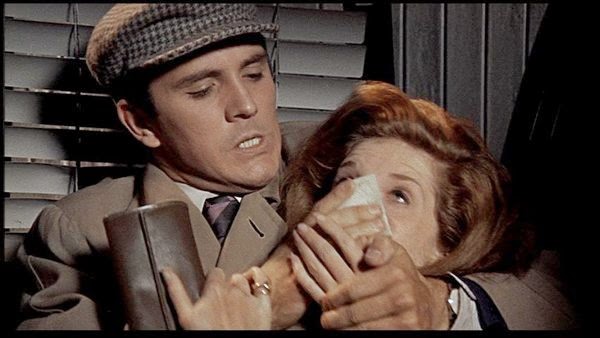
When I put together the post on Best Picture for 1965, I said that the one film I thought might eventually make the list for me as something I’d nominate was The Collector. Having seen it now, I wish I’d waited on Best Picture for that year, because this would absolutely make my list of top movies for that year, particularly in a year as weak on nominations as 1965. I’m not sure I’d pick it over The Battle of Algiers or The Shop on Main Street, but it may well be the best English language film of its year. I suspected that I’d like it. What I didn’t expect was a film this emotionally upsetting and, frankly, good. Why do films like this get lost in history? This is a film that (no joke) should be spoken of in the same sentence as Psycho and Peeping Tom.

As with plenty of thrillers, the high concept here is devilishly simple. A timid, socially awkward butterfly collector named Freddie Clegg (an almost disturbingly youthful Terence Stamp) wins a great deal of money in a football (soccer for those of us on the left of the Atlantic) pool. This allows him to leave his dead end job as a bank clerk and buy an old country house. Once there, he fixes up a basement apartment and, with the chloroform he uses to kill his butterflies, he kidnaps an art student named Miranda Grey (Samantha Eggar). She is someone he’s pined for from afar his whole life, and now, much like his butterflies, he has collected her.

Tuesday, January 6, 2015

What Does the Fox Say?

Film: The Little Foxes
Format: Video from The Magic Flashdrive on laptop.

Before I started watching movies critically, I couldn’t call myself a Bette Davis fan. That was mostly from unfamiliarity rather than from any specific dislike. Watching the 1001 Movies list turned me into a Bette Davis fan to the point when I see that she’s in something, I tend to look at that film with a certain level of anticipation. I’ve had a copy of The Little Foxes sitting on my hard drive for a couple of years but have finally gotten around to it tonight. Bette Davis does not disappoint.

The Little Foxes is a film that, at least for 1941, pulls no punches in its brutality, and a large portion of this comes directly from Bette Davis herself. Davis could play a sympathetic character when the role called for it, but she was always better as a the height of manipulative evil. In The Little Foxes, she’s joined by other characters just as nasty and conniving as she is, all of these characters coming from the same wealthy, vile family.

Tuesday, September 30, 2014

Quaker State

Film: Friendly Persuasion
Format: DVD from Rockford Public Library on laptop.

What is it with Gary Cooper and Quakers? In High Noon he marries a Quaker and in Friendly Persuasion, he is a Quaker. The most interesting thing about the Quakers isn’t that they eschew music and dancing, but that they are total pacifists. So, naturally in films that involve them as major characters, the entire point is to put them in situations where violence becomes an option and possibly a necessity. That’s certainly the case with Friendly Persuasion.

Jess Birdwell (Cooper) is a Quaker farmer who happens to be married to the local Quaker preacher, Eliza (Dorothy McGuire, who looks rather remarkably like Michelle Pfeiffer). Eliza, as the preacher, is more than a little dedicated to the Quaker ways. Jess, however, is not. There are also temptations aplenty for their three children: Josh (Anthony Perkins), Mattie (Phyllis Love), and Little Jess (Richard Eyer). The film starts as a light-hearted comedy as these four, particularly Jess, strain the limits of Eliza’s good nature by rebelling in minor ways against her Quaker preaching.

Tuesday, August 19, 2014

Return to Sender

Film: The Letter (1940)
Format: TCM Watch on laptop.

It’s interesting to consider the 1940 version of The Letter a film noir even though it is a solid early example of the style. The reason it feels weird is that this is a remake of a film first made in 1929. I haven’t seen that version yet, so I don’t know how much it conforms. My guess is that it probably doesn’t much. This version, though, is very solidly a noir, having all of the main elements that the noir aficionado looks for. What makes it unusual is that in this case, the femme fatale isn’t the pursuit of the main character, but the main character herself.

The Letter has one of the better openings of a film I’ve seen in at least a year. We open on a quiet Malay night. The moon is high. Rubber drips from a tree into a waiting bucket. The plantation workers are preparing themselves for bed. A shot rings out. A man staggers out of a building onto a porch and stumbles. Leslie Crosbie (Bette Davis) follows him out, watches him fall, and empties the gun into the body on the ground. I couldn’t help but think I was in for a treat after the first minute or two.

Saturday, September 28, 2013

War Begins at Home

Film: Mrs. Miniver
Format: DVD from Rockford Public Library on laptop.

William Wyler, the director of Mrs. Miniver, grew to hate the film that won him a Best Picture Oscar. The reason is because William Wyler was a badass. In 1943, he went to London and worked on films, including documentaries about flight crews. He even flew missions with them and spent time inside a ball turret. The reason he came to disapprove of his most critically-acclaimed film is that he realized exactly how far from reality his film truly was. Seeing just how threadbare and deprived London had become due to the war and the Blitz, Mrs. Miniver simply didn’t go far enough.

Regardless of its detachment from the real horror of wartime England and rationing, Churchill loved Mrs. Miniver and said it was propaganda worth 100 ships. As it happens, I’m reading a book called Citizens of London about Americans in London during the Blitz and after. A day or two ago, I reached the section about Hollywood in London, which is more or less what inspired me to watch Mrs. Miniver now. Having read the first dozen chapters or so and seeing the incredible privation that London and England actually experienced, it’s difficult to rationalize the nice clothing and perfect hair and full refrigerator with what actually happened. Then again, that’s about the only thing with which I have a problem here.

Monday, August 19, 2013

Watching Oscar: Detective Story

Film: Detective Story
Format: DVD from Northern Illinois University Founders Memorial Library on laptop.

I love film noir, as any regular reader of this blog will know by now. While the endings are often harsh, they also tend to be the endings that the characters deserve (thanks in large part to the Hays Code). There’s a sense of justice that comes with film noir that doesn’t happen in a lot of other film styles. With Detective Story, the status as a film noir is far less obvious and something I only really realized after the fact. That’s not because it’s a bad noir, but because the focus of the film is not the typical.

Virtually the entire film takes place inside the station of New York police precinct 21. During the course of the film, we spend a little time with some of the cops and see a series of criminals and others come and go. There are those caught stealing, those who admit to stealing, and those who do what they can to avoid confessing to anything. We get petty crime and major crime. But most of what we see is the most tragic day in the life of detective James McLeod (Kirk Douglas), who goes from being a respected officer to a man completely broken by his own tragic flaws.

Sunday, October 14, 2012

Pimpin' Victorian Style

Film: Wuthering Heights
Format: DVD from Chip Lary’s personal collection on kick-ass portable DVD player.

As a member of the community of 1001 Movies bloggers, it’s nice to reach out and help every now and then. Chip Lary over at Tips from Chip generally goes above and beyond in this department, sending me a few films with the promise of more. Yes, I’m sending some back to him. Not a bad deal for the price of postage. Anyway, one of the films he sent along was the difficult-to-locate 1939 version of Wuthering Heights, which also happened to be the only film left in the 1930s for me.

The film is, of course, based on Emily Bronte’s book of the same name. There’s plenty of sighing, requited but unfulfilled love, and the consistent razoring of the thin line between love and hate. The film is bookended by the arrival of a man to the desolate house of Wuthering Heights where he meets the angry and impolite Heathcliff (Laurence Olivier). The newcomer then sees an apparition out on the moors and Heathcliff runs out after it. Not knowing what to think, we’re given the full story of Heathcliff and Cathy (Merle Oberon), his long-dead love.

Thursday, June 28, 2012

Devil with the Red Dress On

Film: Jezebel
Format: VHS from Northern Illinois University Founders Memorial Library on big ol’ television.

I understand the creation of characters like Miss Julie in Jezebel. This is a character that pops up frequently in movies. She’s in older films like Gone with the Wind or I Know Where I’m Going! and she’s not too different in many respects from the “manic pixie dream girl” so common in indie films of today. So I get the character, and I get why she exists. What I don’t get is why I’m ever supposed to root for her.

Miss Julie (Bette Davis) is a Southern belle, which means that in all situations, it is to her benefit to pretend to be weak and helpless so that men do things for her. She’s not much different in that respect, except that she frequently wants these men to do things that go against either the traditional code of conduct or the moral codes of the time. She’s manipulative and is so because she can be. Put bluntly, she’s the type of woman defined as “headstrong” by those with social graces, as a bitch by people without, and for people with nothing to lose as a word that begins with “c,” rhymes with “runt,” and doesn’t belong on this blog.

Wednesday, April 25, 2012

Plain Jane

Film: The Heiress
Format: DVD from Rockford Public Library on kick-ass portable DVD player.

I work with a guy named Ron who has a thing for Olivia de Havilland. We’ve discussed this back and forth with him pushing de Havilland and me stumping for Barbara Stanwyck. While I won’t ever give over to Ron on this, he’s got me in the fact that Olivia de Havilland won a pair of Oscars and Stanwyck, for all her nominations, got skunked. One of those Oscars came from her role in The Heiress.

This is a strangely dark and angry little romance of both manners and ill manners. Young Catherine Sloper (de Havilland) lives a quiet and solitary life with her father, Dr. Austin Sloper (Ralph Richardson) and her aunt, Lavinia Penniman (Miriam Hopkins). She is a plain girl, shy and retiring, and spends her time doting on her father and tending to her embroidery. Her father compares her unfavorably to her late mother, who was vibrant and lovely. Her aunt, though, sees the good in her and wants nothing more than for her to be happy.

Enter Morris Townsend (Montgomery Clift), who immediately takes a liking to the girl and begins to pursue her romantically. At least that’s what he claims. Her father seems to disagree, though, thinking that Morris is after her for her inheritance. She’s inherited a tidy sum from her late mother, and stands to inherit twice that amount more when her father dies. Morris, we soon discover, is fairly dissolute. He spent his own fortune roaming around Europe, buying himself the finest clothing, and essentially ignoring his widowed sister and her five children. With that as his history, Dr. Sloper smells a bit of a rat.

The awkward Catherine refuses to see this and is convinced that he loves her for her and not for her money. Morris comes to plead his case, and does so unsuccessfully. He creates a plot to elope with Catherine in two nights, but she convinces him that they should elope that very evening. Running off to a small church and marrying, and damn the inheritance, since her father has threatened to rewrite his will should she marry Morris.

In a stunning turn of unexpected assholery, though, Morris doesn’t show up. Instead, he borrows money for passage and goes to California, completely avoiding the situation and abandoning Catherine to spinsterhood. Eventually, Dr. Sloper dies, and while he threatens to cut off Catherine’s inheritance, he does not, leaving her a very wealthy woman.

Of course, Morris returns. The remaining 15 minutes or so of the film, though are too good to spoil, so I won’t. Suffice to say that the ending is extremely satisfying.

There’s a lot of this film that really works, and a lot of what works is de Havilland. She was, as most of the classic Hollywood legends were, a stunningly attractive woman. Here, she is made plain and average. She’s not unattractive; she’s just very, very ordinary. She also tones down her vibrant personality in exchange for one that is painfully shy and drab. It’s a transformation similar to that of Charlize Theron in a film like Monster, or her own transformation in The Snake Pit.

I also like the performance of Ralph Richardson here. He’s generally an actor I enjoy watching, and in this film, he has a tendency to steal most of the scenes he is in. He plays the doctor with a combination of supreme knowledge and decided malice. One of the most effective scenes here is when he confronts Catherine about the real motives of Morris, telling her that she has no real good qualities save that her embroidery is consistently good. It’s a magnificent moment for both actors—he, acting as a doctor performing what he sees as lifesaving surgery without emotion, and she, realizing in that moment (as she tells Lavinia) that her own father dislikes her. His lack of emotion and her flood of realization at this cruelty are both palpable.

I should mention Montgomery Clift here. He’s certainly a capable actor, as his career attests, but I don’t love him here. Most of what draws me away from him is his accent. There is a touch of England in most of the characters in the film, while Clift comes across as a bit of a hick, like the lone American in a British drawing room drama. There’s something off-putting about the way he speaks throughout the film. Couple this with the fact that not a single person uses a single contraction, and there are times when the proceedings feel a bit too stiff and formal, or as formal as they can be when one person can’t seem to get the hang sounding like everyone else.

Regardless of that, The Heiress is a masterful film, precise and measured, and served with exactly the right combination of emotional reactions at exactly the right time. I have a feeling that this is a film that I will revisit again in the future, and I look forward to doing so. As much as I hate to say it, Ron might be onto something here.

Why to watch The Heiress: Olivia de Havilland at her very best, and an ending that is surprising.
Why not to watch: Montgomery Clift’s accent.

Saturday, April 14, 2012

Mo' Money, Mo' Problems

Film: Dodsworth
Format: Internet video on laptop.

It occurs to me that in poor economic times, movies often reflect both the economic realities of the day as well as the fantasy. It seems that when I think of movies made during the Great Depression, for instance, most of them seem to feature the uber-wealthy. It’s almost as if these films offered a sort of money porn for the downtrodden. It also seems often as if the problems that occur in this films are the sort that plague only the wealthy and not the rank and file rest of us. And then, suddenly and out of nowhere for me in this collection of films about rich people being rich, comes a film like Dodsworth.

Our hero, Sam Dodsworth (Walter Huston) is the owner of a large automobile company, and as the film starts, he has sold it off to another company, effectively retiring. He’s decided, as many wealthy retirees might, to take this opportunity to travel to Europe with his wife Fran (Ruth Chatterton) for a sort of second honeymoon. But the ship over presents us with a few hitches in the Dodsworths’ plans. Fran, it soon becomes evident, is younger than her husband, and is desperately afraid of being old before her time. We get inklings of this in her encounters with Captain Clyde Lockert (David Niven), who romances Mrs. Dodsworth rather unsuccessfully, and forces the couple to France instead of England thanks to her potential embarrassment.

And things don’t change in Paris. Here, she encounters Arnold Iselin (Paul Lukas), a wealthy financier, who picks up where Lockert left off. This time, Fran is swept off her feet and she decides that she likes it in Paris, in no small part because of the presence of Iselin. Sam decides that he’s had enough, and returns home while his wife is left in the company of the man trying to steal her away. Once home, Sam becomes lost in his life without his wife around and confused by her lack of communication with him. Her returns to Europe to confront her and essentially offers her the chance to save their marriage by leaving with him for another part of Europe immediately. Again, she goes with him. The mood changes when he reveals that their recently-married daughter is pregnant, and Fran is overwhelmed with excitement until that moment when he says the word she dreads—grandparent.

The night of the child’s birth, when Sam and Fran are in Vienna, she forces him to hide the news from Baron Kurt von Obersdorf (Gregory Gaye) and Sam complies. He also spends the night in, allowing the baron to escort his wife out for the evening. Three is a charm, of course, so when Kurt confesses his love for her, Fran decides that this time it’s the real deal. She tells Sam that she will divorce him and marry the baron, living on in Europe as a part of the minor nobility and setting Sam spiritually adrift once again.

And so he travels, but never discovers precisely how he wants to live. In Italy he runs into Mrs. Edith Cortright (Mary Astor), a young divorcee living in Italy because it is cheap. He remembers her from his first crossing to Italy, and it’s evident that he is immediately smitten with her. Lacking direction and now on the verge of divorce, he moves into her house, deciding not to care what her neighbors think. Then Fran’s impending marriage to the baron falls through, leaving Sam with a quandary. Does he return to the life he had and the wife he loves despite her evident penchant for infidelity? Or does he remain with the woman who has discovered a better way to live, a woman truly alive and in the moment rather than simply running after her own faded youth?

Dodsworth is a film that could have quickly become melodramatic and maudlin, but it resists this temptation throughout. It does so in the best way possible—by presenting real characters with real emotions and who truly experience the passions and joys and problems expressed in the film. Sam Dodsworth may well be a wealthy industrialist at the start of the film, and there’s no loss of opulence as he travels around Europe or strides through his home library, which is roughly the size of my entire house. Regardless of this, he is at heart a real and simple man attempting to discover a meaning for his existence in his world post-career. Sam is not pathetic by any stretch of the imagination. In fact, he’s decent and caring. But he’s also vulnerable and fallible as a person, and easily wounded.

This more than anything is what surprised me about this film. Rather than fall victim to the standard Hollywood tropes, Dodsworth attempts to depict real people going through real emotional struggles, dealing with the pain and frustration of the couple growing apart and their marriage splintering as they realize that they both need and want different things from life, and that each one is incapable of giving the other what he or she needs. It’s poignant and painful, and very, very human.

I can’t say that I’m gobsmacked by this film, but five minutes in, I thought I was in for the standard “It’s good by old Hollywood standards” trope fest. By 15 minutes, I was hooked and buying into it completely. It’s as good and as true as story as you’ll find in any film, and it plays straight with the viewer as well as its characters. A higher compliment, I cannot give.

Why to watch Dodsworth: A story that aims for painful reality rather than Hollywood feel-good.
Why not to watch: Sometimes it seems like old Hollywood thought that only the wealthy could manage to have non-monetary problems.

Monday, December 5, 2011

Post-Traumatic Stress

Film: The Best Years of Our Lives
Format: DVD from Rockford Public Library on kick-ass portable DVD player.

I talk about Old Hollywood a lot on this blog, in part because I know that I have a couple of occasional readers who are either devoted fans or who hate it passionately. I understand both sides. I have an appreciation for films of the ‘30s and ‘40s, but I understand precisely why some folks don’t like them. I feel it’s a duty to suggest when a film fits into that stereotype and should be avoided by the haters or when it transcends them and should be seen by everybody.

The Best Years of Our Lives is very much a film that transcends the stereotype of overacting, schmaltz, and pure escapism. This is a film that would have been very much at home following virtually any war. I could see this film being made about returning Vietnam veterans, or Gulf War veterans, or vets of Afghanistan. In short, while the details of this film have aged in many ways, the themes have not, and the story is still as fresh and real and vital as it was in 1946 in the days following World War II.

We follow the fates of three men. Fred Derry (Dana Andrews) was a bombardier in Europe. In the days before his deployment, he met and married Marie (Virginia Mayo). Now home, he has a wife he barely knows and no career. The only thing he’s capable of doing is working at his old job in a drugstore, spending part of his time behind the soda counter making floats and sundaes. His marriage never really got going and is now a shambles, in part because Marie was more in love with the uniform than with him, and in part because she isn’t content to stay home every night.

Al Stephenson (Fredric March) is the flipside of Fred. While Fred went from being poor in the real world to being a captain in the Air Force, Al went from a job as a loan officer in a bank to a mere Army sergeant (no disrespect meant to the sergeants of the world—this is strictly a rank issue. Sergeants, after all, make the military go ‘round). Now back with his wife Millie (Myrna Loy), daughter Peggy (Teresa Wright), and son Rob (Michael Hall), Al is attempting to fit back in to his civilian life. He does this with the liberal use of alcohol, much to Millie’s silent suffering.

Finally, we have Homer Parrish (Harold Russell), a Navy man who had both of his arms blown off. He’s left with two hooks for hands, and can do almost anything with them, except, as one of our other main characters notes, hold his girl, Wilma (Cathy O’Donnell). Homer’s story is in many ways the most tragic. For him, the loss of his hands means a loss of self-reliance. He wants only to be taken as the man he was, and sees any act of charity or assistance as pity, and he won’t have that. Moreover, he is unwilling to condemn Wilma to a life of looking after him because of his injuries.

What’s noteworthy about this film is that it doesn’t put a rosy spin on everything. Al’s drunkenness, for instance, is never really played for a laugh, but as a symptom of what he saw and experienced in the war. Called upon to give a speech at a gathering, Al continues to drink and Millie grimly ticks off the number of drinks he consumes. It’s tragic. Fred’s relationship with his wife turns sour the moment his back pay from the military runs out, and it never magically gets better because he deserves it or because that’s the way Hollywood movies work out. Their relationship enters a death spiral almost immediately and continues to circle until close to the end of the film. As for Homer, his anger and frustration are perhaps the most easily understood, but even here, we aren’t given a true Hollywood story. In the most poignant moment of the film, he brings Wilma into his bedroom and shows her the reality of his life without hands. It’s stark and painful and very, very real.

And this is precisely why this film is so good. It was created in a time when Hollywood directors and producers and studios sugar coated everything, a time when melodrama was king. But not here. These stories are real and visceral and human, which makes them compelling and worth watching. No one is spared the tragedy of these men returning from hell, least of all the audience.

It’s worth noting that Harold Russell really did lose both of his hands. He made only five movies in his lifetime, and this was his first. That he is less adept on screen than his costars is understandable. That he won a Best Supporting Actor Oscar for this role is equally understandable. While he is certainly not the greatest actor on this screen, he adds a real human touch to the film, and the presence of those twin hooks is so shocking and startling at first, the we almost ignore the man. By the end of the film, though, Homer Parrish the character is far more than the two metal hooks he wears, and that is a testament to any actor, as well as to a brilliant screenwriter.

This is a tremendous film, one of the great films of its decade and one of the great films of American film history. Just off years of making propaganda, pro-war films that boosted the morale of the home front, Hollywood managed to create one of the most powerful and moving post-war films ever conceived. The Deer Hunter works in much the same vein, but not with the same effect. The Best Years of Our Lives gives us no flashy situations, no violence or loss of life. What it does give us, though, is the sort of quiet human tragedy that any war creates. It is brilliant and sad and uplifting all at the same time, a true work of cinematic art.

As a final note, it’s been years since I saw this. The first time I did see it, I was a little kid. My father rented the film—on reels, no less—from the public library, and screened it on a fold-up movie screen in the living room. It was no less powerful now, 30+ years later.

Why to watch The Best Years of Our Lives: A film perfect for its own time, and continually relevant today.
Why not to watch: The title leads one to think it’s a film about happiness and fluffy bunnies…and it ain’t.

Sunday, September 25, 2011

Starting Point

Films: Roman Holiday
Format: DVD from Rockford Public Library on kick-ass portable DVD player.

All actors start somewhere. Those who end up having a career get lucky at some point and are in something that hits. Those who become legendary have the same luck, but prove that some of that luck was created by them in the first place. Audrey Hepburn is one of those legendary performers, and she started in Roman Holiday. I consider myself a fan of Audrey Hepburn, so I was very interested in seeing this, her first major role, and the film that earned her an Oscar.

The story is a pretty simple one. Princess Ann (Hepburn), who is from an unspecified European country, is currently on a tour around Europe to boost trade and good will. However, she is bored by the tasks put in front of her and intensely frustrated. Upset, she’s given a sedative, but when she is left on her own, she runs off into the streets of Rome where she is picked up by Joe Bradley (Gregory Peck), a reporter working for a news service in Rome. Joe doesn’t recognize her at first, and believes her to be drunk because of the sedative. He takes her back to his place and puts her up for the night.

He discovers who she is in the morning and calls in his photographer friend Irving Radovich (Eddie Albert) to help him. He gets his editor to agree to a huge price for an exclusive story on the princess on what is essentially her first day off in her life. While she goes off on her own at first and gets a severe haircut (that looks better on her than her long hair, incidentally), Joe makes plans, then meets up with her again and takes her around the city while Irving hangs out incognito and snaps photos of their day. And as will surprise no one, the pair falls hard for each other by the end of the day, a scene made poignant when both realize that they live in very different worlds. All of this leads to the inevitable concluding scene.

Roman Holiday is in many ways the template for the typical romantic comedy. It has all of the earmarks of romantic comedies that are still being made today—an extremely privileged woman has everything she wants except for the one thing she really wants, and that comes from an unexpected place. The pair meets cute and has wacky adventures together—in this case involving a scooter ride through Rome and Ann trying her first cigarette—before they decide at the end that they really want to be together. While the career of princess is perhaps a bit less common these days, women in romantic comedies still tend to have these sorts of dream careers (book editor, museum curator, high-profile author, etc.). And the guy tends to be ultimately decent despite being a little dangerous or potentially deceitful at the start.

Most of the time, this formula doesn’t work for me. It doesn’t work because it’s so obviously lifestyle porn and romance porn for women that I can’t bring myself to do much but be repelled by it. Modern romantic comedies generally involve the guy acting in ways that would get a restraining order slapped on him in a heartbeat. But that doesn’t happen here. In fact, Joe and eventually Irving are downright noble in their actions throughout. Part of that may be the year in which this film was made, but part of that is the characters themselves.

There are some very cute scenes. At the Mouth of Truth, for instance. Tradition states that if a liar puts his or her hand in the mouth, it will bite the hand off. Joe places his hand in the mouth, gives a scream, and then pulls out his sleeve with his hand missing, only to reveal it tucked up his sleeve. According to legend, Audrey Hepburn didn’t know Peck was going to pull that stunt, and her scream reaction is a genuine one. Just as cute are the pratfalls taken by Irving when Joe is trying to clue him in on the identity of Princess Ann. These are sweet moments of real joy, because they come across as actual instead of overly “film-y” or forced.

What romantic comedies seem to have forgotten is that what’s important is not that the characters fall for each other eventually, or even that opposites attract, at least on film. What’s important is that we as the audience care for these people and want the same things they do. I dislike most characters in modern rom-coms because they are shallow, stupid, snotty, selfish, and other words that probably start with “s.” In a well-made romantic comedy like this one, I want the characters to end up happily because I like them and have grown to care for them. That’s the success of this film more than anything else.

And it doesn’t hurt that Audrey Hepburn is Audrey Hepburn. That covers a lot of faults. When the film has very few and only minor faults to begin with, the end result is something truly special. And it also doesn’t hurt that the ending is the right one. It may not be the one that everyone likes, but it’s still the right one.

Why to watch Roman Holiday: Because it’s the start of Audrey Hepburn’s career.
Why not to watch: The ending is the right one, but you might not like it.

Thursday, July 22, 2010

Christ Tangential

Film: Ben-Hur, Life of Brian
Format: DVD from DeKalb Public Library (Ben-Hur), DVD from personal collection (Brian), both on big ol’ television

If you’re going to tell a story, you may as well tell a big story, and if you can tie it in to an even bigger story, so much the better. The typical Bible epic focuses on the lives of the people in the Bible, either Old Testament or New. There are a few other films that attempt to do the whole “sword and sandals” thing without much of the sword, and without much of the Jesus. As a case in point, we have Ben-Hur and Life of Brian.

Ben-Hur, of course, takes this story and itself quite seriously. The winner of the highest percentage of Academy Awards in history (it won 11 out of the 12 handed out that year), it is perhaps more than any other film objectively great. It tells the story of a wealthy Jewish prince named Judah Ben-Hur (Charlton Heston) and his life, which runs tangentially to that of Jesus Christ. In fact, the film opens with the birth of Christ, despite the fact that Jesus is, at best, a tertiary character here, and the actor who portrayed him, Claude Heater in his only film role, never shows his face and is uncredited.

At the beginning of the story, we are introduced to Messala (Stephen Boyd), the new tribune for the Jerusalem garrison. It turns out that he grew up in the area and always dreamed of running this outpost. He is quickly greeted by his old childhood friend, Judah Ben-Hur. However, this reunion soon turns sour. Judah wishes for freedom for his people, and balks when Messala asks him to help him destroyed the Jewish rebellion. This causes no end of trouble between the two. When a loose roof tile slides off Judah’s house, hitting the new governor, Judah is accused of attempted assassination and handed over to the slave galleys while his mother and sister are imprisoned, eventually becoming lepers. We get in the scene of Judah’s sentence, the essence of Messala, who tells Judah that he is condemning him simply because people knew they were friends. If he’s that quick to pass sentence on a friend, the people will fear him.

On the march to his new ship home, Judah is refused water until a mysterious stranger (obviously Jesus, even from the back) helps him. Once on the ship, he survives by hating the Romans. In a crucial battle, he saves the life of the Roman commander, Quintus Arrius (Jack Hawkins), who eventually befriends him and adopts him as a son and Roman citizen.

However, Judah wants revenge on Messala and journies back to Jerusalem. Along the way, he encounters one of the original three wise men, Balthazar (Finaly Currie) and an Arab sheik named Ilderim (Hugh Griffith). Judah agrees to race Ilderim’s chariot in the grand arena against Messala.

This is the real culmination of the film for me. The chariot race is truly something special, and despite the fact that this movie is a good 50 years old, this scene still holds up as one of the greatest ever filmed. The action is intense, particularly between Messala and Judah. Judah, of course, wins the race, and Messala is badly wounded when his chariot wheel flies off and he is trampled under the feet of another team. He dies of these wounds, but not before telling Judah of the fate of his mother and sister, now plagued with leprosy.

After this, the movie becomes quite a bit more moralistic, and dovetails back with the story of Christ. For my money, the film could have ended shortly after the chariot race, but what do I know?

Life of Brian is the second film from the Monty Python team, a comedy group I almost literally grew up with. I’m a huge Python fan—I had a dog named Monty Python, and another named Basil Fawlty. Again, this movie runs parallel to the life of Christ, and is the tale of Brian (Graham Chapman), the baby born in the manger next to Jesus. Brian’s life parallels that of Christ in many ways, including his becoming a prophet and martyrdom on the cross.

The film, which should come as no surprise from anyone even vaguely familiar with the Python team, is a long gag. Brian finds himself in a variety of dangerous situations, all caused by drastic misunderstandings of the people around him. His mother (Terry Jones, also the director and team member) is constantly annoyed with him, and tells him that his father is a Roman named Naughtius Maximus, who raped her, at least at first.

Brian falls for Judith (Sue Jones-Davies), who is a member of the People’s Front of Judea, a radical organization that wishes to overthrow Roman rule, provided they can get anything out of committee. Asked to write “Romans go home” on the palace wall, Brian is caught, given a grammar lecture by a guard (John Cleese), and forced to paint the phrase on the wall 100 times. This, of course, gets him pursued further, causes him to get a ride on a spaceship, be captured, imprisoned by Pontius Pilate (Michael Palin), who has a terrible speech impediment, escape, become a reluctant prophet and messiah, be recaptured, and eventually crucified.

The entire Python team—Chapman, Cleese, Palin, Jones, Eric Idle, and Terry Gilliam (a hell of a director in his own right)—play numerous roles throughout the film, while Python regular Carol Cleveland has just a few bit roles.

There are things missing from this film in a big way. I love Gilliam’s weird little animation sequences, and except for the titles and the completely gratuitous alien spaceship sequence, there is no animation here. Additionally, there is almost too much story here for the Pythons. The Quest for the Holy Grail has a semblance of a story, but it also goes off the rails time and time again, which is where most of the fun comes from. Brian does not—it sticks to its main theme, with the comedy coming from the characters rather than the incomplete sketches and bizarre segues from one thing to the next.

Sadly, I think Brian is the least of the Python films. It’s gutsy and ballsy (coming allegedly from an offhand comment from Eric Idle. When asked what the team’s next film would be, he answered, “Jesus Christ: Lust for Glory”) and ambitious. It’s these qualities that put it on this list, and also make it far less funny than the other Python films. They push it pretty hard. There’s a lot of language and gratuitous male and female frontal nudity, not to mention the mocking of religion, belief, Christianity, Judaism, and just about everything else.

Recently, an American named Kim “Howard” Johnson, who was a Python fan and flew himself to Tunisia to work on the film, published his notes and diary from his time working on the film. It’s a gushing, sometimes fawning account of his five weeks with the team, but it’s also worth a read for any Python fan. I enjoyed the book and I enjoy the movie, but it’s almost never the Python I choose to watch.

Why to watch Ben-Hur: A real epic of the original mode and, of course, the chariot race.
Why not to watch: After the chariots, it turns maudlin.

Why to watch Life of Brian: It’s a Monty Python film.
Why not to watch: Every other Monty Python film is better.