Showing posts with label Rob Reiner. Show all posts

Thursday, December 18, 2014

Number One Fan

Film: Misery
Format: DVD from Rockford Public Library on laptop.

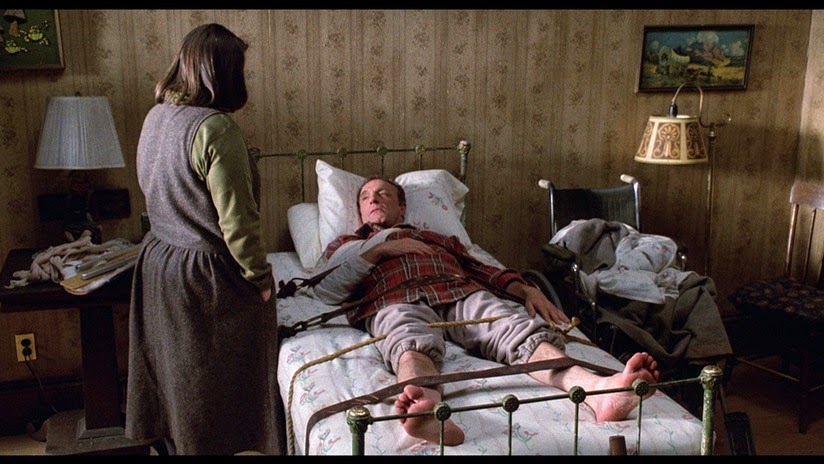
Watch enough movies, and eventually you’ll see some stuff that you just don’t want to see again. Usually, that means a film that I don’t want to watch again regardless of what I thought of it. I don’t plan on watching Salo a second time, for instance, because there are things I don’t want to sit through again and because I think it’s an affront. A film like Idi i Smotri, though, I think is one of the great films of its year but I don’t think I have the emotional capacity to see it a second time. Misery is unique in this respect. I love this film, but there is a single scene I have never been able to watch a second time. If you’ve seen Misery, you know the precise scene I am talking about.

Aside from that one scene, Misery is most notable for being the film that made the nation aware that Kathy Bates existed, and we have to give the movie its props for that. Before this, who knew who she was? After this, who didn’t? Bates’s performance as Annie Wilkes is one of the all-time great out-of-nowhere performances in film history. Bates may have been around before this film, but once she was seen here, she was everywhere.

Saturday, August 30, 2014

I Can Handle the Truth

Film: A Few Good Men
Format: DVD from Rockford Public Library on laptop.

Once upon a time, Rob Reiner was one of the best directors working. A Few Good Men comes right at the end of that period in his career—right before he directed the colossal stinkbomb North, as a matter of fact. A Few Good Men has a lot going for it. In addition to a top-of-the-line cast, including Jack Nicholson in one of his best and most iconic roles, it also has a screenplay from Aaron Sorkin at his best. This is a smart film. It’s one I’ve seen multiple times before, and settling into it today was like putting on a pair of comfortable slippers. I always remember that I like this film. I don’t always remember how beautifully written it is.

At the military base in Guantanamo Bay, two soldiers unexpectedly attack another soldier. Cut to Washington D.C. where Lieutenant JoAnne Galloway (Demi Moore) brings the incident to the attention of her superiors. The soldier who was attacked died in the attack. While it seems like a cut and dried case, it is her opinion that it sounds like a “code red,” an unofficial disciplinary action. She advocates for the case to come to trial and a lawyer be assigned to the two soldiers, Harold Dawson (Wolfgang Bodison) and Louden Downey (James Marshall).

Sunday, June 9, 2013

Inconceivable!

Film: The Princess Bride
Format: LogoTV on rockin’ flatscreen.

When I started this project, I knew that eventually I would get to my 1,000th review. For this sort of a milestone, I wanted something special, something I knew I loved. In that sense, I’ve been saving The Princess Bride since I started for just this moment. It’s not in my top-5 or top-10 of greatest films, but it’s at or near the top in terms of movies that make me happy, that make me appreciate the fact that movies exist. I can’t watch it without smiling the whole time.

For the three people who haven’t seen this, here’s a quick synopsis: the entire story is framed by a grandfather (Peter Falk) reading a story to his sick grandson (Fred Savage). At first, the grandson is not interested at all, but as the story goes on, he becomes more and more involved in the story. This framing story intrudes now and then, but never in a way that damages the story itself.

Monday, August 13, 2012

The King of All Rom-Coms

Film: When Harry Met Sally
Format: VHS from personal collection on big ol’ television.

There was a moment in American film when Meg Ryan became America’s sweetheart and the go-to girl for romantic comedies. It happened at some point in the middle of When Harry Met Sally, which was a star-making turn for a whole bunch of people. It was certainly Meg Ryan’s coming out party, reinforced Billy Crystal’s stature in general, cemented Rob Reiner as one of the better directors of the age, and gave us great supporting roles for Bruno Kirby and Carrie Fisher.

Harry Burns (Crystal) and Sally Albright (Ryan) meet when they drive from Chicago to New York together after college. There’s no attraction between them and they’re both fine with this. Harry is of the opinion that men and women can’t be friends because there’s always the question of sex cropping up between them. When they get to New York, they part, thinking that this part of their life is over.

Saturday, March 3, 2012

Growing Up

Films: Stand By Me; Hoop Dreams
Format: DVD from personal collection on kick-ass portable DVD player (Stand By Me); Streaming video from NetFlix on rockin’ flatscreen (Hoop Dreams).

I have long been of the opinion that coming-of-age movies come in two varieties. For girls, coming of age is all about sex and coming to terms with their role as those who can bring life into the world. It’s not so much about motherhood and more about the responsibility of what sex can and does represent. For boys, coming of age is all about encountering death and coming to grips with the idea of mortality, the knowledge that life is transitory. For boys, perhaps no film both embodies and breaks this cycle like Stand By Me.

The film follows four boys on the verge of junior high in what will ultimately be the weekend that turns them from boys into men. Each of the boys is different, and each one is dealing with something specific in his life. Gordie (Wil Wheaton) is in many ways the stand-out of the group, and it is he who narrates the story (with Richard Dreyfuss in the role as narrator), telling it from his memory. Gordie is bright and comes from a good family, but it is a family touched by tragedy. Four months earlier, his older brother Denny (John Cusack) was killed in a car accident, and since that time, Gordie feels like he has become invisible, and that both of his parents feel like they’d have rather lost him than his brother. It is Gordie who tells us the story, and so the events very much come from his perspective.

Gordie’s best friend in the world is Chris (River Phoenix), a kid from a bad family and someone who seems predestined to turn out bad. He’s a tough kid with a father who drinks and with an older brother with the nickname Eyeball (Bradley Gregg), who is constantly in trouble. Chris has already started to fit himself into the mold of bad kid, having been suspended from stealing lunch money at school. Also in the crew are Vern (Jerry O’Connell), the “fat” kid who is also naïve and a little thick. His brother Billy (Casey Siemaszko) is another rotten kid who hangs out with Eyeball. Rounding out the crew is Teddy (Corey Feldman), who is a little unhinged, filled with anger, and is saddled with a father currently in a mental institution.

The plot centers around Ray Brower (Kent Luttrell), a kid who has gone missing. One day, Vern overhears his brother and another member of his gang discussing the missing kid. Billy and his friend stole a car and went joyriding, and found the body of Ray Brower about 20 miles away from town, evidently hit by a passing train. Vern tells his friends and they decide that they will go find the body and report it, becoming heroes. To do this, they’ll have to walk the whole way and camp out, but they figure it’s worth it.

And that’s really the movie. The boys walk through the woods, encounter a junkman and his “vicious” dog, a train, leeches, and more. And along the way, Gordie and Chris discover quite a bit about themselves. Chris deals with the fact that he’s too smart to be a bad kid but no one believes in him and Gordie deals with the fact that he feels like his parents don’t love him.

Stand By Me trades on significant scenes that don’t specifically move the plot forward but instead give us additional insight into the characters of the four boys. We also deal with Ace Merrill (Kiefer Sutherland), the leader of the gang of older boys who terrorize Gordie and his friends. This is not pleasant terrorization—there is a real sense that Ace is not merely a criminal in training but a fully realized sociopath barely able to keep his sinister urges in check. All of this culminates in a showdown at the body of Ray Brower in which the younger boys (particularly Chris and Gordie) are forced to make a decision that will affect them and their friendship from that point forward.

This is a marvelous film, one that it had been too long since I’d seen. I had forgotten just how good it really is, and how good the four boys are in their roles. They are good enough that I can’t think of other people in the parts. Cory Feldman, so often relegated to ridiculous sequels and embarrassing roles showed here that could, once upon a time, pull off a real role. River Phoenix brings surprising maturity to the role of Chris, yet it’s a believable maturity, one that seems natural. Wil Wheaton has a sort of emotional and moral center that makes him bigger than his slight frame. And Jerry O’Connell is so natural that it seems like he’s not acting, but simply living the script.

Stand By Me is a piece of magic, a captured moment between childhood innocence and adult experience. It is as good a film about growing up as exists.

Hoop Dreams is a much different story about growing up, different in no small part because it is the real thing. The film follows the real lives of two Chicago high school athletes named Arthur Agee and William Gates. Both are inner city kids living in terrible conditions, but both kids have real ability on the basketball court. When the film opens, the boys are on the cusp of high school. As often happens in Chicago, the boys are recruited by area high schools, and both end up at St. Joseph.

What follows is their journey through four years of high school and the various troubles and problems they encounter as well as their triumphs. The goal of both boys, naturally, is to play in the NBA at a time (during the filming) when basketball was king in Chicago. And immediately, the two stories are as different as they are similar. Both boys attend St. Joseph on a scholarship for basketball. It’s determined that both boys are entering at about a fifth grade academic level, for instance.

But in terms of talent, it’s a very different story. Arthur ends up on the freshman team, and continues to struggle in school, not really progressing. He’s similarly immature on the basketball court. William plays on the varsity team as a freshman, and improves tremendously as a basketball player and as a student, but improves only enough to keep himself on the basketball court in many ways. A tuition increase before their sophomore year means a change in their lives. William’s family is unable to pay, but he gets assistance from a family near the school, allowing him to continue. Arthur, though, is removed from the school, which sets him back a half year, and he returns to the public school system.

And life goes on. Arthur’s homelife is turned upside down when his father leaves, and then returns a year later after spending seven months in prison. William’s father is not in his life, but he becomes a father himself. He also tears apart his knee, missing most of his junior year and reinjuring the knee in the last game of the season.

As the film continues, we the audience learn about the reality of life in the city, on the courts and in the schools. We learn, for instance, that many of the top high school players have their shoes and wardrobes essentially financed by drug pushers, who give the kids spending money. William learns at a Nike camp that college coaches aren’t as concerned with team play as they are with kids who can stand out.

Where Hoop Dreams succeeds is in making the lives of these kids real. It gives us a sense of the world they live in. Additionally, it shows us that the reality we all suspected all our lives is true. The kids who have the athletic talent are the ones who get special treatment. It becomes obvious at the start of sophomore year when the high school finds a way to keep William enrolled but cuts Arthur loose. The same thing happens at the Nike camp. The moment that William sustains a muscle injury, the interest in him fades. It reveals itself to be a meat market. The coaches essentially admit as much, realizing that these kids who throw themselves around the court are their meal ticket, and knowing that most of them will not make it to the pros.

It’s also evident that both of these kids have a lot of hopes and dreams riding on them as well as a lot of people who are looking to make a buck on them. It’s tragic in many ways. We see, for instance, William’s brother trying to live through him, and Arthur’s father pinning his hopes and dreams onto his son. It’s a deadly combination of expectation, pressure, and largesse from those around them. It’s a wonder any of them survive at all.

What Hoop Dreams shows us is that few of them do. The dream may survive in many kids, but for every one who makes it even to a major college program, let alone the NBA, there are hundreds who never make it past the playground and become just another person on the street. It’s noteworthy, though, that both of the young men in this film, at least as of a few years ago, have lived lives of service to their community and have dedicated themselves to providing opportunities for others.

Back in the days when I participated in sports, I was told that there would be character building and other tangible benefits of participation. Honestly, I didn’t learn anything, and I came from a high school that produced a few NFL players. Perhaps I wasn’t good enough and thus was not worth enough of the coaches’ time and effort for character building and lessons in determination. It seems, though, that William and Arthur were, and that they did learn something in spite of the crush of the meat market after all.

Why to watch Stand By Me: A bittersweet tale of childhood that sugarcoats nothing.
Why not to watch: It’s far more profane than you remember.

Why to watch Hoop Dreams: True human stories.
Why not to watch: You might not be prepared for scenes of actual knee surgery.

Wednesday, July 20, 2011

Tonight They're Gonna Rock You

Films: This is Spinal Tap; Anvil! The Story of Anvil
Format: Streaming video from NetFlix on laptop.

The deathbed utterance “Dying is easy; comedy is hard” has been attributed to at least half a dozen people. Regardless of who said it, there’s truth in that sentiment. I would add that in terms of comedy, the most difficult comedy to do well is parody. Parody runs a fine line. Go too far and it comes across as stupid; don’t go far enough, and it doesn’t come across as parody. Anyone interested in creating parody should take a very close look at Rob Reiner’s This is Spinal Tap. This film, chronicling the American tour of one of England’s loudest bands, is so pitch perfect in terms of being just this side of believability. A couple of minor tweaks, and Spinal Tap could be a real band at the end of their career.

The film is a self-styled “rockumentary” created by Marty DeBergi (Rob Reiner) who learns that British metal group Spinal Tap is heading to the U.S. for a tour to promote its latest album, Smell the Glove. So DeBergi heads out with the group to see what a tour and album release is like. The band consists (initially) of five members: David St. Hubbins (Michael McKean), Nigel Tufnel (Christopher Guest), Derek Smalls (Harry Shearer), Viv Savage (David Kaff), and Mick Shrimpton (R.J. Parnell).

It becomes pretty evident right away that Spinal Tap is, for lack of a better way to describe them, a terrible band. They’re quick to jump onto whatever looks to be the latest trend, starting as a skiffle group, toying with feel-good psychedelia, and ultimately ending as a leather and mildly evil-obsessed metal band cranking out tunes about sex and faux mysticism. As the tour progresses, the group suffers a series of setbacks with cancellations, an album that won’t be released thanks to its lurid and sexist cover, and eventually a road manager (Tony Hendra, sporting the awesome rock name Ian Faith) who’s simply had enough and walks away.

The band tries everything it can to promote itself and get fans excited, and true to form, everything ends disastrously. Stage props get stuck, trapping band members inside, the group gets lost behind the stage, and eventually, they create a Stonehenge monument as set dressing that looks more at home in a child’s diorama than on a stage. Things are further complicated by the arrival of David’s girlfriend Jeanine (June Chadwick), who is obviously despised by Nigel. As the tour winds down, the remaining members consider their options and decide that perhaps the best part of valor here is to simply walk away and pursue other things…but is there perhaps a glimmer of hope at fleeting fame in the distance? Now if they could get past the fact that their drummers seem to keep dying…

This is Spinal Tap works for any number of reasons, but it’s the members of the band, especially McKean, Guest, and Shearer, who really sell this film. The three of them play these parts so close to reality that it almost seems like they could be in earnest, but just off enough that they come across as ridiculous. It’s an almost flawless parody in that respect. The songs are masterpieces of bad songwriting and great comedy. It’s entirely possible that someone not in on the joke would accept Spinal Tap as a real band that just isn’t that good at songwriting.

The film is ably helped by a huge number of tremendous cameo appearances—Bruno Kirby, Ed Begley Jr., Fran Drescher (not annoying for once), Billy Crystal, Howard Hesseman, Fred Willard, Paul Shaffer, and even Angelica Huston all show up for a few minutes—all recognizable and all great in their tiny roles. They sell the film as much as anyone else.

I can’t say enough about this film. I loved it when it was shiny and new, and I love it now. I like the characters, who are played perfectly. I like the songs. Most of all, I like the situations that these poor guys are put into and have to deal with. As I said at the top of this post, This is Spinal Tap is parody at its best. There are scenes in this (Stonehenge, Nigel’s piano piece, Derek’s cucumber in his pants, the pod that doesn’t open, “Hello, Cleveland!”) and lines (“These go to 11,” “Lick My Love Pump”) that will continue to be referenced for years to come.

So if This is Spinal Tap is a near-perfect parody of a failed rock band that doesn’t quite make it, who does one react when the story of Spinal Tap becomes a reality without the parody and with a lot more pathos? Sit down to watch Anvil! The Story of Anvil, and that’s exactly what you’re going to get. Anvil was (and in many ways still is) the original beating heart of thrash metal, but unless you’ve seen this film, you probably haven’t heard of them. I’m not trying to go all hipster on you here; I’m stating the truth. Anvil is cited as an influence and/or an equal by such bands as Metallica and Anthrax, but the two guys who started the band and have been in it for 30 years now work jobs like delivering food for a catering service.

Our two heroes are Steve “Lips” Kudlow and Robb Reiner (the extra “b” keeps him differentiated from the director of Spinal Tap) who are the creative heart behind the band. Kudlow is the guitar player, singer, and front man while Reiner plays the drums. Also in the band are long-time Anvil fans bassist Glenn Five and guitarist Ivan Hurd. Kudlow works for a catering business, and the band—in some ways attempting to relive the glory days of the 80s when they were an up-and-coming sensation—still performs. In fact, Kudlow’s philosophy seems to reflect a sort of upbeat pessimism. He says, essentially, that things won’t get any worse than what they are, and if they do, he’s at least got what he’s got.

Things appear to turn around when he is contacted by a woman named Tiziana Arrigoni who wants Anvil to come to Europe for a five-week tour. Things go well at first, but quickly devolve into something entirely too reminiscent of Spinal Tap. Venues turn out to be tiny, crowds are sparse, advertising doesn’t happen, trains are missed. By the end of the tour, Anvil plays at a venue in Transylvania. The auditorium seats 10,000. Only 174 people show up.

The end result of this disastrous tour is that the band has made no money, and since they all took five weeks off from their jobs, they’re now behind. Bassist Glenn Five is essentially homeless, while guitarist Ivan Hurd is behind on his mortgage. Ultimately, two things of note happen on the tour. First, Hurd marries Arrigoni. Second, despite all of the problems, Kudlow remains positive and is grateful for the experience. Seriously, he’s the most upbeat guy ever.

Now, with everyone in dire financial straits, Kudlow has the brilliant idea of cutting the band’s thirteenth album with Chris Tsangarides. Producing the album will take thousands of dollars, which Kudlow tries to earn with a second job. Eventually, he gets the money loaned by his sister, and through a second mortgage on his house. So the album gets made, and no record company wants to touch it, another kick to the groin for the hardworking band. Nothing seems to work for them no matter how hard they try. At one point, just as Nigel leaves the band in Spinal Tap, Reiner walks away from the recording session of the new album, leaving his long time partner alone and attempting to keep the band working.

But this is still not the end of this short film. Another tour opportunity appears. After this many years, do they make one more attempt?

I’m not a metal fan, and I’ve never been one. I’ll never be one. But I love these guys. I genuinely like these guys, and this movie as absolutely heartbreaking. It’s funny, it’s sad, and it’s very very real. These two guys deserve a bite of the apple, and as a person watching this film, I want them to have it. This film, just as their music is to them, is a labor of love, a piece of true passion and dedication and faith and love.

It’s strange to me that what is so entertaining and funny in one film is so terribly tragic in the next. There’s a thin line between stupid and clever as the members of Spinal Tap say. There’s also a thin line between comedy and tragedy.

Why to watch This is Spinal Tap: Because few films are this funny.
Why not to watch: Because they’ve got armadillos in their trousers.

Why to watch Anvil! The Story of Anvil: There’s no joy like cheering for an underdog.
Why not to watch: Seeing someone’s dreams get crushed sucks.