Tuesday, March 27, 2012

Serendipity

Film: Magnolia
Format: DVD from NetFlix on big ol’ television.

I’d heard of Magnolia.

I’d heard of it, but I’m not sure I was entirely prepared for it. This film is overwhelming, and I mean that only positively, only as something that is true and not as something critical of what Paul Thomas Anderson created with this film. This film is relentless and unrelenting and doesn’t stop except for brief moments. And it’s three hours long.

I’m not going to attempt a plot summary here, because Magnolia is not about plot. It is instead about a series of characters whose lives all intertwine at a single point in time. It is about the power of coincidence and chance, the failure of people and their brutality to those who they love the most, abuse, and the failure of fathers to their children. As the movie spins around and around, jumping from character to character and story to story, it becomes gripping almost in spite of itself—these stories have no real obvious connection in general except in the ways that some of the characters are related. So rather than go point by point, it’s a better idea to give a sort of story through-line. Essentially, there are two twined stories here that meet at the end.

We have quiz show host Jimmy Gator (Philip Baker Hall), host of the longest running quiz show on television. The show pits three kids against three adults. Jimmy is dying of cancer that has metastasized into his bones. Jimmy’s daughter Claudia (Melora Walters) is a cocaine addict who may have possibly been molested by her father. In any event, she’s not on speaking terms with him, and won’t accept him into her apartment when he tries to tell her that he is dying.

Claudia’s apartment is investigated by Officer Jim Kurring (John C. Reilly). Kurring is a decent cop who doesn’t get a great deal of respect from other officers as we learn in an opening scene. Called to Claudia’s apartment on a call from neighbors, he decides that he likes her and would like to see her, not knowing about her drug issues (although it’s evident that he suspects).

Meanwhile, Donnie Smith (William H. Macy), a former champion on Jimmy Gator’s quiz show, is down on his luck. Fired from his job and destitute, he has put his entire being into the idea of getting braces in the hopes that it will help him land the male bartender with whom he is infatuated. But even here he is shot down and mocked by an effeminate barfly (Henry Gibson).

One of the current kid champions of the game show is Stanley (Jeremy Blackman), who is oppressed in many ways by his father (Michael Bowen). Now close to earning a small fortune on the show, Stanley is browbeaten by his father to keep performing because he needs the money. In the game that we see, Stanley, nervous and emotionally abused, pees himself right around the same time Jimmy Gator collapses on stage.

The other set of connected stories begins with former television producer Earl Partridge (Jason Robards), who is dying and bedridden. His wife Linda (Julianne Moore) steals his medication and has some of her own. She married the old man for his money, but has since decided that she truly loves him and wants to rewrite the will so that she gets nothing just to prove it.

The problem is that if she has the will declared invalid, everything goes to Earl’s son, Frank T.J. Mackey (Tom Cruise), a professional womanizer who has created a series of misogynist self-help guides and seminars teaching men how to essentially trick women into sex. Virtually disowned by his father and of no interest to the step-mother, Frank spends a good deal of the film being interviewed, lying about his past, and being called on his lies by a woman named Gwenovier (April Grace). Additionally, he is contacted by Earl’s live-in nurse Phil (Philip Seymour Hoffman) to be informed that the father he has essentially disowned is dying.

And all of this, assisted by a rain of frogs, comes together at the end.

It’s a lot to keep track of, and the film offers little or no warning when switching from one story to the next. As mentioned earlier, this film is relentless in showing us all of these characters at their most vulnerable moments. This culminates in an emotionally devastating scene of the characters, each in his or her turn, singing along with Aimee Mann’s “Wise Up.” Few scenes in movie history are this powerful or poignant, or as painful, or frankly as beautiful. If the rest of the film were terrible, it might be rescued by this scene.

What’s truly astounding here—more than these intertwined stories and the emotional intensity, that is—is the performances across the board. John C. Reilly, for instance, is an underrated dramatic actor, and proves it nowhere better than here. It’s also probably Tom Cruise’s best performance in his career, and that’s coming from someone who, in general, likes Tom Cruise as an actor. The same could be said of Julianne Moore, which is again, remarkable considering her career. There are also some great bit roles from actors I like quite a bit. Patton Oswalt shows up for a minute or so at the start, for instance. I also need to mention the great Ricky Jay, who plays the quiz show producer and the narrator who bookends the film. If you don’t know who Ricky Jay is, look him up on YouTube. He’s one of the greatest card trick magicians to ever walk on a stage. Don’t believe me? Watch this.

Magnolia is about those moments of vulnerability when we are at our weakest and our strongest. It is about all of us at our best and our worst, and how for many of us, those two things happen at the same time.

I’m overwhelmed. I’m also stunned that it was nominated for only three Oscars, lost all three, and wasn’t nominated for Best Picture. Stupid Academy.

Why to watch Magnolia: It’s holy-shit good.
Why not to watch: If you don’t pay attention the whole time, you’ll get lost.

Sunday, March 25, 2012

Comedy Set Pieces

Film: Mon Oncle (My Uncle); It’s a Gift
Format: Streaming video from Hulu+ on rockin’ flatscreen (Mon Oncle); DVD from NetFlix on big ol’ television (It’s a Gift).

I understand that there are many people who do not appreciate the particular comic style of Jacques Tati. I understand this even though I am not of that opinion. Tati’s work was groundbreaking in its own way, a unique blend of pantomime, timing, sight gags, and auditory humor. While most people in the States (and I imagine around the world with the possible exception of France) are unfamiliar with him, his influence is pretty wide-ranging. Rowan Atkinson’s Mr. Bean is a direct descendant, for instance (and for good or ill, depending on your point of view), as is much of what was done by Monty Python.

Mon Oncle (My Uncle) is the second of Tati’s films concerning the life and struggles of Monsieur Hulot (an uncredited Tati), a bumbling, but well-meaning man of no means existing in his own little world in the middle of Paris. Hulot is a makeup-less clown, a fool, and a man who never met a person, place or situation he couldn’t further destroy or screw up. In this film, Tati pits him against the perils of modern (at least for the late ‘50s) and mechanized living.

Hulot is, at least in terms of character, set against his sister (Adrienne Servantie) and her husband (Jean-Pierre Zola), the Arpels. They live in an ultra-modern house filled with every possible mechanized contraption imaginable. The house itself is virtually empty and is more of a show piece than an actual place to live. Their furniture, for instance, is completely modern—it’s sleek and attractive—but it’s also uncomfortable and virtually unusable. Every possible task has a push button—Madame Arpel, for instance, pushes a button to flip a steak on the stove, and must rush to another button to open the door when someone arrives. Their garden is similarly modern, set out in geometric shapes that contain either low hedges or identically colored patches of rock. The centerpiece is a fountain of dyed-blue water that spouts from the mouth of a fish. At least it spouts when someone arrives who Madame Arpel wishes to impress.

The Arpels have a son named Gerard (Alain Becourt), who is bored in his own house and truly comes alive only when Uncle Hulot is around. Gerard gets into minor trouble outside of the home, but inside, is incapable of expressing anything more than boredom because of the sterility of his environment and the consumer- and convenience-minded thinking of his parents. The plot, such as it is, concerns finding Hulot a job with his brother-in-law’s company and/or finding him a wife in the person of the Arpels’ next-door neighbor (Dominique Marie). And, as is the case with Tati’s character in all situations, insanity, madness, and chaos are the result of his very presence.

Mon Oncle strikes me as a natural follow-up to Monsieur Hulot’s Holiday. Tati is recognizable as the same character despite a slight change in outfit—while the pipe is still ever-present, he always wears a tan overcoat. Throughout the film, Hulot is blamed for things he did not do and gets away with many things that he did, suffering a sort of karmic justice for his bumbling errors in other places.

For all of its mania, Mon Oncle moves quite slowly. There really is not much of a plot here, and Hulot and the neighbor do not meet until well into the film. Indeed, while the film is unquestionably a comedy, there is little here that is laugh-out-loud funny. But that’s not really the intent of the film, or the intent of what Tati did. Instead, we are given a series of set pieces that indicate the absurdity of everything going on in the world of the film, and thus the world at large. Tati’s Hulot is a ridiculous character, a buffoon, but he is no more ridiculous than the rest of the characters on the screen with their dreams of a perfect modern life and pretentions of having and being more than they do and are.

So, because it is what it is, I understand when people tell me that they are turned off by Tati’s work or that they don’t find it funny. In many ways, it’s not intended to be that. It can be difficult to follow as well, since most of the dialogue is merely a murmur and what we see and the sound effects are far more important than the words being spoken. Tati worked with both sight gags and sound gags. The humor comes not from the situations per se, but from the implications of what is happening. Given a drink holder that is to be plunged into the ground, for instance, Hulot manages to stab the main water line of the fountain, and is thus relegated to keeping his foot on the new hole. When showing off her kitchen to her guests, Madame Arpel is forced to shout over the sounds of her machinery. Sure, there’s convenience and even a stark, modern beauty in the house. But at what cost? And that’s more or less the point.

It’s satire and subtle commentary on the world through an absurd lens. While individual scenes are not riotous or even memorable, what is is the overall production itself. Mon Oncle is much greater than the sum of its parts and scenes—it works to combine all of its elements into a greater picture and impression. In many ways, while we are smiling at the antics of Hulot and the Arpels, Jacques Tati is looking through the screen and laughing at us.

W.C. Fields was a very different comedian from Tati, in that his work was rarely silent. Additionally, he didn’t always cause the chaos around him, but suffered from other people creating that chaos. However, the results of his comedy are remarkably similar to that of Tati in many ways. While the two approached the nature of comedy from very different directions, their films work almost exactly the same way.

It’s a Gift, generally considered a high point in Fields’s career, is remarkably similar in tone to Tati’s work in that there is sort of a through line of a plot, but the plot is really secondary to everything else that is going on. This film, like many others in his career, is merely an excuse for Fields to do his routine in front of a movie audience rather than on stage. The point is not to see what happens by the end of the film, but to see what happens to Fields moment by moment and how he reacts to it.

As with many comedies, the story is ridiculously simple. Harold Bissonette (Fields) runs a small general store, has a self-centered daughter (Jean Rouverol), a noisy and annoying son (Tom Bupp), and a shrill harpy of a wife (Kathleen Howard). In other words, except for his occupation, he’s every W.C. Fields character ever. His one dream in life is to own an orange grove in California, and when his Uncle Bean dies, he gets his chance. Over the objections of his wife and daughter, Bissonette (pronounced bis-o-NAY by his social climbing wife) packs up the family and moves to the new property only to discover that it is worthless for growing oranges. However, there are developers very interested in purchasing his new property, allowing for the requisite happy ending of an early comedy.

But again, the plot really isn’t that important. While everything is essentially loosely connected to this story, the family doesn’t get in the car to move until there are about 20 minutes left, and doesn’t get to California and the bum orange grove until nearly the very end. Why? Because it’s not really about that. It’s about seeing Fields traumatized by his neighbors. The middle sequence of the film consists of Fields attempting to get a little sleep on his porch and being disturbed by a series of accidents, neighbors, passers-by, and other minor calamities. This sequences goes on for a very long time, making a substantial portion of the film, and has nothing to do with the family heading out west. It’s there so that Fields can be Fields.

The Fields persona is in full force in this film. He keeps up a nearly constant patter of dialogue, some of it remarkably funny, even now close to 80 years after the fact. His grumblings touch on everything and are liberally sprinkled with anger toward everything around him and constant apologies and explanations to his shrew of a wife. As with Tati, the film moves from set piece to set piece—the shaving sequence, the blind man in the store, the car that won’t run—and weaves back and forth around the plot without really worrying whether or not the story is advanced.

It’s a Gift is essentially pointless, but it’s also funny. It doesn’t need to be anything more than that, honestly.

Why to watch Mon Oncle: There’s a unique, absurd charm to the work of Tati.
Why not to watch: It doesn’t go anywhere.

Why to watch It’s a Gift: W.C. Fields was a unique performer.
Why not to watch: It’s silly, short, and overacted by everyone not named W.C. Fields.

Saturday, March 24, 2012

Out, Damned Spot!

Film: Kumonosu-Jo (Throne of Blood)
Format: DVD from DeKalb Public Library on rockin’ flatscreen.

I’ve reviewed a few Kurosawa films for this blog before, and I’ve liked all of them that I’ve seen. I was pretty gushing about Rashomon and Ikiru, for instance, and with reason. They’re great films. I have a tendency to bring up Kumonosu-Jo (Throne of Blood, although the name translates more accurately to “Spider Web Castle”) when Kurosawa comes up in conversation. There’s a reason for this. I think it’s his best film. I knew going into this that I really liked this film a lot, but I’d forgotten exactly why, and exactly how damn much I really like this film.

To wrap this film up in a nutshell, this is Kurosawa’s take on Shakespeare’s Macbeth. Pretty much anything that happens in Macbeth happens here, with the main difference being that it takes place in feudal Japan, which means there’s a ton of samurai running around. Macbeth is already really bloody, and when you add in a bunch of samurai it’s only going to get bloodier (and thus far more awesome). It’s possible that you are not familiar with Macbeth. If that’s the case, first, shame on you. Go read it. Second, I’ll give you a quick-and-dirty on the story as told by Kurosawa.

We open with a feudal lord being besieged by his enemies. The tides of battle do not favor him and his various fortresses are being assaulted. However, suddenly, hope dawns. Miki (Minoru Chiaki), the commander of the second fortress, is fighting back. Better, Washizu (legendary actor Toshiro Mifune), commander of the first fortress is routing the enemy. Victory comes in the hands of these two men, and for their valor, they are summoned to the notorious Spider Web Castle. It is called this because it is in the heart of Spider Web Forest, so named because of its twisting, complicated paths that are a significant part of the castle’s defenses.

Washizu and Miki get lost in the forest and come across an evil spirit spinning thread. He tells them that their fate is that Washizu will be named commander of the garrison—a huge honor—and that Miki will be promoted to commander of the first fortress. Additionally, he tells them that Washizu will someday command Spider Web Castle itself, and that Miki’s son is destined to rule after. They aren’t sure that they can believe these tidings, but when they do finally reach the castle, they receive the promotions that were foretold.

And now, as the saying goes, shit gets real. Washizu’s wife, Asaji (Isuzu Yamada), in a particularly passive-aggressive manner, tells her husband that if he is to command Spider Web Castle, the best way is to kill the great lord. After all, the great lord will certainly kill him if he discovers Washizu’s ambition to rule. And, she questions how much Miki can be trusted, since he has a share in this destiny as well. Washizu doesn’t want to listen, but fate intervenes. The great lord comes to the garrison to stay, as he is planning an offensive against the enemy who attacked at the start of the film. For this attack, he gives Washizu the honor of leading the charge, with Miki to command Spider Web Castle itself.

Sounds like an honor, but it’s immediately twisted by Asaji, who says that this is merely a ruse. Put Washizu at the head of the attack, and he is certain to be killed, allowing Miki to usurp the position. Slowly, a plot is hatched, and Washizu kills the great lord, laying the blame at the feet of another samurai leader. It doesn’t really fool anybody, but Miki seems to go along with this in return for having his son named as heir.

And then the wheels come off. Asaji slowly starts to go insane and Washizu begins to become overwhelmed with paranoia and fear. He begins seeing ghosts, and has Miki assassinated to prevent further betrayal. More and more, he confines himself to the castle where he rules, and more and more on the outside, his enemies start to confer with each other and plan to remove Washizu, causing the new great lord to seek the counsel of the forest spirit again. Any more than this would go into spoiler territory, and it’s not worth the risk. Really, if you don’t know what happens in Macbeth, you should find out for yourself, not by having me spit it out for you.

There is very much to love in this film. Mifune, of course, is terrific as always. He goes through a number of mood changes, and he plays them all believably. Particularly at the end, when his madness is growing, he is especially effective. It helps greatly that Mifune looks the part of a samurai lord; he’s believable on its face. He expresses equal parts fear, rage, and insanity in the second half of the film, frequently all at once, and most effectively in the banquet scene. Here, he encounters Miki’s ghost. This is a wonderfully filmed sequence, because it clearly shows us that only Washizu sees the ghost. It can thus be interpreted any number of ways—his guilt, perhaps, or maybe he truly is seeing the ghost because he ordered the assassination.

The best part of the film, aside from the impressive hail of arrows at the end, though, is Asaji. She is almost unique in film. With her heavy kimono and eyebrows painted high on her forehead, there is a real sense that she is very much an evil spirit, too. She is always calm and calculating (except at the end), offering her terrible advice with a sort of studied practice. She moves slowly and deliberately for much of the film, a fact that only adds to the dream-like nature of her performance. More than that, she’s so plainly wicked that it’s almost impossible not to respect her based on that alone.

If I had two wishes regarding this film, they’d be easy to make. First, while I love the crisp black-and-white of this film, I’d also love to see it in color. There’s a unique pageantry to the samurai costumes and pennants, and to have those in color would be great. Second, early in the film, Miki and Washizu are lost in the forest. This sequence, while only a couple of minutes long, gets tedious. The two ride up in a fog, stop their horses, then ride off in a different direction. Then again. Then again. Then again. I understand why this happens—since it comes after the encounter with the spirit, there is a sense of the pair needing to get back to the real world. It also emphasizes the complexity of the forest itself. But a minute could go from this without much lost.

But really, that’s it. Everything else here borders on perfection.

Why to watch Kumonosu Jo: Because it represents a high point not just in Japanese cinema, but in world cinema.
Why not to watch: The fog scene gets old very quickly.

Friday, March 23, 2012

Another Award?


Taste of Cinema is rapidly becoming one of my favorite blogs, and David, who runs the place, dropped my name for the 7 x 7 Link Award. Like any good web-based award, there are rules to follow, so here they are:

RULE 1: Tell everyone something that no one else knows about you.

RULE 2: Link to one of the posts that I personally think best fits the following categories: Most Beautiful Piece, Most Helpful Piece, Most Popular Piece, Most Controversial Piece, Most Surprisingly Successful Piece, Most Underrated Piece, and Most Pride-Worthy Piece.

RULE 3: Pass this award on to seven other bloggers.

So...

Part 1: Something no one else knows about me: There was a time in my life when I seriously (really!) considered going into full-time linguistic research. I took a class in historical linguistics, and my instructor, a guy named Cecil Brown, allowed us each the opportunity to explore one language family. I got one of the last choices in the class, and I selected Austro-Micronesian languages. By the time I finished my research, he told me that, based on what I'd done, I was one of the top 50 living experts on that particular language family. But then he retired, and his replacement wasn't nearly so supportive, so I moved on into theoretical linguistics.

Part 2: This will not be easy, as I have more than 500 posts to sift through. I'll do my best.

Most Beautiful Piece: This is probably the most difficult for me to pick. I'm not a particularly beautiful writer. If I have to pick one, I'll pick the reviews I wrote on my birthday in 2010 for three of my favorite films ever. I don't do any of them justice, but I can't think of another place where my love of film in general is more evident.

Most Helpful Piece: I don't know really how helpful these are, seeing that my blog isn't used in the creation of the various editions of The List, but every year, I suggest 10 films that should be included. Here's the latest of those.

Most Popular Piece: I have no idea why, but my review of Candyman has gotten more hits than any other. Go figure.

Most Controversial Piece: I'd have thought this would be Hugo since I'm evidently the only person in the world who didn't join in the Scorsese bukkake on this one, but it turns out that I caught more hell for my review of Chicago than any two other posts combined.

Most Surprisingly Successful Piece: Just as I can't explain the popularity of my Candyman review, I have no idea why the fifth most popular entry point to my site is a review of two old films about mental illness. However, it seems that there are a few fans out there of Shock Corridor and The Snake Pit.

Most Underrated Piece: When I write a review of an obscure film, it doesn't surprise me when I don't get a lot of comments. When I write a review of the one Bollywood movie that everyone's heard of and get no comments, I'm a little hurt. And yet, to date, no one has anything to say about what I said about Monsoon Wedding.

Most Pride-Worthy Piece: As a critic, I stand on the shoulders of giants. A lot of what I have to say about a film is informed by critics who have come before me. However, I do have an insight every now and then. As far as I know, I'm the first person to connect Hitchcock's The Birds to the start of the zombie movie phenomenon. It's there--really--and it's an observation that's entirely from my own brain, even if someone else said it first.

Part 3: So, who should do this next?
Squish Lessard at The Film Vituperatum
Nick Jobe at Random Ramblings of a Demented Doorknob
Jason Soto at Invasion of the B Movies
Nolahn at The Bargain Bin Review
Klaus Ming at Movie Reviews in About 100 Words or Less
Dan Heaton at Public Transportation Snob
Kevin at BigHominid's Hairy Chasms

Fut the Whuck?

Film: Un Chien Andalou (An Andalusian Dog)
Format: Streaming video from NetFlix on rockin’ flatscreen.

As evidenced by the current state of where I stand, I’ve made a real effort at watching the earliest films on The List, and have virtually completed the first 100 films. However, Un Chien Andalou (An Andalusian Dog) has, until tonight, remained unwatched. My brother Tom is going through much of this list on his own (I think he has the fifth edition), and when I spoke to him a couple of weeks ago, he wondered at the fact that I hadn’t bothered to get through this short little oddity yet. I confess that the reason has been fear.

I know how this film starts. It starts, notoriously, with a man slicing a razor blade across an eyeball. Now, I know this is an illusion of sorts; a cow’s eye was used for the effect. That doesn’t make it any easier for me to watch. In fact, I sat for several minutes with the film frozen just before that moment, trying to steel myself for what was to come. It’s thankfully quick, but still pretty awful, especially if you have a thing with eyes.

Un Chien Andalou is essentially plotless, a series of images that follow one after the other. A cloud slices across the moon and the razor blade slices across the eye and suddenly eight years pass. A man falls off his bicycle, then ants crawl from a hole in his hand (a reference to a French idiom for wanting to kill someone). A severed hand appears in the street, and a woman is run down while the man watches. The man makes sexual advances on the woman from the start of the movie, alternately imagining her clothed and unclothed. He then drags a pair of pianos with a dead donkey on them toward her. There are a couple of priests involved in this as well. More ants in the palm. Hands through a wall act as a doorbell, or are shaking a drink.

You know what? I don’t know. The images seem sometimes related to each other, but often are simply random and have only the meaning I think we ascribe to them. They aren’t particularly meaningful in and of themselves but are only given the meaning that we give them. That, in many ways, is the nature of surrealism, at least to my mind.

I’m not sure I want to ascribe a great deal of meaning to it, really. I know that this is considered one of the great moments of surrealist art, and there’s reason for that. But most of us, myself included, want to ascribe meaning to what we see. We quite naturally want to put a story together, or make some kind of narrative, or at least generate a meaning for what is put in front of us. And there’s no meaning here intentionally.

It makes this film difficult to judge on its face. I’ve seen it now, and I know there is value in what I have seen, but there’s no real desire in me to see it again. I mean, I like it when the man covers his mouth, then pulls his hand away and his mouth is gone. But really, what’s the point of having the woman’s armpit hair appear in its place? And do I really want to create a personal meaning for armpit hair on the face? I think not.

Why to watch Un Chien Andalou: The first instance of real surrealism in film.
Why not to watch: Sliced eyeball.

Wednesday, March 21, 2012

Workers of the World, Unite

Film: Czlowiek z Zelaza (Man of Iron); Oktyabr (October)
Format: Streaming video from NetFlix on rockin’ flatscreen (Czlowiek); DVD from NetFlix on kick-ass portable DVD player (Oktyaber).

The world, in reality, spins through space, pulled into its constant orbit by the gravity of the sun, and to a lesser extent by gravitational forces exerted through the rest of the solar system, the galaxy, and the universe. But societies, governments, and countries don’t spin. They exist on a sort of pendulum that swings back and forth from one extreme to the other. We’re seeing that in American politics right now, but even in times of the pendulum being relatively centered in the U.S., we can see the same phenomenon in other countries and cultures around the world. When the pendulum gets too far in one direction, revolution results.

Czlowiek z Zelaza (Man of Iron) is the story of one such revolution, in this case one that was huge news around the world when I was quite a bit younger. The Solidarity movement in Poland was the first time I remember a crack appearing in the Iron Curtain of eastern Europe. The name that everyone heard was Lech Walesa, and Walesa does appear in this film in stock footage (and briefly in a marriage scene between two characters), but he is not the main focus. Instead, we concentrate on Maciek Tomczyk (Jerzy Radziwilowicz). Tomczyk is the son of Mateusz Birkut, the subject of Andrzej Wadjz’s earlier film Czlowiek z Marmaru. (It’s also worth noting that Jerzy Radziwilowicz played Birkut in that film, and in this film—he plays the father and the son.)

Much of the story comes from the point of view of Winkel (Marian Opania), a journalist sent by the Polish government to to a hit piece on Tomczyk. The reason is that Tomczyk is leading a workers’ strike. Winkel is fed as much information as he can get, and poses as a sympathetic ear to the strikers to learn as much as possible about Tomczyk as he can. Initially at least, Winkel is hampered by the fact that the striking workers have called a moratorium on the sale of alcohol, which presents a real problem for the alcoholic Winkel, causing him to spend most of the film either rtrying to scrounge booze or suffering from severe withdrawal. In an early scene, for instance, he drops a bottle, mops up the spilled vodka with a towel, wrings it into a glass, and drinks it.

Since Winkel’s job is to find out everything he can about his target, a great deal of the film is told in flashback through the memories of the people Winkel interviews. Much of this is told through stock footage and historical footage of the actual striking workers, both in the early 1980s with the Solidarity strike and the earlier shipyard strike in 1970. The 1970 strike becomes important, because it informs a great deal of what happens through the rest of the film. We learn, for instance, that Mateusz Birkut was killed in the 1970 riots around the strike at the shipyards, and now Tomczyk is essentially causing the same strike to take place in the film’s present. We see Tomczyk hauled off in a straightjacket, allowing the government to manufacture the story that he is mentally ill.

Of course, the truth lies somewhere not quite exposed in the film. Winkel learns a great deal of the reality of the Solidarity movement, but also knows that his career (if not his life) will be jeopardized by a favorable report on the movement. The film quite obviously sides with the workers and against the communist system, a piece of irony, since the original communist movement was an appeal to the workers as well.

Czlowiek z Zelaza was made at a strange time in Poland’s history. The film was created and distributed during a short period during which such criticism of the government was allowed. It is surprising, in fact, how critical the film is of the Polish regime, essentially exposing it as a corrupt institution and in need of the continued rebellion by the workers.

Essentially, while Tomczyk may be the focus of the film, it is Winkel who is the real subject. Suffering from DTs and desperate for a drink, he experiences all of the fear and paranoia we might expect from a man living under the heel of an oppressive government and operating in the position he has. His every possible move is one of betrayal; anything he does will either betray him to his government or to the ideals he is learning throughout the film. It’s an interesting study in the life of this man.

And let’s not forget for a moment that despite the let-up in Polish censorship at the time, that creating a film this critical of the ruling class was amazingly ballsy. Even if the film weren’t interesting from a character and historical perspective, it would be worth watching for that alone.

Of course, if the Bolshevik Revolution hadn’t happened in the middle of World War I, there’d have been no need for the Polish workers to strike or create Solidarity. Sergei Eisenstein’s Oktyabr (October) is a heavily propagandized version of the Soviet upheaval and eventual takeover in Russia. The film was shot 10 years after the revolution with the communist regime firmly in place. Thus unlike Czlowiek z Zelaza, this is a film that takes an intense pro-communist stance, blaming all problems on the bourgeoisie and giving all virtue to the workers who took the reins of state.

The plot of the film really doesn’t stray too far from the basic history of the coup—those in power resist and use the power of the provisional government to continue the war against Germany. Slowly, we see the Bolsheviks rising up, forcing the hand of the government to act essentially locally, but by then, it’s too late.

Plotwise, this is a difficult movie to comment on, because it follows such a specific path. There are no real surprises here if you’re aware that the communists took over Russia in October, 1917. Knowing this, and knowing that this film is intended in many respects as a propaganda piece for the Soviet Union, it’s not difficult to see where it’s going at all times. It’s going to the actual coup by the Bolsheviks, and said Bolsheviks will have an almost melodramatic flair, being always good, right, true, and moral while their enemies will be the opposite at all times.

So, since the plot is essentially a cleaned up version of history, it makes more sense to discuss the way that Eisenstein filmed this story instead. Oktyabr is firmly rooted in the montage style, and Eisenstein makes liberal use of dramatic close-ups, almost always shot from underneath to imply both power and nobility of the Bolsheviks so filmed. The film was released in the same year as Abel Gance’s Napoleon, and the two show some distinct similarities in the way that rapid cuts and almost subliminal scene lengths are used to heighten dramatic moments.

I’d also be remiss if I didn’t spend at least a little time discussing the score by Dmitri Shostakovich. It is consistently loud, overwhelming, and laden with brassy instruments, adding both a martial air and a feeling of great importance to everything happening on the screen. It’s frankly a little overwhelming.

This is a hard film to recommend, really. It’s worth seeing only by true students of film or those deeply interested in the Soviet montage style. For those with the patience to delve into what Eisenstein did with the look and feel of the film, with the cinematography—the crowds of running extras, the fact that there are times when it becomes difficult to tell if Eisenstein actually filmed something himself or used stock footage, it’s pretty remarkable. But I also think there’s a good chance that all but the most serious student will find this rough going.

Why to watch Czlowiek z Zelaza: Gripping history that consistently repeats itself.
Why not to watch: If you’re not old enough to remember Solidarity, you may not care.

Why to watch Oktyabr: Because it’s Eisenstein.
Why not to watch: If you know history, there are no real surprises.

Tuesday, March 20, 2012

Braveheart II: This Time, He's Roman

Film: Gladiator
Format: DVD from Rockford Public Library on rockin’ flatscreen.

When the Academy Awards for 2000 rolled around, I don’t remember there being a lot of doubt that the ultimate winner for Best Picture would be anything but Gladiator. There may have been a little buzz around the other films, but Gladiator was the one on everyone’s lips. I drank the Kool-Aid as much as anyone. I remember watching it with my wife and being surprised at just how much she got into it as well.

Like many a historical epic, Gladiator takes some license with the source material. A great deal in this case is made from whole cloth in that most of the characters (including the bulk of the major cast) are simply representative of the time and history. While I cannot be sure, only Commodus (Joaquin Phoenix) existed in the real world. License was taken with him, but less than you might expect. His reign was short and plagued by political intrigue, and some historians have determined his reign as the beginning of the fall of the Roman Empire.

Regardless of this, the film is one that doesn’t specifically require historical accuracy to be entertaining. The film follows the life of Maximus Decimus Meridius (Russell Crowe), a general in the Roman Army, serving under Emperor Marcus Aurelius (Richard Harris). After a victory in Germania, the dying Marcus visits his general. Here he tells him that the fate of Rome lays in his hands—he intends to make Maximus the protector of Rome until the Senate and the people of Rome are ready to rule. This does not sit well with Marcus’s son, the aforementioned Commodus, who kills Marcus Aurelius, and then sentences Maximus to death for not swearing allegiance. He also has Maximus’s wife and son slain.

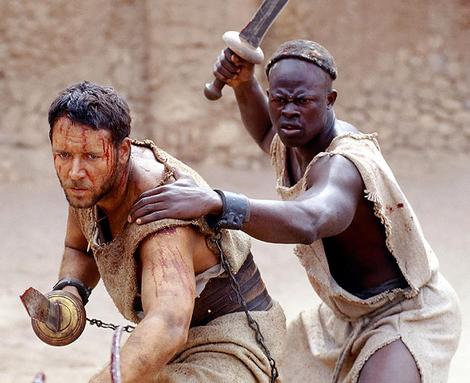
But of course Maximus escapes his execution and returns home to see his family murdered. Wounded, tired, hungry, and sick, Maximus collapses and is picked up by a slave trader and sold to Proximo (Oliver Reed), who owns a stock of gladiators. And so now the great warrior Maximus has been reduced to the lowest state of a warrior. As a gladiator, he meets two men—Juba (Djimon Hounsou) and Hagen (Ralf Moeller)—who will become his friends.

In the rest of the world, Commodus becomes emperor, his treachery suspected but unproven. Intrigue abounds, in part because Commodus displays himself as inept as a ruler. Part of this (at least for the audience) is the fact that he has obvious designs on Lucilla (Connie Nielsen), his sister, and makes no mistake of the fact that he would like her to rule beside him in every incestuous sense of the word. Lucilla, of course, is a former lover of Maximus, and there's still some evident feeling between them. There’s also quite a bit of infighting between Commodus and parts of the Senate, particularly Senator Gracchus (Derek Jacobi). As the film continues, these two spar with increasingly high stakes until Commodus is left with no alternative but to move against Gracchus. Frequently, Lucilla is used as a pawn in this, as is her son Lucius (Spencer Treat Clark).

Of course, the greatest pawn in all of this is Maximus himself, who hides his identity for the bulk of the film, and is known among the gladiators and to Proximo as the Spaniard. His own progression is shown mainly through his progression of gladiatorial battles, each one becoming more and more vicious, more and more extravagant, and up to a point, bloodier and bloodier. This, even more than the story, was the original selling point of this film to the masses. In some ways at least, we in the audience were much the same as those Roman citizens who sat in the Coliseum and watched avidly for the bloody spectacle of death.

I’m not trying to sell this short; the arena combats are fantastic, and are a selling point of the film for a better reason than the fact that they are battles. They are hyper-kinetic contests of speed and brutality, and exciting in a way that only movie battles can be exciting. Today, 12 years after the film was released, they are still one of the major selling points of the film and for the exact same reason. Put plainly, the battles kick ass.

So if the battles are the reason to watch the film, what about everything else? Tonight was the first time in probably a decade I put Gladiator in the spinner, and while I certainly remembered the film, there was quite a bit that I had forgotten. For instance, I had forgotten how much I enjoyed the brief appearance of Richard Harris in this film; he brings an air of wisdom and of serenity to this film much as he did in the first few Harry Potter films. I also had forgotten much of the character of Proximo. I remember now that he was one of my favorite parts of the film when I first saw it, and he was one of my favorite characters this time as well.

The film is a showcase for Russell Crowe, of course, and one that more than any previous turned him into the major star he is today. Certainly he had roles in films like L.A. Confidential before this one, but this was the film that turned him into a household name, and with reason. It’s a star turn like few others.

Ultimately, Gladiator is a film that plays out a great deal like Braveheart of a few years before. It’s evident early on how the film will play out and once Commodus is impressed enough to meet the “Spaniard” after a gladiatorial combat, there’s really only one way the film can end. There’s a great deal of melodrama here, a bit more difficult to recognize because of the intensity of the bloodshed, but melodrama it is.

You know what? Who cares. It’s bread and circuses, but they’re damn fine circuses.

Why to watch Gladiator: Ridley Scott, Joaquin Phoenix, and Russell Crowe at their best.
Why not to watch: The path of this story is pretty evident after 20 minutes.