Showing posts with label Ridley Scott. Show all posts

Monday, October 9, 2023

Stealing Fire

Film: Prometheus
Format: Streaming video from Tubi TV on Fire!

I question the idea of prequels sometimes. They can make sense for those who want the backstory on something that they love, but they cause real problems with science fiction movies. That’s definitely the case with Prometheus, which is a prequel to Alien. It’s also a movie that came out several decades after the movie that follows it in the timeline, and this is an issue, beyond the obvious problem of things not matching up the way they should.

There is also the serious question of how to classify this movie. There are definite horror elements, and anything in the greater Alien universe is absolutely going to struggle getting away entirely from the horror designation. But Prometheus is only horror in parts. There are certainly elements of horror here, but not a lot of surprises. Anyone who knows Alien knows where we are going and can assume the fates of most of the people on board the ship after which the movie is named. And so, this becomes nothing more than a playing out of events to get us to setting up the chess board for Alien the way we need it set up.

Thursday, July 28, 2022

The Godfather of Fashion

Films: House of Gucci
Format: DVD from DeKalb Public Library on the kid’s television.

Before Oscar season this year, I expected House of Gucci to be on my list of Oscar movies. There was enough going on here that I thought there would be at least a Best Picture nomination. However, that’s not at all what happened. Instead, I’m watching this on my own because its lone Oscar nomination was for hair and makeup, a category I don’t address on this blog. Now that I’ve watched it, I have to agree with the Academy; this didn’t live up to the hype.

On the surface, House of Gucci is the story of Patrizia Reggiani (Lady Gaga) and her marriage to, divorce from, and eventual contracted murder of her husband, Maurizio Gucci (Adam Driver), the heir to half of the Gucci fashion empire. And, on the surface, it’s hard not to expect that there will be a lot here to like. The cast is a good one and this is helmed by the generally reliable Ridley Scott. Even better, House of Gucci is very much a mob film at its heart. There are a lot of parallels here to The Godfather films, for instance.

Monday, April 4, 2022

Rasho-Mano a Mano

Films: The Last Duel
Format: DVD from Sycamore Public Library through interlibrary loan on rockin’ flatscreen.

When The Last Duel came out, there was some initial thought about Oscar time, but the film seemed to tank at the box office. Ridley Scott famously blamed the failure of the film at the box office on Millennials not having the attention span for a movie of this length or it not appearing on their cell phones. That seems like sour grapes, apologizing for a movie that is, to be honest, too damn long.

I’m not going to apologize for that opinion. The Last Duel is very much in the style of Rashomon in the sense that we get three different takes on the same story, three perspectives on a tragedy, concluding with the duel in the title. That may seem like that means there’s a lot of ground to cover, but Kurosawa did four version of the same story in Rashomon and did it in an hour less of running time. The Last Duel is bloated, and while there’s plenty here that’s good, there’s a lot that can and should be cut.

Wednesday, April 24, 2019

Wednesday Horror: Hannibal

Film: Hannibal
Format: DVD from Cortland Public Library on The New Portable.

So let’s talk about sequels for a moment. Typically, sequels are a disappointment, although I have to admit that they’ve gotten a bit better in recent years. But they still don’t have the best of reputations when it comes to movies. I hadn’t heard a great deal good about Hannibal going in. It’s ten years removed from The Silence of the Lambs, which isn’t necessarily a problem, but can be. It also replaced Jodie Foster as Clarice Starling with Julianne Moore. Far be it from me to complain about Julianne Moore, but Clarice will always be Jodie Foster to me, especially since Moore spends a good chunk of the film attempting to recreate Foster’s patois.

Hannibal kind of picks up where the previous film left off. Lector (still played by Anthony Hopkins) has escaped and is somewhere in the wider world. Clarice is continuing to work at her job with the FBI, and is in charge of a drug bust that goes badly. She’s saddled with the responsibility and blame for this despite it clearly being the fault of another person. As it happens, a considerable amount of Hannibal concerns her relationship with the bureau, being particularly antagonistic. I honestly don’t remember this from the first film; here, all of her interactions with others at the FBI are hostile, particularly with Paul Krendler (Ray Liotta).

Saturday, February 27, 2016

Matt Damon Won't Stay Rescued

Film: The Martian
Format: DVD from NetFlix on rockin’ flatscreen.

It’s kind of a running Hollywood joke that Matt Damon gets left places and has to be rescued. That’s the central plot device of The Martian: Matt Damon gets stranded on Mars and needs to be rescued. That might be the basic plot here, but the truth is that The Martian is less about rescuing Matt Damon and more about how balls-out cool space is. If you aren’t awed by space, amazed by it, or humbled by it, you haven’t really looked at it.

So at an unspecified time in the near future, The Martian proposes that we have sent a manned mission to Mars. A crew of six is on the surface of the planet doing Mars-y, space-y stuff when a massive windstorm crops up and threatens their small base. In fact, the storm is so significant that it forces an abort of the mission. The crew scurries to their craft to escape when a piece of blowing debris impales the crew’s botanist Mark Watney (Matt Damon), puncturing his suit and is biomonitor, which makes everyone think he is dead. The ship blasts off with a crew of five, leaving Mark on the planet wounded, but still alive.

Tuesday, July 15, 2014

Nowhere to Run

Film: Black Hawk Down
Format: Streaming video from NetFlix on laptop.

When I was a lot younger and completely into war movies, there was a part of me that wondered what it would be like if the whole film was nothing but war. That, I figured, would be the coolest of all possible films. Well, I don’t have to wonder anymore because I’ve now seen Black Hawk Down. It takes some time for the film to get rolling into the action, but once it does, it’s pretty much shooting and explosions until the final credits. The actual shooting/war part of the film runs about 90 minutes, and it never lets up for more than a minute or two at a time.

Essentially, the film tells the story of the battle for Mogadishu in Somalia in 1993. At that time, the country was torn apart by war and famine. The reason for the famine was that a presumptive warlord named Aidid controlled both Mogadishu and all of the incoming food. Keeping that food hostage and rationed allowed him to control the stomachs, and thus the people, of his entire country. A UN peacekeeping force went to the country and was eventually pulled back. Once that happened, Aidid declared war on the remaining UN forces and a war-torn country became ever worse.

Monday, December 24, 2012

Girls Gone Wild

Film: Thelma & Louise
Format: DVD from Genoa Public Library through interlibrary loan on kick-ass portable DVD player.

For the past year, on the last Tuesday of the month, I’ve put up a review of a film that I hadn’t seen but really should have at this point in my life. This was a part of Ryan McNeil’s Blindspot idea, asking bloggers to catch up on great, classic films of the past that we’re a little embarrassed that we hadn’t seen yet. I’ve seen some good ones this year, and I’m a much more complete film viewer. Now, I admit that all of these films were on my list anyway, so I’d have gotten around to them, but having that slight amount of structure has been fun. This month, though, the last Tuesday is Christmas, and I’m not watching a movie on Christmas. Instead, I’m doing this a day early. And that’s why, between last-minute shopping, a little wrapping, and getting the kitchen ready for tomorrow, I watched Thelma & Louise.

In a nutshell, bored and downtrodden housewife Thelma (Geena Davis) and her street smart and world-weary friend Louise (Susan Sarandon) plan a weekend trip, at least in theory going fishing at the cabin of a friend of Louise. On their first night out, they stop at a bar where Thelma drinks a little too much and dances with a guy named Harlan (Timothy Carhart). When Harlan gets a little too frisky and tries to rape Thelma, Louise responds by shooting Harlan in the chest. The women flee, trying to figure out what to do.

Tuesday, March 20, 2012

Braveheart II: This Time, He's Roman

Film: Gladiator
Format: DVD from Rockford Public Library on rockin’ flatscreen.

When the Academy Awards for 2000 rolled around, I don’t remember there being a lot of doubt that the ultimate winner for Best Picture would be anything but Gladiator. There may have been a little buzz around the other films, but Gladiator was the one on everyone’s lips. I drank the Kool-Aid as much as anyone. I remember watching it with my wife and being surprised at just how much she got into it as well.

Like many a historical epic, Gladiator takes some license with the source material. A great deal in this case is made from whole cloth in that most of the characters (including the bulk of the major cast) are simply representative of the time and history. While I cannot be sure, only Commodus (Joaquin Phoenix) existed in the real world. License was taken with him, but less than you might expect. His reign was short and plagued by political intrigue, and some historians have determined his reign as the beginning of the fall of the Roman Empire.

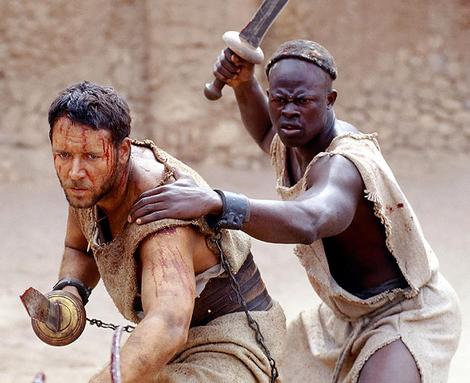
Regardless of this, the film is one that doesn’t specifically require historical accuracy to be entertaining. The film follows the life of Maximus Decimus Meridius (Russell Crowe), a general in the Roman Army, serving under Emperor Marcus Aurelius (Richard Harris). After a victory in Germania, the dying Marcus visits his general. Here he tells him that the fate of Rome lays in his hands—he intends to make Maximus the protector of Rome until the Senate and the people of Rome are ready to rule. This does not sit well with Marcus’s son, the aforementioned Commodus, who kills Marcus Aurelius, and then sentences Maximus to death for not swearing allegiance. He also has Maximus’s wife and son slain.

But of course Maximus escapes his execution and returns home to see his family murdered. Wounded, tired, hungry, and sick, Maximus collapses and is picked up by a slave trader and sold to Proximo (Oliver Reed), who owns a stock of gladiators. And so now the great warrior Maximus has been reduced to the lowest state of a warrior. As a gladiator, he meets two men—Juba (Djimon Hounsou) and Hagen (Ralf Moeller)—who will become his friends.

In the rest of the world, Commodus becomes emperor, his treachery suspected but unproven. Intrigue abounds, in part because Commodus displays himself as inept as a ruler. Part of this (at least for the audience) is the fact that he has obvious designs on Lucilla (Connie Nielsen), his sister, and makes no mistake of the fact that he would like her to rule beside him in every incestuous sense of the word. Lucilla, of course, is a former lover of Maximus, and there's still some evident feeling between them. There’s also quite a bit of infighting between Commodus and parts of the Senate, particularly Senator Gracchus (Derek Jacobi). As the film continues, these two spar with increasingly high stakes until Commodus is left with no alternative but to move against Gracchus. Frequently, Lucilla is used as a pawn in this, as is her son Lucius (Spencer Treat Clark).

Of course, the greatest pawn in all of this is Maximus himself, who hides his identity for the bulk of the film, and is known among the gladiators and to Proximo as the Spaniard. His own progression is shown mainly through his progression of gladiatorial battles, each one becoming more and more vicious, more and more extravagant, and up to a point, bloodier and bloodier. This, even more than the story, was the original selling point of this film to the masses. In some ways at least, we in the audience were much the same as those Roman citizens who sat in the Coliseum and watched avidly for the bloody spectacle of death.

I’m not trying to sell this short; the arena combats are fantastic, and are a selling point of the film for a better reason than the fact that they are battles. They are hyper-kinetic contests of speed and brutality, and exciting in a way that only movie battles can be exciting. Today, 12 years after the film was released, they are still one of the major selling points of the film and for the exact same reason. Put plainly, the battles kick ass.

So if the battles are the reason to watch the film, what about everything else? Tonight was the first time in probably a decade I put Gladiator in the spinner, and while I certainly remembered the film, there was quite a bit that I had forgotten. For instance, I had forgotten how much I enjoyed the brief appearance of Richard Harris in this film; he brings an air of wisdom and of serenity to this film much as he did in the first few Harry Potter films. I also had forgotten much of the character of Proximo. I remember now that he was one of my favorite parts of the film when I first saw it, and he was one of my favorite characters this time as well.

The film is a showcase for Russell Crowe, of course, and one that more than any previous turned him into the major star he is today. Certainly he had roles in films like L.A. Confidential before this one, but this was the film that turned him into a household name, and with reason. It’s a star turn like few others.

Ultimately, Gladiator is a film that plays out a great deal like Braveheart of a few years before. It’s evident early on how the film will play out and once Commodus is impressed enough to meet the “Spaniard” after a gladiatorial combat, there’s really only one way the film can end. There’s a great deal of melodrama here, a bit more difficult to recognize because of the intensity of the bloodshed, but melodrama it is.

You know what? Who cares. It’s bread and circuses, but they’re damn fine circuses.

Why to watch Gladiator: Ridley Scott, Joaquin Phoenix, and Russell Crowe at their best.
Why not to watch: The path of this story is pretty evident after 20 minutes.

Sunday, February 20, 2011

The Best Month Ever: June, 1982 Part 2

Films: E.T. the Extra-Terrestrial, Blade Runner
Format: DVDs from personal collection on kick-ass portable DVD player (E.T.) and on big ol’ television (Blade Runner).

[These reviews have been included as a part of Pussy Goes Grrr's Juxtaposition Blogathon!]

The biggest film event of 1982 was not Star Trek II: The Wrath of Khan no matter what the Trekkies have to say about it. The movie of the year was E.T. the Extra-Terrestrial. Like any great kid movie, this one enamored both adults and kids and became a huge sensation, solidifying Steven Spielberg’s reputation as a director who could capture magic on film and could do no wrong, an amazing feat from a guy just a few years removed from 1941.

There’s not much reason to go into the plot here—if you haven’t seen E.T. it’s because you’ve seen fewer than a dozen movies in your life, are less than 20 years old, or live under a rock (which makes me question how you have Internet access). There are other options, but it’s still no excuse for not having seen this film, which even now, 30 years later, is remarkable for how well it captures a particular mystery and sense of youthful adventure. Suffice to say that a squat little alien gets left behind by his compatriots, is discovered by a boy who helps protect him, and the two attempt to get the critter back to its people while the big bad government attempts to kidnap the alien for research purposes.

Starring in the film is Henry Thomas as Elliott, the boy who finds the alien in the woods behind his house. He’s a good child actor, although at times he’s difficult to notice simply because he spends so much of his time next to the creation that is the focus of the movie: the alien. Also featured as his siblings are Robert MacNaughton as Elliott’s older brother/tormentor Michael and, of course, Drew Barrymore as little sister Gertie. This film was the break-out role for Barrymore, who has gone on to a tremendous Hollywood career. MacNaughton, on the other hand, has vanished from acting and at last account works in a post office. In many ways, though, he is the most natural of the kids on the screen. I had a brother much like Michael. He tormented me the way Michael torments Elliott. At the same time, once Michael discovers what is going on, he’s Elliott’s protector and confidant. This is a great screen relationship, and speaks to smart and believable characters.

E.T. is filled with early Spielberg tropes—a missing father, evil government, and magical childhood adventures, things it holds in common with Spielberg-written films like The Goonies. There’s also a sense of high adventure--Raiders of the Lost Ark, Jurassic Park, and Close Encounters of the Third Kind all bear this stamp.

What’s fascinating to me, and it’s a connection I didn’t see until today, is that for Spielberg, at least at this point in his career, dangers came from planet Earth while salvation came from the stars. Early Spielberg films have terrestrial, or at least formerly terrestrial dangers. The bad things in Duel, Jaws, Raiders of the Lost Ark, and even Jurassic Park and Poltergeist have Earth origins. In outer space-related, science fiction films, the aliens are misunderstood at worst and actively beneficent at best.

And get this—I’ve also only realized on this watching (it’s been a long time since I’ve seen this film) that E.T. the character is essentially space Jesus. Much of the symbolism is there. This is an odd realization, and an odd position for the Jewish Spielberg to add into American film mythology, but there it is. It would not surprise me if a cut scene involved E.T. walking on water and then turning around and transmuting that water into kid-friendly root beer. Quick spoiler:

*** E.T. PHONE HOME ***

Think about it—E.T. has magical abilities. He can levitate objects and move them, and has a special connection with Elliott in the sense that what one feels, the other feels as well. He can also heal the injured and afflicted. E.T. is persecuted and hunted by those who don’t understand what he is. Eventually, E.T. dies, but comes back to life and ascends into the heavens, but not before he tells Elliott that he will continue to live on in his heart…just like Jesus does. Both are misunderstood by all but those who believe (although the argument could be made that Jesus is misunderstood in particular by the most devout). Still, there are enough points of similarity that the two occupy the same general sphere of altruistic, beneficent, otherworldly beings with miraculous powers. The one can be seen as a version of the other.

*** PLEASE CHECK THE NUMBER AND DIAL AGAIN ***

It’s without a doubt true that E.T. has entered the American mythology and lexicon. There are several iconic moments—“E.T. phone home” and the bicycle across the face of the moon being the most obvious ones, not to mention the huge upsurge in sales of Reese’s Pieces in the years to follow this film’s release. But the real reason the film has had such staying power, and will continue to charm children and adults is that it is a recognizable and great story. This is a true boy’s-own adventure, immediately accessible to kids of virtually any age, and still entertaining for the parents.

I like E.T. just fine. My tastes tend to run to the more violent, weird, thoughtful, and/or disturbing, but it’s a difficult film not to like. Of the great and noteworthy films released in this greatest month of American movies ever, this one is my least favorite—but it’s my least favorite in a hell of a good group. It’s sweet and endearing—perhaps too much so—but as a movie conceived and written for kids, it hits almost every mark. As a jaded high schooler, I wasn’t a big fan of this film. As an adult with kids, I appreciate it for what it is, and what it is is special.

And this brings us to the final movie on The List from this marvelous month: Blade Runner. For a long time, I think I liked this movie because I was supposed to like it. Everyone told me how great it was, and how much I should appreciate it, so I went along with that idea without really understanding what the movie was or what it was about.

And then I finally got around to reading Phillip K. Dick’s book, Do Androids Dream of Electric Sheep? Suddenly, Blade Runner made sense to me, because I suddenly had context for it. Certain aspects of the film are not really explained in the film and exist almost as artifacts from the book. But I’m getting ahead of myself.

Blade Runner exists in a world where nearly-human androids have been created for use in off-world colonies. Because of some problems that existed in the past, these androids, called “replicants,” are not permitted on Earth, despite the fact that many of them attempt to come to Earth. Because of this, special agents of the police, blade runners, exist to “retire” the replicants, “retire” being an obvious euphemism for “terminate with extreme prejudice using a high caliber pistol. Our blade runner in question, Deckard (Harrison Ford), has just been given a contract on a series of replicants that are of a new model, and have not only been spotted on Earth, but have killed at least one agent.

That’s enough of the plot, really. What exists around this plot, though, are artifacts of Dick’s world that don’t really make it into the film. For instance, there’s really no reason given why so many of the questions on the test to determine if someone is a replicant deal with the death or torture of animals. There’s no indication of exactly why people are still living on Earth despite the massive advertising blitz to send people to the colony worlds. These aspects of the story are explained fully in the book. They add to the experience, though, but are not necessary for the Blade Runner experience.

We get an interesting cast taking us through the story. In addition to Harrison Ford, the film features Edward James Olmos as Gaff, who acts both as Deckard’s foil and as his partner. Deckard’s nominal boss in this situation is Bryant, played by the always-excellent M. Emmet Walsh (an actor so good Roger Ebert once said that any movie that featured him can’t be all bad). As the replicants, we get the terrifying Brion James as Leon, Joanna Cassidy as Zhora, Sean Young as Rachael, Daryl Hannah as Pris, and the great Rutger Hauer as Roy Batty. Batty is a terrifying presence in the film, in no small part thanks to Hauer’s talents. Also worth noting is the underrated and entertaining William Sanderson as J.F. Sebastian, an afflicted toy maker and geneticist.

The cast is great, and so is the story, but it’s the mise-en-scene that is the true star of this film. Blade Runner looks real to such a degree that it becomes real. Costuming, makeup, set design—it all works perfectly to create a real, believable world of the future. Ridley Scott was smart enough to make this future multi-cultural, giving it a pan-linguistic patois and a decidedly Asian flavor that functions perfectly as a backdrop for the action on screen.

I don’t normally like Sean Young, but she’s good here. It’s also worth noting that in general, Daryl Hannah is great when she plays non-humans. The minute a script asks her to be something that isn’t 100% human, she excels. Go figure.

There are multiple versions of this film out there. One version contains the much-maligned voice over explaining the film. There’s a definitive edition, a director’s cut (the first real director’s cut ever made), and it can be difficult to tell which one to watch. I’ll say it here—watch the director’s cut. When you have someone as good as Ridley Scott making the film, go with his vision. That being said, there are a couple of spoilers to handle:

*** LOOK! A REPLICANT! ***

The big question in the director’s cut is whether or not Deckard is himself a replicant. There’s evidence on both sides of the issue. For years, I believed he was for two reasons. First, he dreams of a unicorn, and Gaff places an origami unicorn in his apartment, almost as if he knows the implanted memories in Deckard’s head. Second, replicants have a particular eye gleam in certain angles of light, a gleam that appears in Deckard’s eyes at one point. I’m not so sure these days. I can tell you that in the book, this is never even considered as a question. There’s no indication that Deckard is a replicant. There’s also no love story between him and Rachael—Deckard is married in the book.

Second, why does Roy Batty save Deckard at the end? Because he does. Maybe it’s to prove that he has free will. Maybe he wanted his last conscious act to be something positive. Maybe he wanted someone to know that he was more than a killer. Again, this doesn’t happen in the book and is entirely a creation of this script.

*** TIME TO DIE ***

Like all good science fiction, Blade Runner explores the essential question of what it means to be human, and in this case, what humanity means in a world that is increasingly becoming dehumanized. That’s a central theme of author Ray Bradbury, which is one reason I can think of that there’s a building named after him in the film. Blade Runner may not answer this question fully, but should it? It offers the question as food for thought, and that should be good enough.

And so we close on this greatest month of American films in history, at least before the December deck stacking for the Oscars. I miss that prior age in the sense that there’s no mystery of when a truly great film will be released now. Summer blockbusters are just that—expensive and bombastic, and the great films don’t show up until Christmas. There’s little chance of a magical June ever happening again, and that makes me sad.

Why to watch E.T. the Extra-Terrestrial: The greatest kid adventure ever made.
Why not to watch: Too cute by a half.

Why to watch Blade Runner: The birth of cyberpunk, plus kick-ass humanoid robots.
Why not to watch: A vague, possibly unsatisfying ending.

Thursday, September 9, 2010

Rip-leeeeeeeeeeee!

Films: Alien, Aliens
Format: DVDs from personal collection on laptop.


It’s been awhile since I updated, mostly because of a film that will be appearing here in a few days. I just received the last DVD for that, and while I’m interested in finishing that film up, I needed a break from it today. So I’m watching a couple of films I dearly love instead: Alien and its arguably better sequel, Aliens.

Alien is the story of the crew of the Nostromo, a towing ship with a crew of seven. The ship has been roving around the galaxy and is, at the start of the film, loaded with 20 million tons of unrefined ore. The ship is headed back to Earth with the crew in hypersleep, when they are suddenly awakened by a distress beacon from a nearby planet. The crew investigates and discovers something startling—a massive alien spacecraft with no evidence of survivors. The ship itself is huge, and the creatures it held, based on the scale, were massive. The skeletal remains of one sits in a chair on what passes for the bridge, with bizarre wounds—it appears to have had its ribcage burst apart from the inside.

What there is is a room filled with bizarre eggs. As the crew investigates, one of the eggs splits open and a creature leaps out, attaching itself to the faceplate of a crewman named Kane (John Hurt). It burns through the glass and attaches itself to his face. Kane is still alive, and the rest of the crew drag him back aboard the Nostromo before taking off. Any attempt to remove the creature threatens Kane’s life, so they leave him where he is. After a few days, the thing falls off his face and lies dead on the floor. This takes the first hour of the film.

Of course, if that was all there was, there wouldn’t be much of a film, let alone one of the greatest science fiction/horror films ever made. At the next meal, Kane convulses, and a brand new creature pops out of his chest in a scene that, despite being 30+ years old, is still effective and startling. The creature runs away, grows to a massive size, and then begins to pick of members of the crew one at a time. This crew, in no order, consists of Brett (Harry Dean Stanton), Lambert (Veronica Cartwright), Dallas (Tom Skerritt), Parker (Yaphet Kotto) and Ash (Ian Holm). Once things get going, they really get going. Half an hour after Kane’s abortive last meal, half of the remaining crew is dead in one way or another.

There are other surprises along the way, of course. It would still be a great movie without all of the additional surprises that crop up along the way and the interplay of the personalities. Ash, for instance, is a hardass who tows the company line in all things. Parker and Brett just want their share of the money for the job. These characters turn into real people with depth over the course of the film, which is one of the reasons the film is so effective, as is the fact that we don’t really see many of the deaths on screen in front of us.

The two stars of this film are Sigourney Weaver as Ripley and the alien itself, which was based on the artwork of H.R. Giger. Beyond these two, and the rest of the cast, what makes the film work so well is the blending of genres. Alien is absolutely a science fiction film, but it is equally horror. Essentially, it is a slasher movie or a haunted house picture set in outer space, with higher stakes because the characters literally cannot get away from creature, since they are millions of miles away from home.

It’s worth noting that Alien was written by Dan O’Bannon, who was a college friend of John Carpenter. In fact, O’Bannon starred in Carpenter’s college film project, a low-budget science fiction comedy called Dark Star that is actually worth watching despite the $0 special effects budget (the alien in this film is played by an inflated beach ball). It’s not immediately clear to me who is responsible for the overall look of the film, but as far as I am aware, it’s the first time that a film of this type feature such a dirty, industrial look for the future. Far from the lean and clean spacecraft of earlier science fiction films, the Nostromo looks like an overcrowded factory with pipes and wires hanging everywhere, and not quite enough lighting to see everything clearly. It’s really effective. This is made even more effective by the constant smoking of the crew, which adds a foggy, smoky atmosphere to every scene.

It’s also notable in the sense of Ripley’s role. There are two female parts in this film—Ripley and Lambert. Lambert is far more of a traditional sci-fi woman’s role. She screams a lot, and spends a good bulk of the last hour crying, a stereotype often played in movies based on the idea that women are more emotionally fragile than men. Ripley, on the other hand, is a extremely strong, in-charge character. O’Bannon’s original script considered all of the character roles unisex, so there’s nothing specific about Ripley’s part that requires a woman to be in the role. What that means is that Ripley is, in many ways, one of the first film characters who is her job in the film first, and a woman second. There were certainly female asskickers in film before Ripley, but this role is different. Ripley isn’t a kung fu killer or a sexy assassin trading on looks and slinky outfits. She’s a competent performer in her job who merely happens to be a woman, making this an important film in terms of the presence and treatment of women by and in film.


Alien proved to be such a success that seven years later, its sequel was produced. Aliens does not pick up from where the first film left off, but instead gives us a new story with only one character consistent—Sigourney Weaver’s Ripley. The biggest change is the directorial duties. Ridley Scott opted not to direct the sequel, giving way to James Cameron. Cameron is much more attuned to straight action, and in this sequel he delivers.

In fact, Aliens is very much a straightforward science fiction film. While there are scares and jump moments here, no one would call this film horror. It takes place nearly 60 years after the original film. Ripley’s escape pod has been rescued, and she learns that, to coin a film clichรฉ, everyone she knows and loves is dead, including her daughter. She’s put on trial by Weyland-Yutani, the company she worked for because of the destruction of the Nostromo, and is banned from finding work in the same field. Shortly thereafter, she is contacted by the company again when a terrible secret is revealed. The company has placed settlers on the original planet, and they have now lost contact with the colony.

Ripley, because she is the only one to have survived contact with the alien species the first time, agrees to return to the planet to investigate what has happened. She accompanies a team of marines who are going just in case the worst has happened (and if you know anything about films, you already know that the worst has happened). The colony has been overrun—the people are dead, and the place is crawling with the same kind of alien that ravaged Nostromo in the first film. Of course, the kicker this time is that there are a bunch of aliens this time—probably coming from the thousands of eggs that didn’t open in the first film.

Ripley is seen as something of a crackpot at first, at least until the marines first encounter the creatures for the first time. It’s at this point that the personalities of the marines start to come into play, and we get a better sense of who they are, and they are an interesting bunch. A good half of the marines bite it in the first encounter, and those remaining are a motley assortment. Ripley is still around naturally, as is a little girl they encounter on the planet early on. This is Newt (Carrie Henn), who survived the carnage by hiding from the giant creatures. Also surviving at this point is Hicks (Michael Biehn), the corporal, and a solid soldier; Bishop (Lance Henriksen), who is more of an advisor (see the spoiler below); Carter Burke (Paul Reiser), a company representative; Hudson (Bill Paxton), a wannabe tough guy who is prone to panic; Gorman (William Hope), the inexperienced lieutenant; and Vasquez (Jenette Goldstein), a tough-as-nails marine out to prove that women can do anything men can do.

*** QUICK SPOILER ***

Bishop is an android. This is revealed early in the film, so it’s not much of a spoiler. Ripley has an intense reaction to this, though, because Ash in the first film was also an android, and attempted to kill her as well as the rest of the Nostromo’s crew.

*** LIKE I SAID, QUICK SPOILER ***

Again, the goal is to survive, this time against overwhelming alien odds. The characters attempt to get off the planet, fighting against time and the aliens as well as each other. While there are certainly tense moments, this is an action film. The characters aren’t stalked by the aliens, but assaulted by them, and the aliens are fended off with high caliber weaponry, flame throwers, and explosives. Burke wants nothing other than a live specimen to bring back to Weyland-Yutani, and threatens the others at every turn.

There are two payoffs in this film. The first is that Ripley continues to be a strong female presence on the screen, this time with mothering instincts kicking in thanks to the presence of young Newt. While in Alien the Ripley role could have been handled by a man or a woman, in this film, the role is definitely a female one. Ripley is no less competent, no less bad-ass, and no less an asskicker than in the first film, but here she is allowed to be more than just a character who happens to be female. Here, she is allowed to be an asskicker who happens to have a nurturing, caring side. It’s an even better role than the first film.

The second great payoff is the confrontation between Ripley in the forklift suit and the queen alien in the loading dock. In this moment, Ripley comes into her own in one of the great fight scenes in science fiction film history. It says a great deal for Cameron’s script and Cameron himself that he was not only able to recognize this quality in the character, but keep it and expand it in the sequel without it ever becoming trite or maudlin. Ripley’s relationship with Newt is entirely believable. This is especially true in the director’s cut of the film, which reveals Ripley’s relationship with her biological daughter.

Aliens happens to be far more quotable than the original film as well. I don’t know if I can think of more than a couple of actual lines from the first film, but there are more than a dozen from Aliens that have become classics not only for the genre, but for film in general.

So which film is better? It’s impossible for me to say. These are not really comparable films despite the fact that the enemy is the same and the main character is the same. Alien is a horror film in a science fiction setting. The fact that the characters happen to be on a spaceship just means that they don’t have a way of getting out of the situation. They’re trapped, but they’d be trapped the same way in a deserted house with a guy carrying a machete. The second film is a straight action film. It's a war with an unusual foe, and so it really works like a war film in a lot of ways.

Naturally, with the success of the first two films, more sequels appeared. Specifically, there was Alien3 and Alien: Resurrection. The first of these was directed by David Fincher, who was so disgusted by what happened with the film that he wanted to have his name removed from it. Fincher has since gone on to have a tremendous career, but Alien3 started it out on a very wrong foot. In truth, it’s not a terrible film. It’s actually okay, but it starts with two strikes against it, namely the first two films in the series. Had it been a stand-alone film, it would have something of a following for no other reason than the kick-ass critter. As the third film in one of the greatest science fiction properties ever made, though, it falls woefully short. The fourth film is really better not mentioned any further. For my money, the series ends after the second film.

Why to watch Alien: Because it’s freakin’ awesome!
Why not to watch: Lambert needs a punch in the kisser.

Why to watch Aliens: More of what made the first movie great, plus a shit-ton of great quotes.
Why not to watch: Where the series went after this film.