Sunday, April 7, 2013

Watching Oscar: All the King's Men

Film: All the King’s Men
Format: DVD from Northern Illinois University Founders Memorial Library on laptop.

There was a time when America was at least perceived as being pretty naïve. Films like Mr. Smith Goes to Washington played with this idea. So does All the King’s Men. The main difference is that some of that naivety survived Mr. Smith and it most definitely does not make it through All the King’s Men intact. This is the story of the rise and fall of a man. There are shades (but only shades) of MacBeth here, but that’s often the case when this is the base story. In truth, it’s more Citizen Kane than anything else.

Newspaper reporter Jack Burden (John Ireland) is ready for a vacation, but is instead sent to an out of the way corner of his state to report on a man named Willie Stark (Broderick Crawford). Stark is upset because he feels (rightfully) like his state is being run for the personal gain and pleasure of the few instead of for the good of the people. Burden is entranced by Stark and is disappointed when Stark runs for treasurer of his county and loses. Stark decides to concentrate on getting a law degree and fighting for the people as an attorney.

Saturday, April 6, 2013

Only the Silent Survive

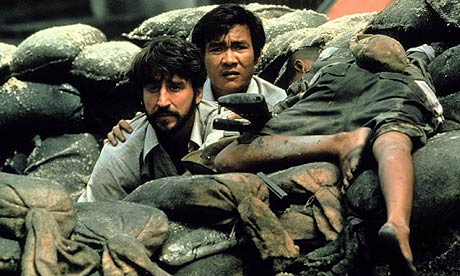
Film: The Killing Fields
Format: DVD from NetFlix on laptop.

I know very little about the reign of terror that inspired The Killing Fields except what I saw in that film today. I’m not sure how much of it I could take, and I’ve watched countless films on the Holocaust. Am I suggesting that the depredations of the Khmer Rouge was somehow worse than what happened in Germany in the 1930s and 1940s? I am not. But at what point do we really measure atrocities? At some point, evils on this scale are all equally horrible, equally terrible, and need to be stopped and prevented equally. But as with anything, the first step is knowledge. Knowing what happened, we may be able to stop it from happening again.

The Killing Fields is a story about the rise of the Khmer Rouge and the fall of Cambodia, but it is also the story of two men. American journalist Sydney Schanberg (Sam Waterston) has come to Cambodia to cover the parts of the Vietnam War that has spilled over the border and what would eventually become the growing conflict in Cambodia itself. Assisting him is Cambodian journalist Dith Pran (Haing S. Ngor). Also in the area is photographer Al Rockoff (John Malkovich) and British journalist John Swain (Julian Sands). Schanberg fights with the military, personified here by Major Reeves (Craig T. Nelson) and the U.S. government, personified by the U.S. Consul in Cambodia (Spalding Gray).

Friday, April 5, 2013

Family Business

Film: Ukigusa (Floating Weeds)
Format: Streaming video from Hulu+ on laptop.

I don’t have a great deal of experience watching the films of Yasujiro Ozu. Ukigusa (Floating Weeds, and sometimes spelled Ukikusa) is only the third of his films that I’ve seen. I’ve noticed some themes, though. First, Ozu hated to move his camera. While he’s happy to cut between shots, almost everything he does is a static shot. This lends an unusual quality to his films—despite people moving within each scene, there is very much a sense of a static world, almost a still life with people in it.

The second thing is that Ozu appears to be obsessed with family relationships. Even in a film like this one, where a huge percentage of the main characters are a part of a traveling theater troupe, it’s all about family and about the relationships between people. The problems here are the problems of real, believable people. We aren’t changing the world, but dealing with life. Of course, for these people, it is the world.

Thursday, April 4, 2013

Mann and Stewart

Film: The Man from Laramie
Format: DVD from Northern Illinois University Founders Memorial Library on Sue’s Mother’s Day gift.

Roger Ebert died today, which is completely shitty. I kind of didn’t want to post anything because of it, because we’ve truly lost a giant and a real inspiration. Would I have started reviewing movies without Ebert? In the long sense, no. It was Ebert along with Gene Siskel who made me think that being a geek for movies was okay. They made it socially acceptable to nerd out over this stuff. But then I thought I should put up a review. Ebert worked pretty much until the day he died. Reviewing a film today is the best way to honor the man who has been an inspiration to me and almost every reviewer and critic I know.

Evidently, director Anthony Mann and James Stewart collaborated a total of eight times, five of them Westerns. The Man from Laramie was the last of their collaborations, and according to the text on the back of the DVD case, the best of them. Going in, I had my doubts; a Western needs to be more than just well-made to rank above Winchester ‘73 in my books. This is a pretty standard horse and saddle picture, in a lot of respects. We’ve got cattlemen and people trying to keep more land than they need, bullies, natives, and a revenge plot. What more could a picture ask for?

Wednesday, April 3, 2013

Deep Cover

Film: Cache (Hidden); La Pianiste (The Piano Teacher)
Format: DVDs from Rockford Public Library on laptop.

Michael Haneke is a strange director in a lot of ways. I don’t know if I like his work or not. In that way, he sort of reminds me of Darren Aronofsky. I love Aronofsky’s work, but I always get the feeling that I’m not sure I want to see it again. Haneke also reminds me of the author J.G. Ballard. Nothing good ever happens in Ballard’s work, and nothing good happens in Haneke’s work, either. Haneke tends to deal with the uglier side of human emotions, the parts we don’t like to talk or think about. He winds people up in unpleasant ways and forces them to fight for their very souls. In that respect, he also reminds me of David Lynch. A good deal of Haneke’s work is exposing the rot underneath the surface of everyday life.

Cache (Hidden) presents a world very much like that of Haneke’s other films. We have, on the surface, a fairly normal upper-middle class Parisian family. It consists of Georges Laurent (Daniel Auteuil), the host of a television program about literature; his wife Anne (Juliette Binoche), a book publisher; and their son Pierrot (Lester Makedonsky), who is about 12 and swims competitively. Out of the blue, the family starts receiving unsolicited videotapes that show that their house is under surveillance. More disturbing, the tapes start showing up with drawings. These drawings look as if they were created by a child. Most show a young child spitting up blood, but one shows a rooster being decapitated.

Tuesday, April 2, 2013

Off Script: Creepshow

Film: Creepshow
Format: DVD from Rockford Public Library on laptop.

It seems that whenever I watch and write about a horror film from the late 1970s or 1980s, I reference Video Bug, the video rental place we went to when I was a kid. Creepshow, the 1982 horror/comedy anthology based on the look and feel of old E.C. comics like The Haunt of Fear is yet another film that I was introduced to through the magic of video rental. When? I don’t really know. Sometime between 1982 and 1985, for certain. I have fond memories of Creepshow, as should most people who have seen it.

I have it on very good authority that the sequels, particularly the third one, are crap, but the first one really is a lot of fun. Part of this is the direction from George Romero, who really made a lot of effort to make Creepshow look as much like the comics it’s based on as possible. Another major plus is the presence of Stephen King. King not only takes the main role in one of the five stories, he also wrote three of the five episodes specifically for the film and adapted a fourth from one of his previously published works. That gives this film a lot of credibility, and it’s credibility that really pays off.

Monday, April 1, 2013

Three Minutes to Wapner

Film: Rain Man
Format: DVD from personal collection on laptop.

It’s a cliché that the best way for an actor to win an Oscar is to play a character who is badly broken either mentally, physically, or emotionally but still accessible as a person and a character by the audience. To quote Robert Downey, Jr. in Tropic Thunder, you never go full retard. I can think of no better example of this than Dustin Hoffman’s Oscar-winning performance in Rain Man. The film was a phenomenon and is still a cultural touchstone in a number of ways. Despite the fact that I’d only seen it once before today and my wife had only seen it once, too, it’s one of the most frequently referenced films in my house. “I’m an excellent driver,” is a common phrase, and anyone using the word “definitely” can rightly expect to have “not my underwear” quoted as a follow-up.

Charlie Babbitt (Tom Cruise) is a somewhat shady businessman dealing in exotic cars. He’s playing fast and loose with his customers and the EPA. He owes a great deal of money, can’t get his vehicles through their emissions checks, and is behind on a loan. When the news of the death of his estranged father arrives, it’s something of a mixed blessing. After all, Sanford Babbitt had millions, and Charlie is the only likely inheritor.