Showing posts with label Edmund Goulding. Show all posts

Sunday, February 4, 2018

...It Still Looks Like Surrender

Films: White Banners
Format: Internet video on laptop.

I’ve learned a few things in doing this blog based on large lists of films. One of the things you learn quickly is that when you locate a film that’s been difficult to find, the best thing to do is watch it as quickly as you can. Frequent commenter Joel posted a link to White Banners the other day, and while I had plans to start my 2017 Oscar films today, I knew that I’d have to change those plans. It turns out that the same website has a couple other difficult-to-find films, so I’ll likely be hitting those soon enough.

Before I jump into the movie, it’s worth talking about a little bit of Oscar history here. It’s not often that you encounter a movie that changed the way that Oscars are nominated and voted on, but White Banners is such a movie. Fay Bainter was nominated for Best Actress for this role, and was simultaneously nominated for Supporting Actress for Jezebel, which she won. I’m not entirely sure how the rules were changed—I’m going off what IMDB tells me here on Bainter’s trivia page (if you know, please—use the comments below). It’s also worth noting that it was Bainter who handed Hattie McDaniel her Oscar the next year.

Tuesday, February 23, 2016

Motherhood

Film: The Trespasser
Format: Internet video on The Nook.

I’ve said it before, but it bears repeating: when I dip into the distant past on Oscar films, I’m never really sure what I’m going to get. In the case of The Trespasser, released in 1929 but eligible for the 1930 Oscars, I’m getting something that absolutely screams that it’s from the period just after the invention of talkies. Evidently, this was filmed originally as a silent movie and then rushed into talkie production when the world shifted to films with sound. It feels very much like that. The melodrama is so thick here that it appears to have been made with 50% tree sap. In its own way, it’s almost impressive just how many melodramatic notes it manages to hit.

Marion Donnell (Gloria Swanson, in her talkie debut) works as a stenographer for a lawyer, but as the movie begins, she is quitting her job. Why? Because she is eloping with Jack Merrick (Robert Ames), son of one of the most powerful men in Chicago. The two get married and spend a particularly blissful night together until the next morning when Jack’s father (William Holden, no not that one) shows up. Naturally he doesn’t approve of his son marrying a girl who actually has to work for a living and he’s convinced that Marion is a gold digger. He suggests an annulment followed by a change to introduce Marion to society. At least that’s what he tells his son. In reality, he’s going to do everything he can to destroy Marion, but she doesn’t give him the chance. She can’t convince Jack to walk out on the family money, so she walks out.

Wednesday, October 7, 2015

I've Got My Philosophy

Film: The Razor’s Edge
Format: Movies! Channel on rockin’ flatscreen.

Older movies are often preachy. It more or less comes with the territory, and so I try to ignore it whenever I can. With a film like the Razor’s Edge, though, the moralizing happens a lot in the first part of the film. It more or less goes away in the second two acts, but boy is this thing preachy at the start. The good news is that if you can bear down on the film for the first hour or so, it opens up into something that becomes interesting.

Larry Darrell (Tyrone Power, and a part of me hopes that this character’s middle name is also Darrell) has returned from World War I in a deep psychological funk. On the last day of the war, one of his friends died, and specifically died saving Larry’s life. Larry’s existential crisis has led him to a place where he is motivated only to determine what his life means. He’s turned down so potential jobs to “find himself,” which means heading to Paris and delaying his proposed marriage to Isabel Bradley (Gene Tierney). This is all to the good in the opinion of Elliott Templeton (Clifton Webb), Isabel’s uncle. Elliott is not a fan of Larry because Larry has turned down multiple chances to join society and has opted instead to be a much more common man.

Tuesday, March 4, 2014

Dark Victory

Format: DVD from Northern Illinois University Founders Memorial Library on laptop.

When I started watching films seriously, I wasn’t much of a Bette Davis fan. I didn’t understand the appeal. One of the things I’ve taken away from the last several years is that my opinions have changed a ton, and being a Bette Davis fan is one of those changes. I do love me some Bette Davis. When she’s good, and she almost always was, it’s hard to think of anyone better. The biggest hole in my Bette Davis filmography was Dark Victory until tonight. This is one of Davis’s better films and one of the more interesting films of 1939, which is saying something when considering how many great films came from that year.

Judith Traherne (Davis) is a spoiled rich girl who spends her days with her horses and partying with her friends. She’s been having headaches, though, and one day while riding a horse she hopes to turn into a steeplechase champion, she takes a tumble. A fall down the stairs leads to her being dragged to the doctor by her best friend Ann (Geraldine Fitzgerald). Her regular doctor, Dr. Parsons (Henry Travers) can’t make headway, so he takes her to a brain specialist named Dr. Frederick Steele (George Brent). A few tests and some worried looks later and we learn that Judith Traherne is suffering from a malignant brain tumor that requires immediate surgery.

Saturday, February 15, 2014

The Constant Nymph

Format: Turner Classic Movies on rockin’ flatscreen.

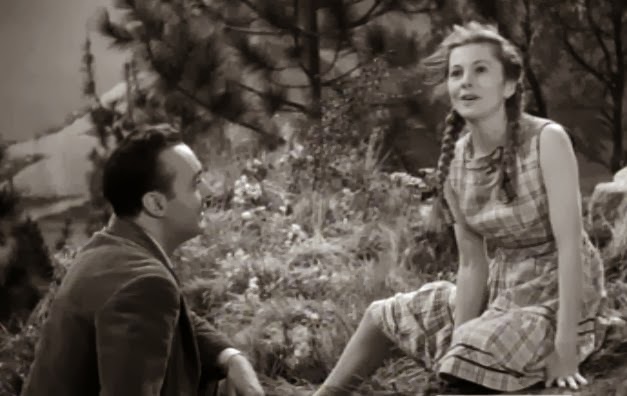
There are stories that change dramatically in how they are seen over time. What seems normal for one era becomes bizarre or even disturbing for another. Such is the case with The Constant Nymph, which goes the Lolita route a decade and a half before Kubrick’s Lolita and plays things straight, not a hint of comedy. This may well have been the poignant story of a young girl madly in love with an older man in 1948, but seen today, the love comes off more as obsession. For what it’s worth, the obsession does come off as realistic. A great deal of that is thanks to Joan Fontaine.

A composer named Lewis Dodd (Charles Boyer) has received unkind notices on his latest composition. He decides to get away for a bit and goes to visit his friend and fellow composer Albert Sanger (Montagu Love), who lives with his third or fourth wife and multiple daughters in a Swiss chalet. Dodd is a frequent guest and everyone knows and loves him. This is especially true of Tessa Sanger (Joan Fontaine), Albert’s 14-year-old daughter. Evidently unknown to everyone but obvious to anyone, Tessa is madly in love with Dodd, and it’s evident that the two have some level of spiritual connection. For Dodd, this is not romantic, but for Tessa, it is the stuff that romantic dreams are made of.

Sunday, January 12, 2014

The Devil's Holiday

Film: The Devil’s Holiday
Format: Internet video on laptop.

When you watch movies based on a list, you’re apt to run into ones that strike you the wrong way. The Devil’s Holiday is one such film. The premise is a pretty standard one, and I’m used to the acting style of the late ‘20s and early ‘30s that this didn’t bother me too much. There’s just something about this film that hits me wrong. By the time I got to the end, I knew exactly what the problem was, but I was catching hints of my issues almost immediately.

In a city—it may be mentioned which one specifically and New York is always a good default—a young woman named Hallie (Nancy Carroll) works as something a baby step away from being a prostitute in addition to her duties as a manicurist. Basically, she’s a freelance escort called in by various salesmen looking to close large deals, and she makes her living by getting a small piece of the commission on these sales. When a rube named David Stone (Phillips Holmes) shows up, Hallie is called in to soften him up to make a big deal go through. Hallie is excited because she’ll get 3% of the take, which will (she hopes) propel her on to her dream of living in Paris.

Tuesday, July 10, 2012

Watching Oscar: Grand Hotel

Film: Grand Hotel
Format: DVD from Rockford Public Library on kick-ass portable DVD player.

It’s not without some trepidation that I look at older Oscar films. There was a massive feeling of accomplishment when I knocked out everything from 1936 and previous—the first 100 films on The List—and I knew that diving back into that early period would often mean some difficulties. I opted for Grand Hotel for the simple reason that I found it on a library shelf. Often, my movie selection goes no further than 1) I found it and 2) I realize it’s on one list or another.

Grand Hotel takes place in Berlin during the Great Depression, following the typical 1930s pattern of displaying opulence during a period of economic disaster. It opens with Dr. Otternschlag (Lewis Stone) muttering that at the Grand Hotel, people come and people go but that nothing ever happens. He repeats this line at the end of the film. In between, of course, we see a great deal happen.